.png)
.png)


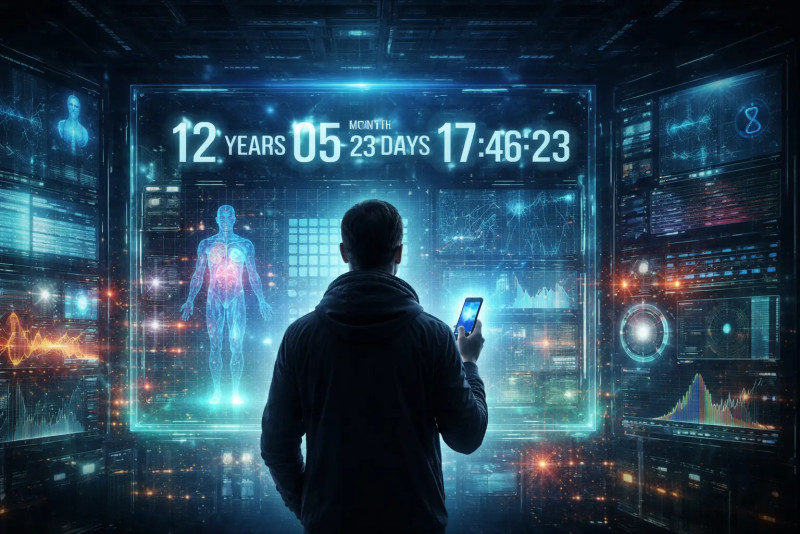
The Day the Clock Started Ticking: Can a Machine Truly Know Your Last Breath?
Imagine waking up, grabbing your phone, and instead of a weather report, you see a countdown. Not for your next vacation or a grocery delivery, but for the end of your story. It sounds like a plot from a dark sci-fi flick, doesn't it? But here in 2026, we aren't just imagining it anymore. We are living in a world where silicon chips and complex math are getting eerily good at guessing when the "game over" screen appears for us.
For decades, doctors have used their gut and a few charts to tell us how much time we might have left. Now, there’s a new player in the room. It doesn't have a heartbeat, but it can scan millions of data points in a blink. From your morning coffee habit to the scar tissue in your heart, machines are starting to predict death with an accuracy that is both breathtaking and a little bit terrifying.
The Tech Behind the "Death Predictor"
You might have heard of life2vec. It’s not just a fancy name; it’s a system developed by researchers in Denmark and the U.S. that treats your life like a book. Every job change, every hospital visit, and even your salary is treated like a "word" in a sentence. By reading your "life story" up to this point, it can predict what happens in the next chapter—including the ending.
In a massive study involving over 6 million people, this model hit a 78% to 79% accuracy rate in predicting mortality over a four-year period. That’s better than almost any traditional method used by insurance companies today.
But it doesn't stop there. Just recently, a system called Delphi-2M has stepped onto the scene. Trained on data from nearly 2.3 million people across the UK and Denmark, it can forecast the risk of over 1,000 different diseases a decade before they even show up. It’s like having a crystal ball, but instead of magic, it’s powered by heavy-duty processors and raw data.
Why This Is Actually Great News (No, Really!)
I know what you're thinking: "Who on earth would want to know that?" It feels heavy. But look at it from another angle. If a machine tells a 45-year-old man he has a 90% risk of a heart event in the next three years because of a specific pattern in his medical history, he doesn't just sit there. He changes.
-
Precision Prevention: Doctors are already using tools like the MAARS model (Multimodal AI for Ventricular Arrhythmia Risk Stratification). It looks at heart MRI scans for tiny scars that a human eye would miss. This tech has reached 93% accuracy in identifying people at risk of sudden cardiac death.
-
The End of "Guesswork": In many ICUs, AI models are now outperforming senior oncologists. One study showed AI had a 60% positive predictive value for short-term mortality compared to just 34.8% for human doctors. This allows families to have those "hard conversations" earlier, ensuring the final days are filled with dignity rather than aggressive, futile treatments.
The Ethical Minefield: Who Owns Your Expiry Date?
With great power comes a massive headache for lawyers and ethicists. If a machine knows you might die in five years, should your insurance company know? Should your bank see it before they give you a 30-year mortgage?
There's also the "Black Box" problem. Sometimes, these machines can’t explain why they think you’re at risk. They just see a pattern. This has led to concerns about bias—where people from certain backgrounds might get "higher risk" scores simply because the data the AI learned from was flawed.
"We are moving from a world of 'What happened?' to a world of 'What will happen?' It’s the ultimate shift in the human experience." — Anonymous Health Tech Analyst
Living with the "Death Clock"
Apps like the "Death Clock" are already popping up on app stores, claiming to use AI to tell you your life expectancy. While some see them as a gimmick, they represent a shift in our culture. We are becoming a society that wants to quantify everything.
Knowing the end might make us live the "now" a little bit better. If the machine says you have 40 years left, maybe you take that trip. If it says 10, maybe you stop working 80 hours a week.
Frequently Asked Questions (FAQs)
Can AI really predict exactly when I will die?
Not to the second. It’s about probability. It says, "Based on millions of people like you, there is an X% chance of death in this timeframe." It’s a weather forecast, not a scheduled appointment.
2. Is my data safe with these mortality models?
This is a huge debate. Most research models like life2vec use strictly anonymized data. However, as commercial apps enter the market, you should be very careful about who you share your health records with.
3. Will my doctor start using this soon?
In some specialized fields like cardiology and oncology, they already are. It helps them decide who needs a pacemaker or who should focus on palliative care.
4. Can I "beat" the AI prediction?
Absolutely. The whole point of these predictions is to act as a warning. If the AI flags a risk based on your lifestyle, changing that lifestyle can change the outcome. The machine predicts your current path, not a fixed destiny.
The Final Verdict
The day machines start predicting death accurately isn't coming—it's here. We are standing at a crossroads where data meets destiny. It’s scary, sure, but it’s also the greatest tool we’ve ever had to extend human life and make every remaining second count.
Disclaimer: The information in this article is for informational purposes only and does not constitute medical advice. Always consult with a qualified healthcare professional regarding any health concerns or life-expectancy questions. AI models are statistical tools and can produce errors or biased results.
References and Sources: