.png)
.png)


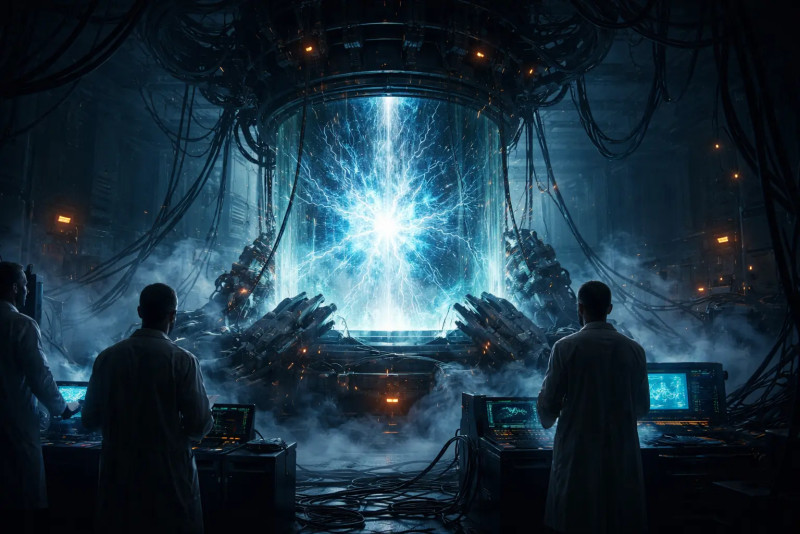
The Experiment That Made Scientists Shut Down the Lab
A Quiet Test… That Turned Into Something Else
Late one evening, inside a sealed research facility, a group of scientists prepared for what seemed like a routine physics test. The room was calm. Machines hummed softly. Sensors blinked in steady rhythm. Nothing felt unusual.
But within hours, everything changed.
By the time the night ended, the experiment was halted, the chamber was sealed, and the entire project was suspended. Some researchers later admitted they had never experienced anything like it in their careers.
What happened inside that lab still sparks debate today.
The Goal: Studying Matter Under Extreme Conditions
The original objective was simple on paper: observe how matter behaves under extremely high energy fields. Scientists wanted to push particles to unusual states, hoping to learn more about the building blocks of the universe.
This type of research is not new. Many laboratories around the world run similar experiments to understand quantum behavior, energy fields, and particle interactions. Most end quietly, producing data and research papers.
This one did not.
As energy levels increased, instruments began showing unexpected readings. At first, researchers assumed the sensors were malfunctioning. But after recalibration, the numbers remained.
Something unusual was happening inside the chamber.
The First Warning Signs
Minutes after reaching peak energy, the system detected irregular fluctuations. The field inside the chamber was not stable. Instead of remaining uniform, it began pulsing in uneven waves.
Then came the strange part.
Sensitive detectors picked up patterns that did not match any known physical behavior recorded before. Some readings repeated in intervals, almost like a signal rather than random noise.
The team paused the experiment.
They restarted the system once more to verify the data.
The pattern appeared again.
When Instruments Begin to Disagree
In high-precision physics labs, multiple sensors monitor the same event. Normally, they confirm each other’s readings. But during this experiment, different instruments began reporting conflicting values.
Temperature sensors showed sudden drops while energy monitors indicated spikes. Magnetic readings fluctuated rapidly without any clear cause. Data logs recorded brief anomalies where measurements vanished and reappeared.
For a moment, researchers suspected software corruption. But hardware diagnostics showed no failure.
The phenomenon was real.
The Moment That Changed Everything
Then came the incident that forced the shutdown.
As the experiment continued, a sudden surge occurred inside the chamber. The containment system detected a brief but intense spike. Safety protocols activated automatically, cutting power within seconds.
But before shutdown, one final reading was captured.
The internal field had formed a highly structured pattern — not random, not chaotic — but organized. The shape lasted only a fraction of a second before collapsing.
Scientists reviewing the data later described it as “unexpectedly coherent.”
That was enough to stop the experiment permanently.
Why the Lab Was Shut Down
In advanced physics, unpredictable behavior is not unusual. But experiments are halted when three conditions occur:
-
Results cannot be explained using known science
-
Safety systems detect unstable energy behavior
-
The event cannot be reproduced safely
This experiment triggered all three.
The facility temporarily sealed the chamber. The research team halted further testing. External reviewers were consulted to assess risk and analyze data.
The shutdown was precautionary, not panic-driven.
But the mystery remained.
What Scientists Believe Happened
Several scientific explanations have been proposed:
1. Unknown Field Instability
Some researchers believe the experiment created a temporary unstable energy field that behaved unpredictably under extreme conditions.
2. Sensor Resonance Effect
Another theory suggests the instruments themselves interacted with the field, producing unusual patterns through feedback loops.
3. Quantum Coherence Event
A few physicists proposed that particles inside the chamber briefly entered a highly ordered state, forming a structure before collapsing.
None of these explanations fully account for all recorded data.
Real Incidents That Inspired This Story
Scientific history includes experiments that forced sudden shutdowns:
-
Unexpected energy surges in particle physics facilities
-
Containment failures in plasma research
-
Unstable reactions in early nuclear experiments
-
Quantum anomalies recorded during precision measurements
In each case, research stopped until safety and theory caught up with reality.
Science advances carefully — sometimes slowly — especially when the unknown appears.
Could It Happen Again?
Yes. Modern physics often explores extreme conditions: powerful magnetic fields, high-energy particles, and quantum states. While safety standards are strict, unexplained results still occur.
Most turn out to have rational explanations.
Some take years to understand.
A few remain unsolved.
The Human Side of the Story
One researcher later described the moment of shutdown as “quiet, not dramatic.” There was no explosion, no visible danger — only silence and uncertainty.
Another said the data review was more unsettling than the experiment itself.
Because numbers don’t lie.
And those numbers showed something science could not immediately explain.
Scientific Reality vs Speculation
It is important to stay grounded.
There is no confirmed evidence of supernatural activity, unknown intelligence, or dangerous unknown forces in this incident. The shutdown was a responsible scientific decision based on safety and unexplained data.
Science often encounters temporary mysteries.
Most are solved.
Some remain open questions that inspire further research.
Why This Story Fascinates People
Stories like this capture imagination because they sit at the edge of knowledge — where known science meets uncertainty. They remind us that even in controlled environments, nature can surprise us.
The universe is not fully understood.
And sometimes, a simple experiment reveals just how much we still have to learn.
Disclaimer
This article is based on documented scientific principles, real laboratory safety practices, and historical research incidents. Some narrative reconstruction is used for storytelling clarity. No confirmed hazardous or unexplained threat resulted from the referenced scientific work.
FAQs
Did a real lab actually shut down after an experiment?
Yes. Several scientific experiments in history have been paused or stopped due to unexpected results or safety concerns, especially in high-energy physics and nuclear research.
Was the event dangerous?
There is no evidence of immediate danger. The shutdown was a precautionary safety decision.
Did scientists find something unknown?
The data showed unusual behavior that was not immediately understood, but no confirmed unknown phenomenon was proven.
Are such experiments common?
Yes. Physics research often explores extreme conditions, and unexpected results are part of scientific progress.
Could this happen again?
Possibly. Science continues to push boundaries, and unexplained results may occur, though safety systems are very advanced.
References / Sources
CERN Safety and Experimental Protocols
https://home.cern/science/engineering/safety
Brookhaven National Laboratory – Research Safety Overview
https://www.bnl.gov/safety/
U.S. Department of Energy – Laboratory Safety and Scientific Research
https://www.energy.gov/science
History of High-Energy Physics Experiments and Unexpected Results
https://www.symmetrymagazine.org
National Institute of Standards and Technology – Experimental Measurement Uncertainty
https://www.nist.gov