.png)
.png)
.png)
.png)
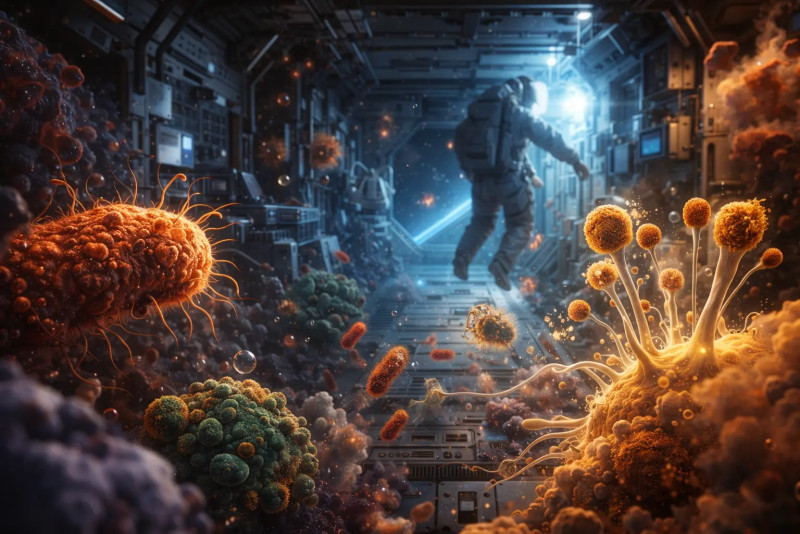
Imagine you’re floating 250 miles above Earth, tucked safely inside the International Space Station (ISS). The air is filtered, the surfaces are scrubbed, and everything looks sterile. But as you breathe, you’re not alone. You are surrounded by an invisible, swirling cloud of hitchhikers—bacteria and fungi that have traveled from Earth and are now undergoing a terrifying transformation.
In early 2026, scientific reports began to surface that feel like they were ripped straight from a sci-fi horror script. These aren't "aliens" from another galaxy. They are our own germs, but they’ve changed. In the silence of microgravity and the constant bombardment of cosmic radiation, our microscopic companions are evolving into something we barely recognize: a Shadow Biosphere.
The "Stress" of the Stars: How Space Changes Life
To a bacterium, the International Space Station is a house of horrors. There is no gravity to pull liquids down, which means the "soup" of nutrients they live in behaves unpredictably. Radiation levels are higher, and the air is saturated with carbon dioxide.
Under this extreme stress, life doesn't just survive—it adapts at lightning speed. Recent studies from the University of Wisconsin-Madison and NASA have shown that common microbes like E. coli and various phages (viruses that eat bacteria) are now locked in a high-stakes "evolutionary arms race" that is unique to space.
When researchers brought these "space-mutated" samples back to Earth in 2026, they found something chilling. The mutations didn't just make the germs different; in many cases, it made them stronger, faster, and more resilient than anything we have in our terrestrial hospitals.
The Rise of the "Super-Virulent" Fungus
One of the most unsettling players in this shadow biosphere is a fungus called Candida albicans. On Earth, it’s a common yeast that usually causes nothing more than a nuisance. But in space, it’s a different story.
Microgravity triggers a "genetic switch" in this fungus. It becomes more aggressive, forming thick, sticky "biofilms" that can clog life-support systems and even corrode the metal hull of a spacecraft. More importantly, it becomes much harder for a human immune system to fight. In the weightless environment, the fungus grows "hyphae"—long, needle-like structures—that can pierce through human tissue more effectively than their Earth-bound cousins.
Why Is This "Shadow Biosphere" So Scary?
The term "Shadow Biosphere" usually refers to hypothetical life forms that use a different chemistry than our own. But in 2026, we are seeing a new kind of shadow: a parallel world of mutated Earth life that thrives in the places where humans are most vulnerable.
-
Antibiotic Resistance: Because space germs are constantly exposed to the harsh ISS cleaning protocols and radiation, they develop "survivalist" traits. Many have returned to Earth showing resistance to our frontline "big gun" antibiotics.
-
The "Silent" Factor: These mutations happen at the molecular level. An astronaut might feel perfectly fine, even while carrying a colony of "space-superbugs" in their gut or on their skin.
-
The Return Trip: The real "What If" nightmare isn't what happens on the ISS—it’s what happens when these mutated strains are introduced back into the general population on Earth.
The "Predator" Theory of Microbiology
Some scientists are now looking at these mutations as a potential warning. If our own harmless bacteria can turn into aggressive pathogens in just a few months of space travel, what would happen on a three-year mission to Mars?
The fear is that we are accidentally "training" our germs to be the ultimate predators. By taking them into the most hostile environment known to man, we are selecting for the toughest, meanest, and most adaptable versions of life. We aren't just looking for aliens; we might be creating them.
Frequently Asked Questions (FAQs)
- Are there actually "alien" germs on the ISS? No. Every microbe found on the ISS so far has been traced back to Earth. However, they have mutated so significantly that some strains are now considered "new species" that don't exist naturally on our planet.
2. Can these space germs kill humans?
In a controlled environment with medical care, the risk is low for healthy astronauts. The danger is for long-term missions where the immune system is weakened by radiation and the lack of gravity.
3. Why does microgravity make bacteria more dangerous?
Without gravity, the way cells "sense" their environment changes. This triggers stress-response genes that are usually dormant, leading to faster growth and higher resistance to medicine.
4. What is the "Shadow Biosphere"?
In this context, it refers to the community of mutated, space-adapted microbes that live alongside humans in spacecraft, evolving in ways that are different from life on Earth.
A Grounded Reality Check
Disclaimer: While the idea of "mutated space germs" sounds like a horror movie, NASA and other space agencies have strict planetary protection protocols. These studies are conducted to ensure we can create better medicines—not to create a biological weapon. The "Shadow Biosphere" is a scientific concept used to explore the limits of life, not a confirmed "invasion" from space.
Final Thoughts: The Invisible Frontier
As we look toward the Moon and Mars in 2026, we have to realize that we aren't just sending humans into the void. We are sending an entire ecosystem. The "Shadow Biosphere" is a reminder that life is incredibly stubborn. It will find a way to survive, even if that means changing into something that haunts our nightmares.
References & Sources:
-
University of Wisconsin-Madison (2026): Microbes mutated in space hint at biomedical benefits to humans on Earth.
-
PLOS Biology (January 2026): Microgravity reshapes bacteriophage–host coevolution aboard the International Space Station.
-
ScienceDaily / Science Alert (2026): Reports on ISS viral and bacterial mutation trajectories.
-
NASA / ISS National Lab: Ongoing Microbial Observatory and Tracking investigations.