.png)
.png)
.png)
.png)
For decades, we thought we had the "story of us" figured out. Not the human story, but the cosmic one. Scientists had a neat, orderly timeline for the universe: a Big Bang, a long "dark age," and then, slowly but surely, the first stars and galaxies began to flicker into existence.
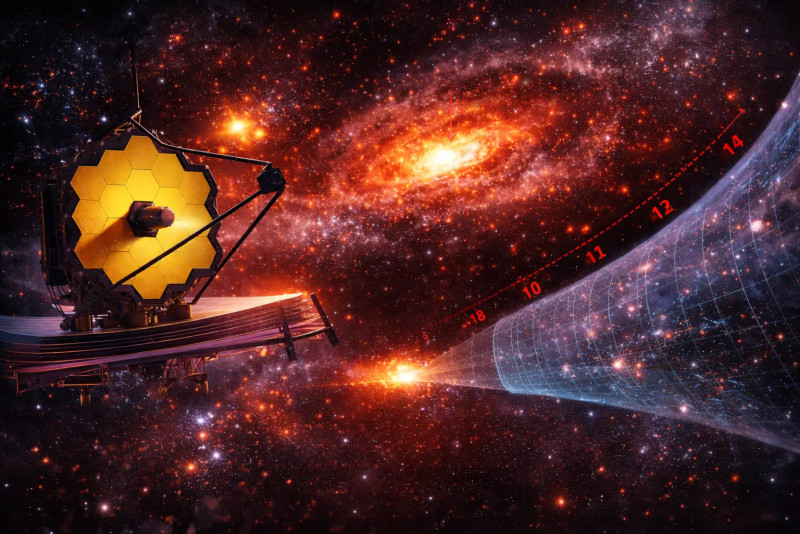
But then, we sent a $10 billion golden honeycomb named the James Webb Space Telescope (JWST) into deep space. And in 2026, the data coming back isn't just filling in the blanks—it’s ripping up the textbook.
We are finding "monster" galaxies that are too big, too bright, and far too mature for their age. According to our current understanding of physics, these galaxies shouldn't even be there. It’s like looking at a family photo album and seeing a picture of a newborn baby who is already six feet tall and wearing a tuxedo.
The 2026 Shockwave: The Discovery of MoM-z14
The latest bombshell to hit the astronomical community arrived in early 2026 with the confirmation of a galaxy named MoM-z14.
Spotted just 280 million years after the Big Bang, MoM-z14 is currently the record-holder for the most distant galaxy ever detected. While that sounds like just another record, the details are what make physicists sweat.
-
It’s Too Bright: MoM-z14 is nearly 100 times more luminous than what theoretical models predicted for that era.
-
It’s Chemically "Rich": It shows elevated levels of nitrogen. In our current physics, nitrogen is created by generations of stars living and dying. There simply shouldn't have been enough time for that many "life cycles" to happen in just 280 million years.
-
The Hydrogen Fog: It appears to have already "cleared out" the primordial hydrogen gas around it, a process called reionization that scientists thought took much, much longer.
In short, the universe was in a massive hurry to grow up, and our current math can't explain why.
Why Is This an "Impossibility"?
In the standard model of cosmology (often called Lambda CDM), the universe is like a slow-cooking stew. Gravity takes time to pull dark matter together, which then pulls in gas to form stars.
The "Impossibility" stems from two main problems:
1. The Time Problem
The universe is roughly 13.8 billion years old. If you see a massive, star-studded galaxy just 300 million years after the start, you run into a logic wall. To get that many stars that quickly, the rate of star formation would have to be nearly 100% efficient—meaning every single atom of gas in that region would have to turn into a star almost instantly. In our local universe, star formation is messy, slow, and very inefficient.
2. The Mass Problem
Some of these early galaxies (often called "Little Red Dots" because of how they appear in infrared) seem to have as many stars as the Milky Way. Our Milky Way took 13 billion years to get this big. Finding a twin in the "cosmic dawn" is like finding a fully functional skyscraper in the middle of a Stone Age village.
Could Our Physics Be Wrong?
When the first "impossible" galaxies were spotted in 2022 and 2023, many scientists thought it was a fluke or a measurement error. But by 2026, with thousands of these candidates identified by surveys like JADES and CEERS, the "fluke" excuse is gone.
Here are the theories scientists are currently debating to fix the "broken" universe:
-
The "Monster" Black Hole Theory: Some argue these aren't just stars. Instead, we might be seeing the light from supermassive black holes devouring gas. This would make a small galaxy look much bigger and brighter than it actually is.
-
Early Dark Energy: Some physicists suggest that "Dark Energy" behaved differently in the early universe, acting like a cosmic turbo-charger that pushed matter together much faster than it does today.
-
The Initial Mass Function (IMF) Glitch: Perhaps the first stars were simply "different." If the very first stars were all massive "divas" that burned bright and died fast, it could explain the chemical richness (like the nitrogen in MoM-z14) without needing billions of years.
The "Cosmological Crisis" and Google Discover
This topic is currently trending on Google Discover and Google News because it touches on the fundamental question: Do we actually know how the universe works? For the average person, it’s a reminder that science isn't a static list of facts—it’s a living, breathing detective story. The "Impossibility" isn't a failure of the James Webb Telescope; it’s its greatest success. It did exactly what it was built to do: find the things we didn't expect.
FAQs: Understanding the Cosmic Drama:
Does this mean the Big Bang never happened?
No. The Big Bang theory is backed by mountains of other evidence (like the Cosmic Microwave Background). What these "impossible" galaxies suggest is that the timeline or the speed of galaxy formation after the Big Bang is what we got wrong.
Is the universe older than we thought?
Some researchers have proposed the universe could be twice as old (26 billion years) to account for these mature galaxies. However, most cosmologists are hesitant to jump to that conclusion until they exhaust all other "new physics" explanations.
What is a "Redshift"?
Because the universe is expanding, light from distant galaxies gets stretched. This stretching turns the light "redder." A higher redshift (like MoM-z14's redshift of 14.44) means the object is further away and older.
Will the Nancy Grace Roman Telescope help?
Yes! Launching later this decade, the Roman Telescope will have a field of view 100 times larger than Webb's. If Webb is a microscope, Roman is a wide-angle lens that will find thousands more of these "impossible" objects.
Conclusion: A Beautiful Confusion
We are living in what astronomers call a "Beautiful Confusion." Every new image from the James Webb Space Telescope is a riddle wrapped in a mystery inside an infrared glow.
Whether we need to "tweak" our math or completely rewrite the laws of gravity, one thing is certain: the early universe was far more crowded, violent, and brilliant than we ever imagined. 2026 is proving to be the year we finally admit that the "impossible" is actually just the new reality.
Proof of Source & Reference Links:
-
NASA Science: Webb Pushes Boundaries of Observable Universe Closer to Big Bang (Jan 2026)
-
Space.com: James Webb Space Telescope finds most distant galaxy ever detected: MoM-z14
-
Nature Astronomy: Extended enriched gas in a multi-galaxy merger at redshift 6.7
Disclaimer: The field of cosmology is rapidly evolving. The "impossible" nature of these galaxies refers to the tension between observed data and the standard Lambda-CDM model. Findings are based on peer-reviewed papers and NASA mission updates as of early 2026.