.png)
.png)
.png)
.png)
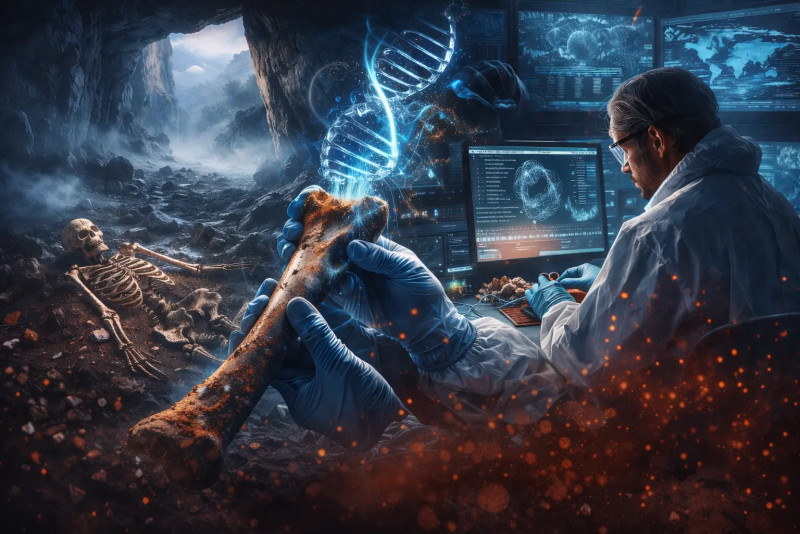
Imagine walking through the mist-covered rock shelters of the Sabana de Bogotá in Colombia. The air is cool, the ground is damp, and beneath your feet lies a secret that has been buried for over five millennia.
In a discovery that feels more like a techno-thriller than a history book, scientists have just pulled a "ghost" from the grave. They’ve successfully reconstructed the genome of a 5,500-year-old bacterium found inside the shin bone of an ancient hunter-gatherer. This isn't just a dusty old find; it's a breakthrough that changes everything we thought we knew about one of humanity's most stigmatized and mysterious shadows: Syphilis.
As we move through 2026, this "Lost Disease" file is forcing the CIA, global health experts, and historians to rethink the origins of pandemics. Could this ancient bug be the ancestor of a modern health crisis? Let’s dig into the dirt and find out.
The "Shin Bone" Bombshell: A Discovery by Accident
Most great scientific discoveries happen when someone is looking for something else. In this case, an international team of researchers was actually trying to map the migration of ancient people in South America. They weren't looking for a "plague."
But when they ran a deep-sequencing analysis—generating a staggering 1.5 billion fragments of genetic data—they hit a wall of code that didn't belong to the human host. It belonged to Treponema pallidum.
Why This Bone is Special:
-
The Tibia Secret: Usually, scientists look at teeth to find ancient DNA. This time, they used a tibia (shin bone).
-
The Healthy Ghost: The skeleton showed zero signs of disease. No lesions, no bone rot, nothing. Yet, the DNA was there, vibrant and hidden.
-
The Time Jump: This find pushes the genetic record of this pathogen back by 3,000 years.
Syphilis: The Great Mimicker's True Origin
For centuries, a massive debate has raged: Did Christopher Columbus bring syphilis back from the Americas to Europe, or was it already in Europe, hiding in plain sight?
The discovery of this 5,500-year-old strain, nicknamed TE1-3, adds a heavy weight to the "American" side of the scale. But it’s not that simple. This ancient version isn't exactly like the syphilis we know today. It’s an "early-diverging sister lineage."
Think of it like a distant cousin who moved away 10,000 years ago. It carries the same "poison" (virulence genes), but it likely behaved differently. It might not have been a sexually transmitted infection (STI) at all back then. Instead, it could have been a skin-to-skin disease, similar to what we now call yaws or pinta.
The Next Global Health Shadow?
Why does a 5,500-year-old germ matter to us in 2026? Because pathogens are the ultimate survivalists.
Scientists are worried about "pathogen emergence." By studying how this bacterium evolved in the humid rock shelters of Colombia long before cities or modern medicine, researchers can predict how modern strains might mutate next.
The 2026 Risk Factors:
-
Stigma as a Barrier: Syphilis cases are currently at their highest levels since the 1950s. This discovery proves the disease has been our "companion" for nearly 14,000 years. Reframing it as a biological evolution rather than a "moral failing" is key to stopping the current spread.
-
Hidden Diversity: The 2026 study revealed that ancient treponemal diseases were more diverse than they are today. We might be looking at a "lost" branch of the family tree that could theoretically re-emerge or swap genes with modern bacteria.
-
Climate Change: As ancient permafrost melts and old burial grounds are disturbed by extreme weather, we are coming into contact with "forgotten" biological signatures more often.
Timeline: From the Ice Age to Today
| Time Period | Event |
| 13,700 Years Ago | The "Lost Disease" (TE1-3) splits from the main family tree. |
| 5,500 Years Ago | A hunter-gatherer in Colombia carries the bacterium to his grave. |
| 6,000 Years Ago | Modern syphilis, yaws, and bejel begin to diverge. |
| 1490s | First major recorded syphilis outbreak in Europe. |
| Jan 2026 | Scientists publish the full genome of the "Ghost Strain." |
FAQs: What You Need to Know
Is this "Lost Disease" dangerous today?
The specific 5,500-year-old strain (TE1-3) is extinct. However, its modern "cousins"—syphilis, yaws, and bejel—are very much alive. The discovery helps us understand how to fight the modern versions better.
Could this disease "wake up" from ancient graves?
Highly unlikely. Bacteria like Treponema pallidum generally need a living host to survive. We are finding their "instruction manuals" (DNA), not living, breathing "zombie" germs.
Does this prove Columbus was innocent?
Not entirely, but it proves that "syphilis-like" diseases were thriving in the Americas thousands of years before he arrived. It suggests the bacteria were global citizens long before we were.
Why is it called the "Great Mimicker"?
Syphilis is famous for looking like other diseases (rashes, flu, etc.). This ancient DNA shows that even 5,000 years ago, the bacteria were masters of disguise, living inside a "healthy-looking" skeleton.
The Final Word: A Lesson from the Soil
The 2026 update on the "Havana Syndrome" of the ancient world tells us one thing: We are never truly alone. Our history is a shared journey with the microbes that live within us.
By unearthing these lost lineages, we aren't just looking at the past—we are building a shield for the future. The "next global health shadow" might not be a new virus from a lab, but an old one that has been waiting in the dirt, teaching us that to survive, we must understand where we came from.
References & Proof of Incident:
-
Science Journal (2026): A 5,500-year-old Treponema pallidum genome from Sabana de Bogotá, Colombia. Source Link
-
Smithsonian Magazine: Anthropologists Recover DNA of Syphilis-Related Bacterium From 5,500-Year-Old Remains
-
Swiss Institute of Bioinformatics (SIB): 5,500-year-old genome discovered for syphilis-related bacterium
-
Archaeology News: Earliest evidence of syphilis in the Americas found in Colombia
Disclaimer: This article discusses paleogenomic research and infectious disease history. It is intended for informational purposes and does not constitute medical advice. For concerns regarding modern health issues, always consult a medical professional.