.png)
.png)
.png)
.png)
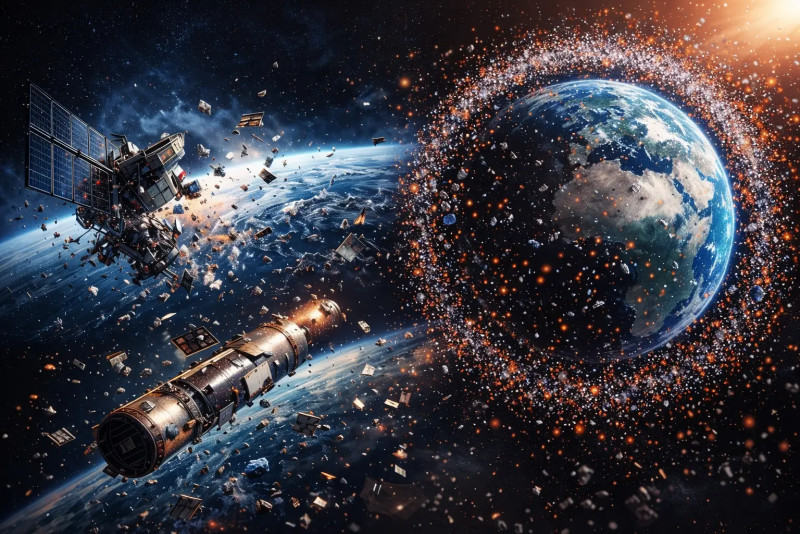
If you looked up at the night sky recently and thought you saw a shooting star, there is a decent chance you actually saw a piece of high-speed trash. We’re talking about old rocket boosters, dead satellites, and even stray flecks of paint screaming around the Earth at 17,500 miles per hour.
Right now, our orbit is starting to look less like a "final frontier" and more like a cosmic junkyard. But in 2026, a Swiss-led mission called ClearSpace-1 is heading up there with one goal: to deploy a giant "Space Claw" and start the world’s most expensive cleaning service.
The big question isn't just if it will work, but if it can save us from the dreaded Kessler Syndrome—a chain reaction of collisions that could trap humanity on Earth forever.
The Nightmare Scenario: What is "Space Junk Armageddon"?
Scientists call it the Kessler Syndrome. Imagine one dead satellite hitting another. They shatter into thousands of tiny shards. Those shards then zip around and hit other satellites, creating even more debris.
Eventually, you get a "debris belt" so thick that nothing can pass through it. No GPS, no satellite internet, no missions to Mars—just a wall of metal trash blocking our exit. In early 2026, experts warned that some orbital bands are already reaching a "critical mass." If we don't start taking things out of orbit, the math says we’re in trouble.
Meet the "Space Claw": How ClearSpace-1 Works
The ClearSpace-1 mission is cinematic. Instead of using nets or harpoons (which other companies are trying), this mission uses a four-armed robotic capture mechanism. It’s essentially a giant claw machine from an arcade, but with stakes that affect the entire planet.
The Mission Plan for 2026:
-
The Launch: The "chaser" satellite will hitch a ride on Europe’s Vega-C rocket.
-
The Stalking: Once in orbit, it will use AI and high-tech sensors to find its target. Originally, the target was a 112kg piece of a Vega rocket (called VESPA), but in 2024, the mission shifted focus to PROBA-1, a veteran ESA satellite that’s been up there for over 20 years.
-
The Hug: The four arms will wrap around the dead satellite in a "controlled embrace." This is the hardest part—the target is "uncooperative," meaning it’s tumbling randomly in the dark.
-
The Kamikaze Dive: Once it has a firm grip, ClearSpace-1 will fire its engines and drag itself—and the trash—down into the Earth’s atmosphere. Both will burn up on reentry, turning into a harmless streak of light.
Why 2026 is the "Make or Break" Year
This isn't just a science experiment anymore. 2026 is the year the space industry has to prove that Active Debris Removal (ADR) is a viable business.
For years, the problem with cleaning space was simple: Who pays for it? Space is "international waters," and nobody wanted to pick up the bill for a dead rocket launched in the 90s. But with companies like SpaceX and Amazon launching thousands of new satellites, the risk of a billion-dollar collision is finally high enough that governments and private investors are opening their wallets.
The Risks: What Could Go Wrong?
Space is hard. Cleaning space is harder.
-
The Collision Risk: If the "Claw" hits the target too hard, it could shatter the dead satellite, turning one piece of junk into ten thousand pieces.
-
The "Ghost" Problem: In late 2023, the original target for this mission was actually hit by other debris before the mission even launched. It’s a literal minefield up there.
-
The Cost: At roughly 86 million euros for a single piece of junk, we need the tech to get much cheaper, much faster.
FAQs: Your Space Junk Questions Answered
Is space junk really a threat to me on Earth?
The chance of getting hit by falling space junk is incredibly low—most of it burns up. The real threat is to your daily life. If a collision chain destroys our GPS and communication satellites, your phone, banking, and weather systems could go dark.
Why don't we just blow it up?
Blowing it up makes the problem 1,000 times worse. A single satellite turns into millions of tiny, lethal fragments that are impossible to track. We need to remove it, not break it.
Can the Space Claw catch anything?
The 2026 mission is a "proof of concept." It’s starting with a relatively small, simple object (PROBA-1). If successful, future versions will be bigger and capable of catching multiple pieces of junk in one trip.
Who is behind ClearSpace-1?
It’s a Swiss startup (ClearSpace) backed by the European Space Agency (ESA) and a consortium of companies across Europe.
The Bottom Line: Is Hope on the Horizon?
ClearSpace-1 isn't going to clean the whole sky in one go. There are over 30,000 tracked objects up there, and the "Space Claw" is only taking out one.
However, it is the first time we are moving from "watching the problem" to "fixing the problem." If the 2026 mission succeeds, it proves that we have the tech to be responsible tenants of our orbit. It’s the difference between letting a house burn down and finally calling the fire department.
References and Sources:
-
European Space Agency (ESA): ClearSpace-1 mission overview and objectives
-
SpaceNews: ClearSpace-1 target change to PROBA-1 (April 2024)
-
Arianespace: Vega C flight contract for 2026 mission
Disclaimer: This article is an editorial overview of the ClearSpace-1 mission based on currently available flight schedules and mission disclosures as of early 2026. Space missions are subject to launch window shifts and technical adjustments.