.png)
.png)


The “SUV” in Space: Inside Gaganyaan-1 — The World’s Most Cramped (and Dangerous) New Crew Capsule
By Ronald Kapper
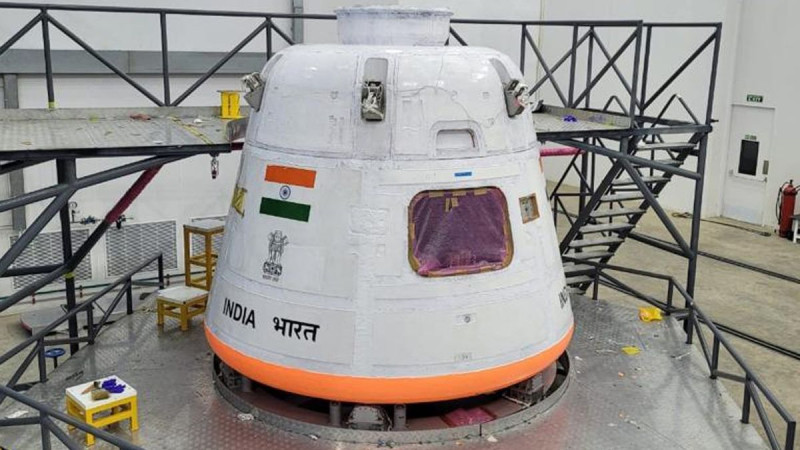
Some spacecraft feel like flying laboratories. Some feel like space stations. And then there is Gaganyaan-1 — a capsule so compact that astronauts compare it to sitting inside a tightly packed vehicle, hurtling above Earth at nearly 28,000 kilometers per hour.
In 2026, this small but powerful spacecraft is expected to carry humans beyond the atmosphere, marking one of the most important space milestones of the decade. But behind the pride, excitement, and engineering brilliance lies a harsh truth: this is not a comfortable ride. It is a test of human endurance, precision engineering, and survival.
The world calls it ambitious. Engineers call it risky. Astronauts call it history.
A Mission Decades in the Making
Human spaceflight is one of the toughest challenges any space agency can face. Unlike satellites or robotic missions, carrying people into space means designing a machine where every single system must work perfectly.
Gaganyaan-1 is the first crewed mission of its program, built to carry three astronauts into low Earth orbit for several days before bringing them safely back home.
Simple in concept. Extremely complex in reality.
A crew capsule must:
-
Protect humans from vacuum
-
Survive extreme heat during re-entry
-
Maintain oxygen and pressure
-
Handle radiation
-
Withstand violent launch forces
-
Return safely through parachute and ocean landing
And all of this must happen inside a space barely larger than a small car cabin.

Why It’s Called the “SUV” of Space
Unlike larger spacecraft such as space stations, the Gaganyaan crew module is compact, dense, and tightly engineered.
Inside, three astronauts sit close together in custom seats, surrounded by control panels, wiring, life-support systems, and safety mechanisms. There is little room to stretch, move, or even turn.
Every inch matters.
The design focuses on strength, survival, and control, not comfort.
Astronauts must operate in:
-
Limited movement space
-
High noise during launch
-
Strong G-forces
-
Constant monitoring environment
In simple words — it is not a journey, it is a test.

The Most Dangerous Part — Launch and Re-entry
Two phases of any space mission are known to be the most dangerous: launch and re-entry.
Launch
During launch, the capsule sits atop a powerful rocket generating enormous thrust. Within minutes, astronauts experience intense G-forces pressing them into their seats. Even a minor system failure can be catastrophic.
To handle this risk, Gaganyaan includes a crew escape system, designed to pull the capsule away instantly if something goes wrong during launch.
This system has already been tested successfully in earlier abort demonstrations.

Re-entry — The Fire Test
Returning to Earth is even more intense.
As the capsule re-enters the atmosphere, temperatures outside can exceed 1,500°C. The heat shield must absorb and deflect this heat while protecting the astronauts inside.
After surviving the fiery descent, parachutes deploy, slowing the capsule before it lands in the ocean.
Every second of this phase must work perfectly.
Inside the Capsule — Life in a Tight Shell
Living inside Gaganyaan-1 is closer to survival mode than comfort mode.
Astronauts rely on:
-
Oxygen supply systems
-
Carbon dioxide removal units
-
Temperature regulation
-
Humidity control
-
Food and hydration packs
-
Waste management systems
Even small failures in these systems can quickly become dangerous in space.
Unlike larger spacecraft, astronauts cannot walk around. Most of the mission is spent seated, monitoring systems, conducting experiments, and maintaining communication with mission control.
It is physically and mentally demanding.

The Psychological Challenge
Space is silent, dark, and isolating. Inside a compact capsule, the psychological pressure can be intense.
Astronauts must handle:
-
Confinement
-
Constant alertness
-
Limited sleep cycles
-
High responsibility
-
Emergency preparedness
Training includes survival drills, underwater simulations, high-G centrifuge training, and emergency escape procedures.
This mission is not only a test of technology — it is a test of human resilience.
The Technology That Keeps Them Alive
Gaganyaan-1 includes several advanced systems:
Environmental Control and Life Support (ECLSS) — Maintains breathable air, temperature, and pressure.
Navigation and Guidance Systems — Ensures correct orbit and safe re-entry path.
Crew Escape System — Emergency separation during launch failure.
Heat Shield Technology — Protects during atmospheric re-entry.
Parachute Recovery System — Ensures safe splashdown in the ocean.
These systems must work together perfectly, with no margin for error.

Why This Mission Matters Globally
Gaganyaan-1 is not just a national milestone. It represents a major step in global human spaceflight.
With this mission, a new chapter opens:
-
Expansion of human space exploration
-
Development of reusable crew technology
-
Future space station collaboration possibilities
-
Inspiration for next-generation space scientists
-
Growth of space medicine and survival research
It also proves that human spaceflight is no longer limited to a few traditional space powers.
The space race has entered a new era.
The Risks That Still Exist
Despite advanced technology, spaceflight always carries risk.
Possible dangers include:
-
Launch vehicle failure
-
Life-support malfunction
-
Heat shield damage
-
Parachute deployment issues
-
Radiation exposure
-
Micro-meteorite impact
Every mission reduces uncertainty, but risk can never be fully eliminated.
Astronauts understand this — and still choose to fly.

Human Courage Behind the Mission
Behind every spacecraft are real people.
Astronauts who train for years.
Engineers who test every bolt.
Teams who monitor every signal.
Space missions are not just machines — they are human stories of courage, discipline, and ambition.
Gaganyaan-1 represents years of preparation, countless tests, and the dream of pushing boundaries beyond Earth.
Could This Be The Start of Something Bigger?
Many experts believe Gaganyaan-1 is only the beginning.
Future possibilities include:
-
Longer human space missions
-
Space station participation
-
Lunar orbit missions
-
Advanced crewed spacecraft designs
-
Space tourism development
The first step is always the hardest — and this mission is that step.
Disclaimer
This article is based on publicly available scientific, engineering, and mission information related to the Gaganyaan human spaceflight program. Space missions involve complex systems and evolving timelines, and some technical or scheduling details may change as the mission progresses. This article is for informational and journalistic purposes only.
Frequently Asked Questions (FAQs)
What is Gaganyaan-1?
Gaganyaan-1 is the first crewed space mission designed to send astronauts into low Earth orbit and return them safely.
How many astronauts will fly?
The mission is designed to carry three astronauts.
Why is the capsule described as cramped?
The crew module is compact with limited movement space, designed for safety and efficiency rather than comfort.
Is the mission dangerous?
All human spaceflight carries risk, especially during launch and re-entry, though safety systems are built to minimize danger.
When will the mission launch?
The mission is planned for the mid-2026 timeframe, subject to technical readiness and testing.
References / Sources
-
ISRO Human Spaceflight Program — Gaganyaan Mission Overview
https://www.isro.gov.in -
ISRO Crew Escape System Test Report
https://www.isro.gov.in/Launchers/crew-escape-system -
Indian Space Research Organisation — Human Spaceflight Updates
https://www.isro.gov.in/Gaganyaan -
Government of India Space Program Briefings
https://www.pib.gov.in -
International Journal of Space Science — Human Space Capsule Design Studies
https://www.sciencedirect.com