.png)
.png)


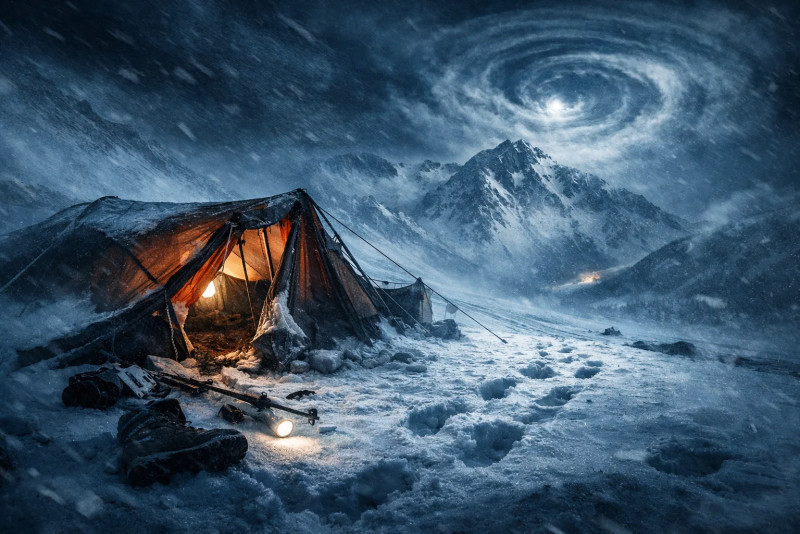
The Dyatlov Pass 2.0: Why Modern Infrasound Theories Are Making This 60-Year-Old Mystery Even Scarier
By Ronald Kapper
High in the silent Ural Mountains, where the wind cuts like glass and the snow buries every sound, nine experienced hikers walked into history — and never came back alive.
For more than six decades, the Dyatlov Pass incident has refused to fade. It is not just a cold case. It is a wound in the world of unexplained mysteries. Something happened on that frozen night in February 1959. Something powerful enough to make trained mountaineers run half-dressed into a deadly storm.

No official explanation has ever fully convinced the public.
But now, a modern scientific idea — infrasound — is giving this mystery a new and darker edge.
And strangely, it may make the story even more frightening than before.

The Night That Never Made Sense
The group, led by Igor Dyatlov, were not amateurs. They were strong, skilled, and prepared. When rescuers finally found their camp weeks later, what they saw was disturbing.
The tent had been cut open from the inside.
Boots, coats, and survival gear were left behind.
The hikers had fled into sub-zero darkness wearing almost nothing.
Some bodies were found near a fire, others deep in the snow, and a few showed strange injuries — cracked ribs, skull damage, yet no external wounds. One hiker was missing her tongue.
There were no clear signs of an avalanche, no enemy attack, and no known natural disaster.
For years, theories ranged from secret military tests to unknown creatures, to strange lights in the sky.
But science has slowly begun to examine something far less visible — sound you cannot hear.

What Is Infrasound — And Why Does It Matter?
Infrasound is sound below the range of human hearing. You cannot hear it, but your body can feel it.
Very low-frequency sound waves can travel long distances and pass through mountains, walls, and even human tissue. They are created by storms, strong winds, earthquakes, and certain landscape shapes.
And here is where things get unsettling.
Scientists have found that infrasound can trigger fear, anxiety, confusion, nausea, and even panic — without people knowing why.
Imagine feeling pure terror… with no visible cause.
Now imagine that happening in the middle of a deadly snowstorm, in total darkness, on a freezing mountain.
The Wind, The Mountain, and The Invisible Force
Recent research suggests that the shape of the mountain where the hikers camped may have acted like a natural sound machine.
When strong winds moved across the curved slope, they could have created a rare effect known as a Kármán vortex street — a repeating pattern of air movement that can generate powerful infrasound waves.
These waves would not be heard, but they could have shaken the hikers mentally and physically.
Some scientists believe this may have caused:
-
Sudden irrational fear
-
Panic and confusion
-
Disorientation
-
Feeling of unseen danger
-
Urge to escape immediately
If true, this means the hikers may not have calmly decided to leave their tent.
They may have fled in pure terror, driven by something they could not understand.

Why Did They Cut The Tent From Inside?
One of the most chilling details of the incident is the slashed tent.
Experienced hikers would never destroy their only shelter in freezing temperatures — unless they believed staying inside meant certain death.
Infrasound can create a sense of invisible threat. People exposed to it in lab conditions sometimes report a feeling described as “presence” — as if something unseen is near.
In extreme situations, this can trigger a fight-or-flight response strong enough to override logic.
If the hikers suddenly felt overwhelming fear, they may have cut the tent in panic rather than calmly opening it.
That moment — seconds of terror — may have sealed their fate.
The Strange Injuries — Explained Differently
Some of the victims had severe internal injuries similar to those seen in high-impact crashes, yet no external damage.
One possible explanation is snow pressure and collapse.
After fleeing, some hikers may have fallen into a hidden snow ravine. Heavy snow could have compressed their bodies, causing internal damage without visible wounds.
This does not explain everything — but it removes the need for violent or supernatural theories.
Sometimes, nature itself is powerful enough.

The Missing Tongue and Soft Tissue
One of the most talked-about details is the missing tongue of Lyudmila Dubinina.
While often described as mysterious, forensic experts have pointed to natural decomposition.
Bodies buried in snow and water are often affected by:
-
Scavenger animals
-
Natural decay
-
Ice and flowing water movement
These factors can remove soft tissue over time.
Yet, the emotional shock of this detail continues to fuel mystery.
Why Infrasound Makes The Story Even Scarier
The terrifying part of the infrasound theory is not violence, monsters, or secret weapons.
It is the idea that something invisible could control human fear.
No warning.
No sound.
No clear cause.
Just sudden terror strong enough to make rational people abandon safety and run into death.
If infrasound truly played a role, then the Dyatlov Pass incident was not an attack.
It was a psychological storm created by nature itself.
And that is far more chilling.

The 2020 Investigation — A Partial Answer
In 2020, Russian authorities reopened the case and concluded that a small avalanche triggered the tragedy.
Some scientists combined this avalanche idea with infrasound — suggesting the sound waves may have triggered panic, causing the hikers to flee, while snow movement later caused injuries.
This combined theory is one of the most scientifically grounded explanations so far.
Yet, many questions remain unanswered.
What Still Cannot Be Fully Explained
Even with modern science, some details remain unsettling:
-
Why were some hikers found far apart?
-
Why did some try to return to the tent?
-
What caused the extreme panic?
-
Were there multiple events in sequence?
The Dyatlov Pass mystery is not fully solved — only partly understood.
And sometimes, partial answers deepen the mystery.
A Human Tragedy, Not Just A Mystery
Behind every theory are nine real people.
Young, hopeful, adventurous.
They laughed, took photos, and wrote journals just hours before everything changed.
The Dyatlov Pass is not just a puzzle — it is a reminder of nature’s power and the limits of human control.
Sometimes, the world does not need monsters to create fear.
Sometimes, the wind itself is enough.

Could It Happen Again?
Infrasound exists everywhere — in storms, mountains, oceans, and earthquakes.
But the exact combination believed to occur at Dyatlov Pass is extremely rare.
Still, the idea that invisible sound can influence human fear continues to be studied today.
The mystery lives on — not as a ghost story, but as a scientific question still unfolding.
Disclaimer
This article presents widely discussed scientific theories and documented historical findings related to the Dyatlov Pass incident. Some aspects remain unresolved, and no single explanation has been universally accepted. The purpose of this article is informational and investigative, not definitive.
Frequently Asked Questions (FAQs)
What happened at Dyatlov Pass in 1959?
Nine experienced hikers died under mysterious conditions in the Ural Mountains after fleeing their tent during a winter expedition.
What is the infrasound theory?
It suggests low-frequency sound waves generated by wind and terrain may have caused panic and fear, leading the hikers to abandon their shelter.
Was it an avalanche?
A 2020 investigation concluded a small avalanche likely contributed, though some researchers combine this with infrasound effects.
Were supernatural causes involved?
There is no scientific evidence supporting supernatural explanations.
Is the mystery fully solved?
No. While modern science explains many parts, some details remain unclear.
References / Source Material
-
Russian Prosecutor General’s Office — Dyatlov Pass 2020 Investigation
https://genproc.gov.ru -
Swiss Federal Institute of Technology — Avalanche Simulation Study (2021)
https://www.nature.com/articles/s43247-020-00081-8 -
Journal of Low Frequency Noise, Vibration and Active Control — Infrasound Effects on Humans
https://journals.sagepub.com -
BBC Documentary Archive — The Dyatlov Pass Incident
https://www.bbc.com -
Smithsonian Magazine — Scientific Reinvestigation of Dyatlov Pass
https://www.smithsonianmag.com