.png)
.png)
.png)
.png)
Imagine you wake up on a Tuesday morning, and your GPS is glitching. By Thursday, your favorite streaming service is dead. By Friday night, the world is effectively "offline."
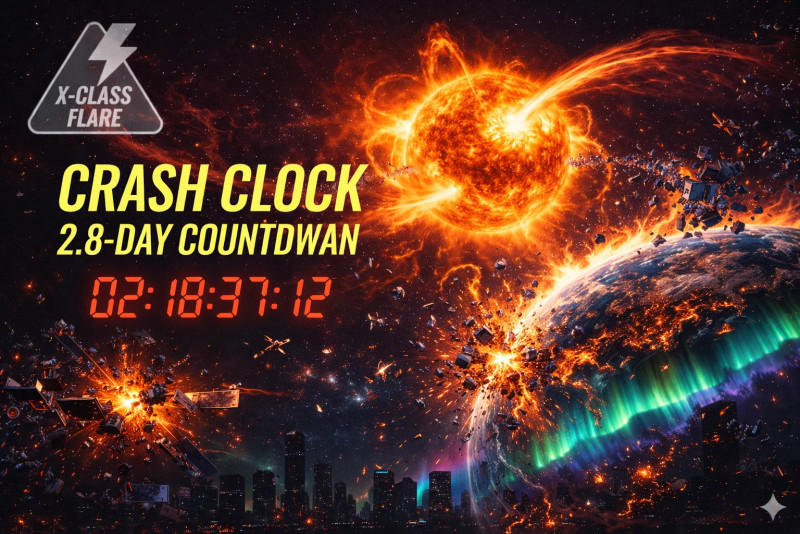
This isn't the plot of a new dystopian thriller. It’s the mathematical reality of a new metric scientists are calling the CRASH Clock. And right now, that clock is sitting at a terrifying 2.8 days.
As we barrel into the peak of the 2026 Solar Maximum, the sun is waking up, and our orbital neighborhood has never been more crowded. Here is the breakdown of why three days is all that stands between us and a potential "orbital house of cards."

What is the "CRASH Clock"? (And why 2.8 days?)
The CRASH Clock (short for Collision Realisation and Significant Harm) is a brand-new metric developed by researchers at Princeton University and the University of British Columbia.
It doesn't measure how much junk is in space. Instead, it measures reaction time.
Specifically, the clock calculates how long it would take for a catastrophic collision to happen if we suddenly lost the ability to "steer" our satellites.
-
In 2018: The CRASH Clock was 121 days. We had months to fix a problem.
-
In 2026: The clock has plummeted to 2.8 days.
The reason? Megaconstellations. With thousands of satellites like SpaceX’s Starlink now blanketing the sky, the margin for error has evaporated. We are effectively playing a high-speed game of Tetris 300 miles above our heads, and we’re running out of room.

The Perfect Storm: Solar Maximum vs. Satellite Traffic
Why is this a 2026 problem? Because the Sun is currently at its Solar Maximum—the most active point in its 11-year cycle. When the sun burps out a massive solar flare or a Coronal Mass Ejection (CME), it creates two massive headaches for satellites:
1. The "Thick Air" Problem (Atmospheric Drag)
When a solar storm hits, it heats Earth’s upper atmosphere, causing it to expand. This turns the thin vacuum of space into "thick soup." Satellites that were gliding smoothly suddenly face intense drag, causing them to drop in altitude and speed up unpredictably.
2. The "Blindfold" Problem (Electronic Chaos)
Intense radiation can fry the sensors satellites use to navigate. If a satellite can't "see" where it is or talk to ground control, it becomes a "zombie satellite"—a multi-ton piece of metal flying at 17,000 mph with no one at the wheel.

72 Hours to Chaos: The Chain Reaction
The fear isn't just one crash; it’s the Kessler Syndrome.
If two satellites collide at those speeds, they don't just dent; they shatter into thousands of jagged pieces. Those pieces then act like cosmic bullets, hitting other satellites, which create more debris, which hit more satellites.
According to the CRASH Clock study, if we lose control of our satellite fleet for just 24 hours, there is already a 30% chance of a major collision. If we hit the 2.8-day mark without regaining control, a catastrophic crash becomes a mathematical probability.
"We are reliant on errorless operations. If the feedback loop breaks, the house of cards falls." — Key takeaway from the Princeton/UBC study.

How This Hits Your Pocketbook and Your Phone
If the "orbital collapse" actually happens, you won't just lose your Twitter feed. The ripple effects on Earth would be massive:
-
The Death of GPS: Everything from your Uber ride to the global food supply chain relies on GPS. Without it, international shipping and aviation would grind to a halt.
-
Financial Meltdown: Global stock markets use satellite-synced atomic clocks to time-stamp trades. If those signals go dark, the "high-frequency" trading world could seize up.
-
The Digital Divide: Millions of people in rural areas who rely on Starlink or satellite internet would be plunged back into the 1990s.

Is There a "Pause" Button?
The good news? We aren't helpless. Space agencies and companies are working on:
-
Space Claws: Missions like ClearSpace-1 are testing tech to grab dead satellites and pull them into the atmosphere to burn up.
-
Better "Traffic Lights": Improved AI-driven collision avoidance systems that can react faster than humans.
-
Hunker Down Protocols: Powering down sensitive electronics before a solar storm hits to prevent permanent damage.
FAQs: The Ticking Clock ❓
Q: Does the CRASH Clock mean a crash will happen in 2.8 days?
A: No. It means if we stopped managing space traffic today, a crash would likely happen within that window. It’s a measure of how fragile the system has become.
Q: Will the debris fall on my house?
A: Highly unlikely. Most satellite debris is small and burns up in the atmosphere long before it hits the ground. The danger is to other satellites, not people on the surface.
Q: Can we just "clean up" the space junk?
A: It’s incredibly hard. Imagine trying to catch millions of speeding bullets with a butterfly net. We can remove big satellites, but the tiny fragments are a permanent hazard.
Q: Is Starlink the problem?
A: Starlink has made the sky more crowded, but they also have the most advanced avoidance systems. The risk comes when those systems are knocked offline by something like a "Carrington Event" solar storm.

The Verdict: Keep Your Eyes on the Sun
2026 is going to be a wild ride for space weather. The CRASH Clock is a wake-up call that our "High-Tech Heaven" is built on a very thin margin of safety. While we probably won't wake up to a total digital blackout tomorrow, the 2.8-day countdown reminds us that in the modern age, we are only ever a few days away from a very different world.
Stay curious, stay prepared, and maybe—just maybe—keep an old-school paper map in your glovebox.
Proof of Sources & References
-
Original Research Paper: An Orbital House of Cards: Frequent Megaconstellation Close Conjunctions (arXiv:2512.09643)
-
Scientific Analysis: Universe Today - 2.8 Days to Disaster: Why We Are Running Out of Time
-
Industry Report: Outer Space Institute - The CRASH Clock Environmental Indicator
-
News Coverage: The Economic Times - Catastrophe in 2.8 days: Scientists warn of digital dark age
-
NASA/NOAA Data: Space Weather Prediction Center - Solar Cycle 25 Forecast
Disclaimer: This article discusses theoretical scientific models and "worst-case scenarios" regarding orbital mechanics and solar activity. While the CRASH Clock is a real metric developed by researchers, an "orbital collapse" is a projection of what could happen if control systems fail, not a confirmed upcoming event. Always refer to official NASA and NOAA alerts for active space weather warnings.