.png)
.png)
.png)
.png)
We’ve all seen the movies. The sky turns a neon shade of purple, the lights flicker once, and then—poof—the world goes silent. No TikTok, no Google Maps, no digital banking. Just you, a cold cup of coffee, and a very quiet smartphone.
While that sounds like a Hollywood script, scientists are currently watching the sun with a mix of awe and genuine nerves. Welcome to 2026, the year the Sun is scheduled to hit its "Solar Maximum," and things are getting spicy up there.
But should you actually start hoarding physical maps and canned beans? Let's dive into why the 2026 solar storm cycle is the talk of the town and what it really means for our plugged-in lives.

What on Earth is a "Solar Maximum"?
The sun isn't just a static ball of fire; it’s a temperamental beast that operates on an 11-year cycle. Think of it like a cosmic heartbeat. Sometimes it’s calm (Solar Minimum), and sometimes it’s basically having a tantrum (Solar Maximum).
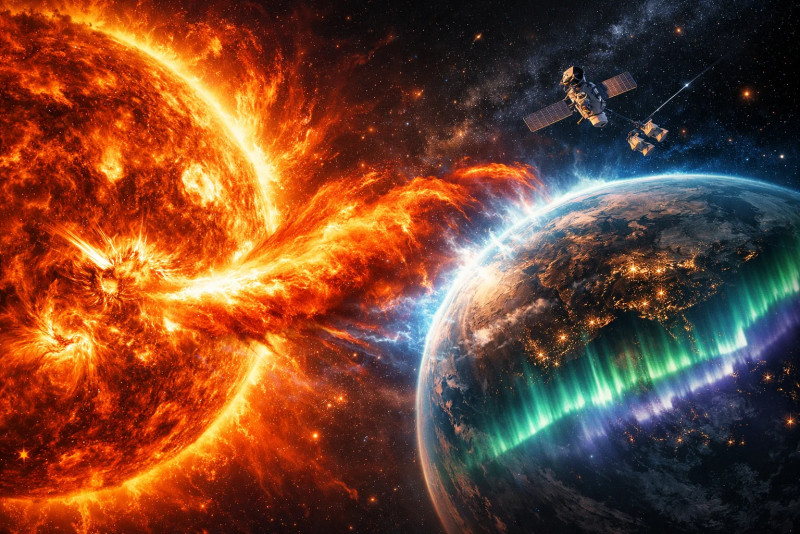
In 2026, we are smack-dab in the peak of Solar Cycle 25. During this phase, the sun’s magnetic fields get tangled up like a pair of headphones in your pocket. When those fields finally "snap," they release a colossal amount of energy in the form of:
-
Solar Flares: Bursts of light and X-rays that hit Earth in 8 minutes.
-
Coronal Mass Ejections (CMEs): Huge clouds of magnetized plasma that travel at millions of miles per hour.
When a CME hits Earth’s magnetic field, it triggers a geomagnetic storm. While this gives us beautiful Auroras (Northern Lights), it also plays bumper cars with our technology.

The "Digital Dark Age": Hype or Reality? ????
The term "Internet Apocalypse" has been bouncing around the web lately. It sounds terrifying, but where did it come from?
The worry is that our modern world is built on a "glass floor." We rely on undersea fiber-optic cables to keep the global internet running. While the cables themselves are fine, the repeaters (the little boxes that boost the signal every 50-100km) are vulnerable to the electrical surges caused by solar storms.
Why 2026 is Different
We haven't experienced a truly massive solar peak since the internet became our life support system. The last "big one" was the Carrington Event in 1859. Back then, it just made telegraph wires spark and gave operators literal shocks. ⚡
If a Carrington-level event happened today?
-
Satellites could fry: GPS would go wonky, making navigation for planes and ships a nightmare.
-
Power Grids could melt: Massive surges could blow out transformers that take months to replace.
-
The Great Disconnect: Global internet could face outages lasting weeks or even months in extreme scenarios.

Recent Warning Shots: The January 2026 Flare
We don't have to guess if the sun is active—it’s already showing off. Just this past January 18, 2026, the sun unleashed a powerful X-class solar flare (the strongest category).
It wasn't a world-ender, but it was a "hey, look at me" moment from our star. It caused radio blackouts over the Pacific and sent astronauts on the ISS scrambling for the shielded parts of the station. It was a reminder that the peak of this cycle is now, and the sun is just getting started.
Fun Fact: During that January storm, the Northern Lights were seen as far south as Alabama and Italy! ????

How to Prepare (Without Losing Your Mind)
Before you start building a lead-lined bunker, remember that agencies like NASA and NOAA monitor the sun 24/7. We usually get about 12 to 48 hours of warning before a CME hits.
Here’s what a "human-level" prep looks like:
-
Keep a Paper Map: If GPS goes down for a day, you don't want to get lost going to the grocery store.
-
Backup Your Data: Keep important photos or documents on an external hard drive, not just the cloud.
-
Have a Small Emergency Kit: A battery-powered radio, some cash (if ATMs go down), and a couple of flashlights.
-
Don't Panic: Most solar storms just result in slightly slower internet or a cool light show in the sky.

FAQs: Your Burning Questions Answered
Q: Will my phone explode during a solar storm?
A: Nope! Your phone is too small to be affected by the magnetic surges. The danger is to the big stuff: power lines, satellites, and long-distance cables.
Q: Is the world ending in 2026?
A: Only if you consider "no Netflix for a week" the end of the world. We are looking at a technological challenge, not an extinction event.
Q: Can we stop a solar storm?
A: We can't stop the sun, but we can "hunker down." Power companies can temporarily shut down grids to prevent equipment from burning out, and satellite operators can put their birds into "safe mode."
The Bottom Line
The 2026 Solar Maximum is a reminder of how fragile our digital "utopia" really is. We are living through a peak of cosmic activity that happens once a decade, and while the risks to our gadgets are real, humanity has a pretty good track record of adapting.
So, keep your eyes on the sky! You might get a once-in-a-lifetime light show—and maybe a much-needed break from your inbox.
Proof of Incident & Sources
-
ESA Monitoring: European Space Agency - January 2026 Space Weather Event
-
NASA Science: Strong X-Class Flare Erupts From Sun - Jan 2026
-
NOAA Updates: Space Weather Prediction Center - Solar Cycle 25 Progression
-
News Coverage: TIME - What to Know About the Biggest Solar Storm in Over 20 Years
Disclaimer: This article is for informational and entertainment purposes. While solar storms represent a real risk to infrastructure, "Digital Dark Age" scenarios are worst-case theoretical models. Always follow official guidance from your local government and space agencies during space weather events.