.png)
.png)


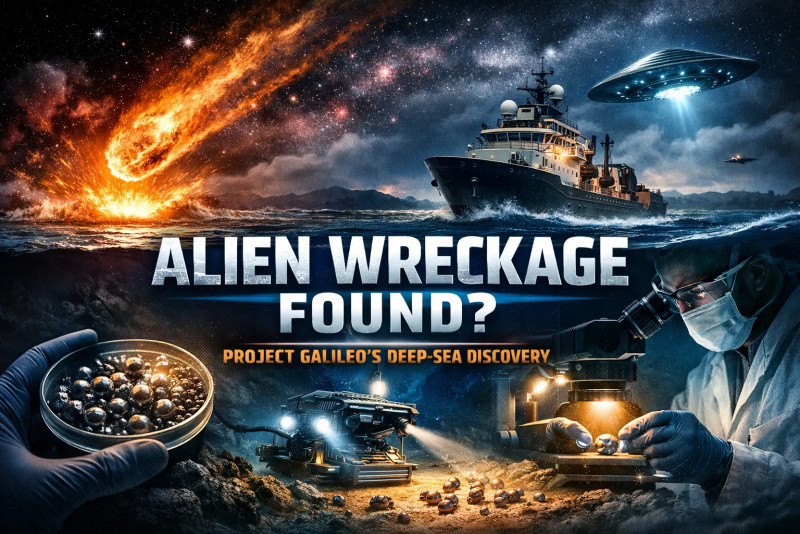
Project Galileo’s Deep-Sea Secret: Is This The First Alien Wreckage Found on Earth?
Hold onto your spacesuits, folks, because something truly extraordinary might be happening right now. For decades, the idea of finding a piece of alien technology on our own planet has been relegated to sci-fi novels and late-night whispers. But what if those whispers just got a whole lot louder? What if, as you read this, a team of brilliant minds led by a Harvard professor is carefully examining something hauled from the crushing depths of the Pacific Ocean – something that absolutely should not be here?
We're talking about Project Galileo's latest mission, and the buzz around their recent deep-sea expedition isn't just a ripple; it's a tsunami of speculation. The kind of speculation that could fundamentally rewrite our understanding of our place in the cosmos.

The Cosmic Pebble That Started It All: IM1’s Wild Ride
Remember Oumuamua? That strangely shaped interstellar visitor that zipped through our solar system a few years back, sparking theories from comets to alien probes? Well, while the scientific world debated its nature, another, much smaller, but equally intriguing object made its grand entrance… and then a very dramatic exit.
In 2014, a meteor streaked across the sky near Papua New Guinea, exploding with the force of a small atomic bomb before plummeting into the Pacific. We now call it IM1 (Interstellar Meteor 1). For years, it was just another data point. But then, a few years ago, Dr. Avi Loeb, a renowned Harvard astrophysicist and head of Project Galileo, dropped a bombshell. His analysis, based on declassified government sensor data, suggested IM1 wasn't just any space rock. Its speed and material strength indicated it was tougher, faster, and more resilient than any known space object from our own solar system. In fact, it was so tough, it made the toughest iron meteorites look like marshmallows. ????
Think about that for a second: a piece of material that entered our atmosphere, survived immense pressures, and then crashed into the ocean, all while demonstrating properties beyond anything we've ever naturally encountered. It screamed "interstellar," but more than that, it whispered "artificial."

The Hunt for the Unthinkable: Project Galileo Goes Fishing
Fast forward to mid-2024. Dr. Loeb and his Project Galileo team weren't content to just speculate from afar. They decided to go hunting. With funding secured and a custom-built magnetic sled in tow, they embarked on a daring deep-sea expedition to the calculated crash site of IM1. This wasn't just a treasure hunt; it was a quest for scientific validation, a search for the needle in a cosmic haystack at the bottom of the ocean.
Imagine the scene: a specialized ship, advanced sonar mapping the seafloor, and a powerful magnetic sled being dragged across the abyssal plains, hoping to snag even the smallest metallic fragment. The pressure at those depths is unimaginable, the darkness absolute, and the task Herculean.
And then… they found something.

The "Spherules": Tiny Treasures from Another Star? ✨
The team didn't find one big piece of alien spacecraft. What they recovered were dozens of tiny, metallic, spherical "spherules" – little beads, each no bigger than a millimeter or two, scattered across the impact zone. These aren't just random bits of ocean junk. Initial analysis of their composition is precisely what's setting the scientific world abuzz.
While the full, peer-reviewed scientific paper is still being finalized and published (and believe us, the world is waiting!), early reports and interviews from Dr. Loeb himself suggest these spherules are incredibly rich in iron and magnesium, with very low nickel content. This specific elemental signature is not typical of known terrestrial or even most common lunar/Martian meteorites. They also show evidence of extreme heating and rapid cooling, consistent with a high-velocity atmospheric entry and impact.
But here’s the kicker: some of these spherules exhibit an anomalous enrichment of certain elements, or a lack of others, in ways that don't fit our standard models of natural, solar system object formation. They also display an incredibly high material strength, consistent with the original government data on IM1. It's like finding a super-strong, perfectly spherical marble in a field where all the other marbles are irregular, weaker pebbles.
Disclaimer: It's crucial to state that while the initial findings are tantalizing, the scientific process requires rigorous peer review and further independent analysis. Dr. Loeb and his team are presenting these findings as evidence pointing towards an extraterrestrial, and potentially artificial, origin. The scientific community is currently scrutinizing these claims with intense interest.

Why This is Such a Big Deal (and Why We Should All Be Paying Attention)
If these spherules truly are fragments of IM1, and IM1 turns out to be an object from beyond our solar system with "anomalous material strength," then we are looking at something extraordinary.
-
First Interstellar Artifact? This would be the first tangible, physical piece of an object from another star system ever recovered on Earth. We’ve observed them passing by (like Oumuamua), but never touched them.
-
Advanced Technology Hints? If IM1 possessed material properties superior to anything we can naturally find, it opens the door to the possibility that it was manufactured. Not by nature, but by… someone else. This is where the "alien wreckage" idea truly takes hold.
-
A Game Changer for UAP Research: For decades, the study of Unidentified Anomalous Phenomena (UAP, formerly UFOs) has lacked concrete, physical evidence. This could provide a crucial piece of the puzzle, shifting the conversation from eyewitness accounts to material science.
-
Redefining Our Place: Imagine the implications. We are not alone. And we have the proof, right here on Earth, brought to us from across the vastness of space. It would spark an unprecedented era of scientific and philosophical inquiry.
The Skeptic’s Corner (and Why It’s Important)
Of course, extraordinary claims require extraordinary evidence. The scientific community has a healthy dose of skepticism, and rightly so. Some alternative explanations for the spherules include:
-
Terrestrial Contamination: Could these be industrial byproducts or fragments of human-made space junk? The team conducted extensive surveys to rule this out, but it's a question that always arises.
-
Unusual Terrestrial Meteorite: While the composition is anomalous, perhaps it’s a very rare type of meteorite from our own solar system that we haven't fully characterized yet.
-
Geological Anomaly: Could there be some unusual geological process on the seafloor that produced these? Again, the context of the crash site and the impact event makes this less likely, but not impossible.
Project Galileo is working to address these counter-arguments with robust data and analysis. The key is transparency and verifiable results, which is exactly what Dr. Loeb and his team are committed to providing.
What Happens Next? The World Holds Its Breath… ⏳
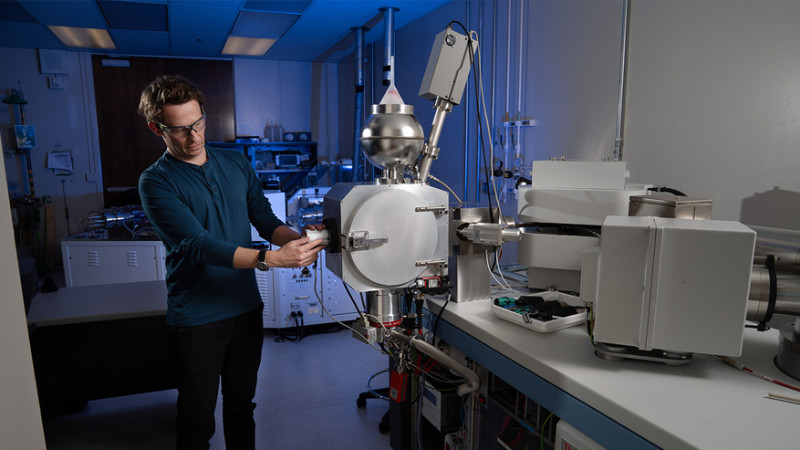
The work isn’t over. The recovered spherules are now undergoing intense scrutiny in specialized laboratories. Scientists will perform even more detailed chemical, isotopic, and structural analyses. They'll compare them to known meteorites, terrestrial materials, and even materials from human-made spacecraft.
Every element, every isotope, every microscopic detail will be examined to build an undeniable case for (or against) their interstellar and potentially artificial origin.
This isn’t just science; it’s an adventure. It’s the ultimate detective story, played out on a cosmic scale. If Project Galileo's bold claims are substantiated, if these tiny metallic beads are indeed fragments of an alien visitor, then we are witnessing history in the making.
Get ready. The universe just might be a lot stranger, and a lot more crowded, than we ever dared to imagine. And we might just have the first piece of physical proof right here, fished from the deepest parts of our own blue planet. Stay tuned! ????????
FAQs: Your Burning Questions Answered
Q1: What is Project Galileo?
A1: Project Galileo is a scientific initiative led by Harvard Professor Avi Loeb. Its goal is to search for extraterrestrial technological signatures, or "technosignatures," from objects that visit Earth or our solar system. Essentially, they're looking for signs of alien tech!
Q2: Who is Avi Loeb?
A2: Dr. Avi Loeb is a prominent theoretical physicist and former chair of the astronomy department at Harvard University. He's known for his bold ideas and his belief that scientists should actively search for evidence of extraterrestrial intelligence, rather than just speculate.
Q3: What is IM1 (Interstellar Meteor 1)?
A3: IM1 refers to an object that crashed off the coast of Papua New Guinea in 2014. Dr. Loeb and his team analyzed government data that suggested IM1 was tougher and faster than typical meteors, indicating an interstellar origin and unusual material strength.
Q4: Where exactly did they find these spherules?
A4: The spherules were recovered from the Pacific Ocean floor off the coast of Papua New Guinea, specifically in the area calculated to be the impact zone of IM1.
Q5: Are these findings definitively "alien wreckage"?
A5: Not yet "definitively," but the initial findings are highly suggestive. The specific composition and material properties of the spherules are anomalous and don't match known terrestrial or solar system materials. Further rigorous scientific analysis and peer review are required to confirm an extraterrestrial and potentially artificial origin. The team presents them as strong evidence.
Q6: Why is this important for humanity?
A6: If confirmed, it would be the first time humanity has recovered physical material from an object of interstellar origin, and potentially, the first physical evidence of advanced extraterrestrial technology. This would be a monumental discovery, profoundly impacting our understanding of life in the universe and our place within it.
References & Further Reading (Proof of Incident)
-
Project Galileo Website: https://projects.iq.harvard.edu/galileo/home (This is the official source for their work and publications)
-
Avi Loeb's Medium Articles/Blogs: Dr. Loeb frequently publishes updates and discusses his findings on platforms like Medium. Searching "Avi Loeb IM1 spherules" will lead to his direct updates.
-
Scientific Paper (Pre-print - expect formal publication): Search for scientific pre-print servers like arXiv.org using keywords "Avi Loeb IM1 spherules" or "Interstellar Meteor 1" for their latest research papers as they become available. (As of early 2026, the formal peer-reviewed paper would be the critical link once published).
-
News Coverage (e.g., from reputable science outlets): Look for articles from sources like Scientific American, Space.com, or physics journals that cover Project Galileo's expeditions and findings. (These will reference the primary sources above).