.png)
.png)
.png)
.png)
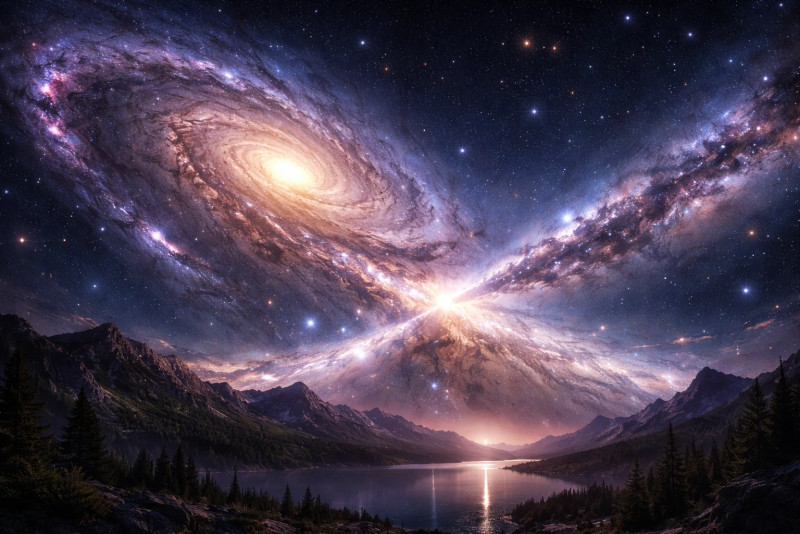
The Great Galactic Smash-Up: When the Milky Way Meets Andromeda
Imagine looking up at the night sky and seeing not just stars, but an entire giant galaxy growing larger and brighter every single night. It sounds like the plot of a high-budget sci-fi flick, but it’s actually the future of our home.
Right now, we are on a high-speed collision course with our neighbor, the Andromeda galaxy. We’re talking about a cosmic dance that will redefine everything we know about our corner of the universe.

The Ultimate Game of Chicken
Space is big. Really big. But apparently, it’s not big enough for both the Milky Way and Andromeda. Currently, Andromeda (also known as M31) is screaming toward us at about 250,000 miles per hour.
If you’re worried about setting an alarm, don’t panic just yet. Andromeda is roughly 2.5 million light-years away. Even at those breakneck speeds, the big "crunch" won't happen for another 4 to 5 billion years. To put that in perspective, the Earth itself is only about 4.5 billion years old. We have plenty of time to finish our coffee.
The Slow-Motion Crash
When we hear the word "collision," we think of car crashes—metal crunching, glass shattering, instant chaos. But a galactic collision is different. It’s more of a ghostly merger.
Galaxies are mostly empty space. If the stars were grains of sand, they would be miles apart. Because of this, when the two galaxies finally meet, individual stars probably won't hit each other. Instead, the two galaxies will pass through one another like smoke rings.

Phase 1: The First Pass
As Andromeda gets closer, it will take over the night sky. It will be massive, glowing with the light of a trillion stars. As the two galaxies pass through each other, gravity will start to pull and tug on the spiral arms of both, stretching them out into long, glowing "tidal tails."

Phase 2: The Cosmic Tug-of-War
After the first pass, the two galaxies will swing back toward each other. Gravity is a stubborn force; once it has a grip, it doesn't let go. They will dance around a common center of gravity, mixing their gas, dust, and stars in a chaotic but beautiful swirl.

Phase 3: The Birth of "Milkomeda"
Eventually—about 7 billion years from now—the two will settle down into a single, massive entity. Scientists have already given this new home a name: Milkomeda.
Unlike the beautiful spirals we see today, Milkomeda will likely be an elliptical galaxy. It will look like a giant, glowing, fuzzy football in the sky.
What Happens to Earth and the Sun?
This is the big question: Are we doomed?
The short answer is: Probably not. The Sun is expected to still be burning (though it will be much hotter and brighter by then) when the merger begins. Because the space between stars is so vast, our Solar System will likely be tossed into a new neighborhood within the new galaxy. We might end up much further from the galactic center, or perhaps closer to the edge.
However, the view would be spectacular. Instead of the thin band of the Milky Way, the entire sky would be flooded with the light of billions of new stars.
Why This Matters Now
You might wonder why we’re obsessing over something that happens billions of years away. The reason is that by studying Andromeda, we are looking into a mirror.
Andromeda is the Milky Way’s "big sister." By watching how it moves and what it’s made of, we learn about our own history. We’ve already discovered that both galaxies have "eaten" smaller galaxies in the past. This upcoming merger is just the final stage of galactic evolution.

The Night Sky of the Future
If humans (or whatever we evolve into) are still around, the "forecast" for the night sky looks something like this:
-
2 Billion Years: Andromeda is significantly larger in the sky.
-
3.8 Billion Years: Andromeda fills the horizon; the sky is distorted by gravitational forces.
-
4 Billion Years: The first pass begins; new stars begin to form rapidly as gas clouds compress.
-
6 Billion Years: The two nuclei of the galaxies merge into one bright core.
Frequently Asked Questions
Will stars actually hit each other?
It is extremely unlikely. The distance between stars is so immense that they will simply slide past one another. The real "collision" happens between the massive clouds of gas and dust.
Will the Earth survive?
The Earth might be scorched by the Sun’s natural evolution (becoming a Red Giant) long before the galaxies finish merging. However, the galactic collision itself won't "break" the planet.
Is Andromeda bigger than the Milky Way?
For a long time, we thought Andromeda was much larger. Recent data suggests they are actually pretty similar in mass—two heavyweights in the same ring.
Can we see Andromeda now?
Yes! On a very dark night, away from city lights, Andromeda is the most distant object visible to the naked eye. It looks like a faint, fuzzy smudge.
- References & Sources
Disclaimer: The timelines mentioned are based on current astrophysical models and satellite data (such as Hubble and Gaia). While these projections are scientifically grounded, they are subject to refinement as we gain more precise measurements of galactic dark matter and velocities.