.png)
.png)


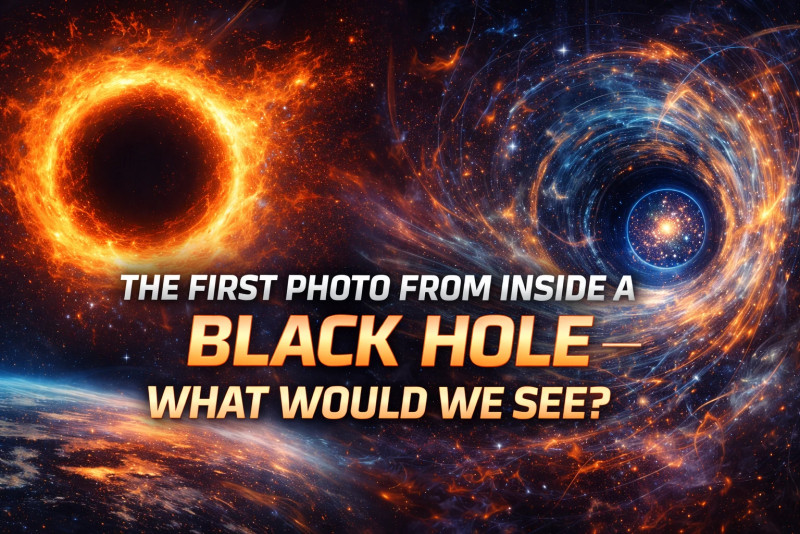
The First Photo From Inside a Black Hole — What Would We See?
In April 2019, humanity witnessed something once believed impossible. Scientists revealed the first-ever image of a black hole, captured by the Event Horizon Telescope. It was more than a scientific milestone. It felt historic, almost unreal. A dark circle surrounded by a glowing ring — a doorway into one of the universe’s deepest mysteries. Yet that image showed only the outside. The real question still fascinates scientists and dreamers alike: What would we see if a camera could photograph the inside of a black hole?
To imagine this, we must first understand what a black hole truly is.

What Is a Black Hole?
A black hole is not a hole in space. It is a region where gravity becomes so powerful that nothing, not even light, can escape. At its center lies the singularity, a point where density becomes extreme and known physics begins to break down. Surrounding it is the event horizon, the invisible boundary beyond which escape becomes impossible.
Once anything crosses this boundary, it is permanently cut off from the rest of the universe.
Crossing the Event Horizon
If a camera could somehow survive the impossible journey past the event horizon, the first thing it would notice is that space itself no longer behaves normally. Directions lose meaning. Up, down, forward, and backward begin to blur into something unfamiliar.
The black hole would not look like a tunnel or cave. Instead, the outside universe would appear twisted and wrapped around like a glowing sphere. Light from distant stars would bend sharply, forming rings, arcs, and warped streaks across the darkness. This phenomenon is called gravitational lensing, and inside a black hole it would be extreme.

Time Begins to Break
Time near a black hole behaves very differently. To an observer far away, the falling camera would appear to slow down and freeze near the event horizon. But from the camera’s own perspective, time would continue normally.
As it moved deeper, the outside universe would appear to speed up dramatically. Stars would shift faster, galaxies would drift, and distant cosmic events might unfold in rapid motion. Some theoretical models suggest that millions of years of the universe could appear to pass in moments.
The Stretching Effect — Spaghettification
One of the most powerful forces near a black hole is tidal gravity. Gravity is stronger closer to the center and weaker farther away. This uneven pull stretches objects lengthwise and compresses them sideways, a process known as spaghettification.
For humans, survival would be impossible. However, a hypothetical indestructible camera might capture space itself stretching and warping. Straight lines would curve, shapes would distort, and reality would appear fluid rather than solid.
When Light Begins to Vanish
As the camera moves deeper, visible light from the universe outside would gradually fade. Not because darkness exists, but because light paths curve inward toward the black hole.
Eventually, the outside universe would shrink into a faint glowing shell, then disappear entirely. The camera would no longer see outward — only inward, toward the collapsing geometry of space.

Approaching the Singularity
Here, science meets mystery.
According to Einstein’s theory of general relativity, the camera would eventually reach the singularity — a point of extreme density where space and time as we understand them may cease to exist. Physics currently cannot fully describe what happens there.
Some theories suggest:
-
Space and time collapse completely
-
Information becomes infinitely compressed
-
The interior may connect to another region of space (wormholes)
-
The laws of physics change at quantum scales
If a photo were captured near this region, it might not resemble anything familiar. No landscape, no horizon — only chaotic distortions of geometry, energy, and collapsing dimensions.
Could the Inside Be Structured?
Some modern quantum gravity theories propose that the singularity may not be a single point but a tiny structured region where space becomes granular, almost like pixels.
If this is true, a photo might reveal an unusual texture — a microscopic pattern representing the fabric of reality itself. This idea remains theoretical, but it highlights how black holes continue to challenge scientific understanding.
The Holographic Universe Idea
Another intriguing theory is the holographic principle. It suggests that all information inside a black hole may be encoded on its surface rather than inside its volume.
If true, the interior might not appear deep at all. Instead, everything could look compressed into a boundary-like structure. This theory remains debated but is one of the most fascinating explanations in modern physics.

Why We Cannot Capture This Photo
Capturing a real photo from inside a black hole is currently impossible.
-
No material can survive the extreme gravity
-
No signal can escape beyond the event horizon
-
Even light cannot return to carry information
This makes the inside of a black hole one of the last truly hidden places in the universe.
What Science Has Already Achieved
In 2019, scientists captured the first image of a black hole’s shadow using the Event Horizon Telescope. Since then, research has advanced rapidly. Future telescopes may provide:
-
Sharper images of event horizons
-
Real-time visuals of black hole environments
-
Magnetic field mapping around black holes
-
Deeper insights through gravitational wave observations
Humanity is slowly uncovering the secrets of these cosmic giants.

Are Black Holes Dangerous to Earth?
Black holes are not cosmic predators waiting to swallow planets. The nearest known black hole is thousands of light-years away and poses no threat.
They are natural objects formed when massive stars collapse. In fact, black holes help shape galaxies, including the supermassive black hole at the center of the Milky Way.
So What Would the First Photo Show?
If we could somehow see inside, the image would likely reveal:
-
A universe bent into curves
-
Time racing forward
-
Light twisted into impossible shapes
-
A descent into a region where physics becomes uncertain
Not a fiery tunnel. Not an explosion. But a silent, powerful distortion of reality itself.
Frequently Asked Questions
Would a person survive inside a black hole?
No. Extreme tidal forces would stretch and destroy the human body long before reaching deep regions.
Would it look completely dark inside?
Not immediately. Light from the outside universe would appear warped at first, but deeper inside, visible light would fade significantly.
Could black holes lead to other universes?
Some theories suggest this possibility, but there is currently no direct evidence.
Why can’t we send a probe inside?
No signal can escape beyond the event horizon, so any data collected would never reach Earth.
Did scientists really photograph a black hole?
Yes. In 2019, the Event Horizon Telescope captured the first image of a black hole’s shadow in galaxy M87.
Scientific Context and Disclaimer
This article is based on established astrophysics, Einstein’s general relativity, and current theoretical models. The interior of a black hole cannot yet be observed directly, and many descriptions remain scientific predictions rather than confirmed observations. No evidence suggests black holes pose any immediate danger to Earth.
References and Sources
Event Horizon Telescope Collaboration (2019)
https://eventhorizontelescope.org
NASA Black Hole Science Overview
https://science.nasa.gov/astrophysics/focus-areas/black-holes
European Southern Observatory Black Hole Research
https://www.eso.org/public/science/blackholes
Stephen Hawking — Black Hole Information Theory
https://www.hawking.org.uk
Nature Journal — Black Hole Imaging Research
https://www.nature.com
National Radio Astronomy Observatory — Event Horizon Telescope
https://public.nrao.edu