


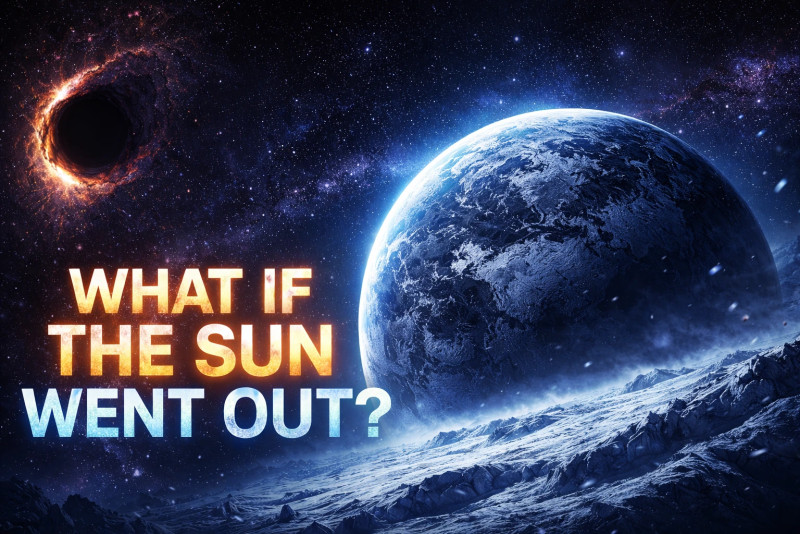
We take the sun for granted. It’s the ultimate alarm clock, the giant battery in the sky, and the reason your morning coffee exists. But have you ever stopped to wonder—really wonder—what would happen if someone just flipped the switch?
Imagine waking up, checking your phone, and realizing the "dawn" is twenty minutes late. Then an hour. Then five. The world is plunged into a darkness that no streetlamp or flashlight can truly push back.
It sounds like a Hollywood disaster flick, but the science behind a "silent sun" is both terrifying and surprisingly hopeful. Here is the hour-by-hour, day-by-day breakdown of what would happen if our star decided to take a permanent break.

The Eight-Minute Grace Period
The craziest part about the sun going out is that we wouldn't even know it happened for about eight minutes and twenty seconds. Light and gravity travel at the same speed.
For those eight minutes, you could be sitting in your backyard, enjoying a warm breeze, totally oblivious to the fact that the solar system’s anchor is gone. It’s only when the last photon finally reaches your eyes that the sky would suddenly go black. No fade-out, no sunset—just an instant "click" into the void.

Hour 1: The Panic and the Stars
Once the lights go out, the moon would vanish instantly too. Remember, the moon doesn't glow; it just reflects the sun. Without that reflection, the moon is just a dark rock in a dark sky.
The good news? You’d see the most incredible view of the Milky Way you’ve ever imagined. Without solar glare or reflected moonlight, the stars would pop with a brightness that would be breathtaking—if you weren't busy panicking about the sudden eternal night.

Day 1: The Big Chill Begins
Most people think we’d freeze to death in an hour. Actually, Earth is pretty good at holding onto heat. Think of the planet like a hot potato wrapped in a thick atmospheric blanket.
On the first day, global temperatures would drop, but it wouldn't be an instant Arctic blast. If it was a pleasant 70°F (21°C) when the sun went out, it might drop to the 40s or 50s within 24 hours. Your power grid would likely still be working (unless you rely 100% on solar panels), so you could still crank up the heater—for now.

Week 1: The Surface Becomes Unbearable
By the end of the first week, things get grim. The average global surface temperature would plunge to around 0°F (-18°C).
Photosynthesis would have stopped the moment the light died. Small plants would start to wither and turn brittle. The ocean surfaces would begin to develop a crust of ice. While the deep water stays liquid thanks to the Earth’s molten core, the "top" of our world would start to feel like the surface of a frozen moon.

Month 1 to Year 1: The Deep Freeze
Within a year, the surface would settle at a bone-chilling -100°F (-73°C). At this point, the atmosphere itself would start to give up. The water vapor would freeze and fall as snow. Eventually, even the gases we breathe—oxygen and nitrogen—would liquify and rain down.

Where Would We Go?
If you're looking for a silver lining, here it is: Humanity wouldn't necessarily go extinct on day one. We are a scrappy species.
We would have two main options for survival:
-
Geothermal Hubs: Places like Iceland, which sit on massive volcanic heat vents, would become the new capitals of the world. We could use that underground heat to stay warm and grow food in massive indoor LED farms.
-
The Deep Ocean: Submarines and underwater bases near "black smokers" (hydrothermal vents) would be safe from the surface cold. These vents provide heat and chemical energy that doesn't depend on the sun at all.
The Long Road to Nowhere
Without the sun’s gravity, the Earth wouldn't just sit there in the dark. We would go "rogue." Our planet would fly off in a straight line at about 67,000 miles per hour, heading out into the deep, interstellar space.
We would become a "Rogue Planet"—a lonely wanderer in the dark, carrying the frozen remains of a once-green world until, millions of years later, we might drift close enough to another star to be captured into a new home.

Frequently Asked Questions
Would we die instantly if the sun went out?
No. We would have roughly 8 minutes of light and gravity. After that, the world would get dark and gradually colder, but the Earth’s atmosphere would keep us warm enough to survive for several days or even weeks on the surface with proper gear.
Could we still grow food without sunlight?
Yes, but not in traditional fields. We would need massive indoor hydroponic farms powered by nuclear or geothermal energy. LED lights can mimic the sun's spectrum to keep plants alive.
What happens to the oceans?
The top layers would freeze solid, acting as a thick "insulation" for the water below. This ice would actually prevent the entire ocean from freezing for hundreds of thousands of years, meaning deep-sea life might not even notice the sun is gone for a long time.
Would the stars still be visible?
Yes! In fact, they would be clearer than ever. Without the sun’s light scattering in our atmosphere, the sky would look like a high-definition photograph of the cosmos 24/7.
Disclaimer: This article is a scientific thought experiment based on current understanding of physics, thermodynamics, and planetary science. The sun is currently in a stable stage of its life cycle (the Main Sequence) and is expected to continue shining for approximately 5 billion more years. No sudden "shutdown" is predicted by any major space agency.
References and Sources: