.png)
.png)


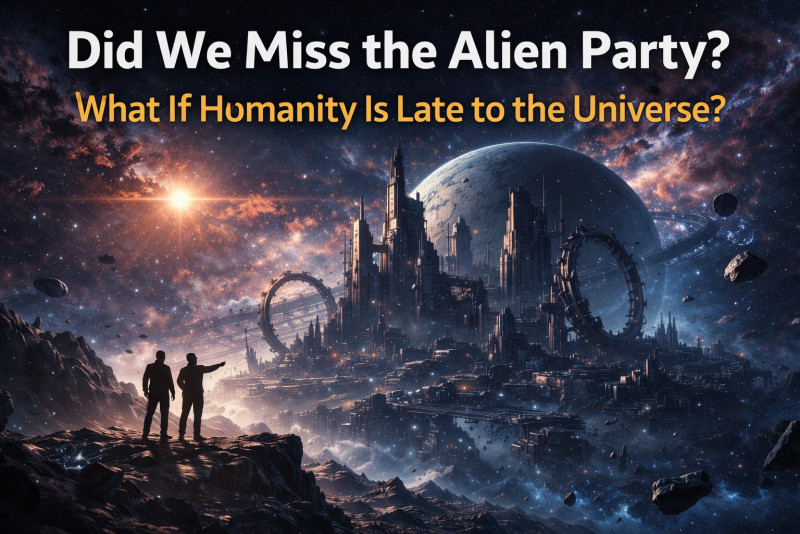
Have you ever walked into a party only to realize you missed the main event? The music is winding down, the snacks are mostly gone, and the best stories have already been told. It’s a bit of a letdown. Now, imagine that same feeling—but on a cosmic scale.
For decades, we’ve been looking for neighbors in the stars, wondering why the universe feels so quiet. But what if the silence isn't because no one is there? What if it’s because everyone else was here billions of years ago and has already moved on?
There is a growing, mind-bending theory among astronomers that humanity might just be the latecomers to a very old, very crowded universe.
The 10-Billion-Year Head Start
To understand why we might be "late," we have to look at the clock. The universe is roughly 13.8 billion years old. Our home, the Earth, is a mere 4.5 billion years old.
That means for nearly 9 billion years, the universe was busy cooking up stars, planets, and potentially, life, while our solar system was nothing more than a cloud of cold dust.
Think about that for a second. If it took 4 billion years for humans to go from single-celled organisms to building the James Webb Space Telescope, imagine what a civilization could do with a 5-billion-year head start. They wouldn't just be ahead of us; they would be gods by our standards.
The Mystery of the "Old" Planets
In the past few years, we’ve discovered planets that shouldn't exist. Take the planet nicknamed "Methuselah" (PSR B1620-26 b). This gas giant is roughly 13 billion years old. It formed just a billion years after the Big Bang itself.
If planets could form that early, then life could have started that early too. While Earth was still a molten ball of lava, these ancient civilizations could have already been building Dyson spheres, colonizing galaxies, or even evolving past the need for physical bodies entirely.
Why Haven't We Found Them?
This brings us to the famous Fermi Paradox: "Where is everybody?" If the universe is crawling with ancient empires, why don't we see their neon signs or hear their radio broadcasts?
There are a few "human-toned" theories that don't involve scary monsters or doom:
-
The Retirement Phase: Maybe advanced civilizations eventually move "inward." Instead of building massive metal cities across the galaxy, they might upload their consciousness into hyper-efficient digital worlds. To us, their home planet would look like a quiet, abandoned rock, but inside, they are living out infinities.
-
The "Firstborn" Responsibility: Some scientists argue we might actually be the first. Maybe the early universe was too violent—too many supernovas and gamma-ray bursts—for life to take hold. If that’s the case, we aren't the latecomers; we’re the "Ancients" that future alien races will one day wonder about.
-
The Technosignature Gap: We are looking for radio waves, a technology we’ve used for about 100 years. An ancient civilization would likely view radio the way we view smoke signals. We’re simply tuned to the wrong frequency.
The Search for Space Trash
Lately, the search has shifted. Instead of listening for a "Hello," scientists like Avi Loeb are looking for "space junk."
If a civilization lasted for millions of years before going extinct, they would have left behind artifacts. Broken probes, abandoned satellites, or even structural debris from massive projects. In 2026, new surveys are looking at interstellar objects passing through our neck of the woods to see if they are truly natural rocks or the rusted remains of a 5-billion-year-old drone.
Are We Ready for the Answer?
Finding out we are late to the party would be a humbling moment for our species. It would mean that all our history, our wars, and our achievements are just a tiny footnote in a much larger, much older story.
But it’s also an exciting thought. It means the "blueprints" for a successful, long-lived civilization are out there somewhere. We just have to find the ruins and learn how they did it.
Frequently Asked Questions
Is there actual proof of ancient alien civilizations?
As of right now, no. We have "anomalies"—things that look weird, like Tabby’s Star or the interstellar object ‘Oumuamua—but no "smoking gun." We have found very old planets, which proves the possibility of ancient life, but not the life itself.
How old is the oldest planet we’ve found?
The oldest known planet is about 13 billion years old. For comparison, Earth is only 4.5 billion years old. That planet has been around for nearly three times as long as ours.
What is a technosignature?
A technosignature is any evidence of technology that we can see from Earth. This could be industrial pollution in a planet's atmosphere, a swarm of satellites, or even the heat given off by a massive computer system.
If they are so advanced, why wouldn't they help us?
Think about how you treat an anthill. You don't necessarily hate the ants, but you don't go out of your way to teach them how to use a smartphone. An ancient civilization might see us as interesting biological curiosities, but not yet ready for "the big talk."
Disclaimer: This article explores scientific theories and astronomical hypotheses regarding the age of the universe and the potential for extraterrestrial life. No definitive evidence of alien civilizations has been confirmed by NASA, ESA, or any other official scientific body. The search for technosignatures remains a theoretical field of study.
References and Sources: