.png)
.png)
.png)
.png)
By Ronald Kapper
The Silent Danger Above Us
Space looks peaceful from Earth. The night sky feels calm, distant, and beautiful. But beyond that quiet glow lies a dangerous reality. The universe is not empty. It is filled with powerful, fast-moving, and sometimes destructive objects. Most pass harmlessly through space. Some, however, carry the potential to reshape worlds.
Right now, scientists are tracking several types of dangerous objects floating through space. From giant asteroids to invisible radiation storms, these threats are real, studied carefully, and monitored every day. Humanity is not helpless, but understanding these dangers is essential.

Asteroids — The Most Immediate Threat
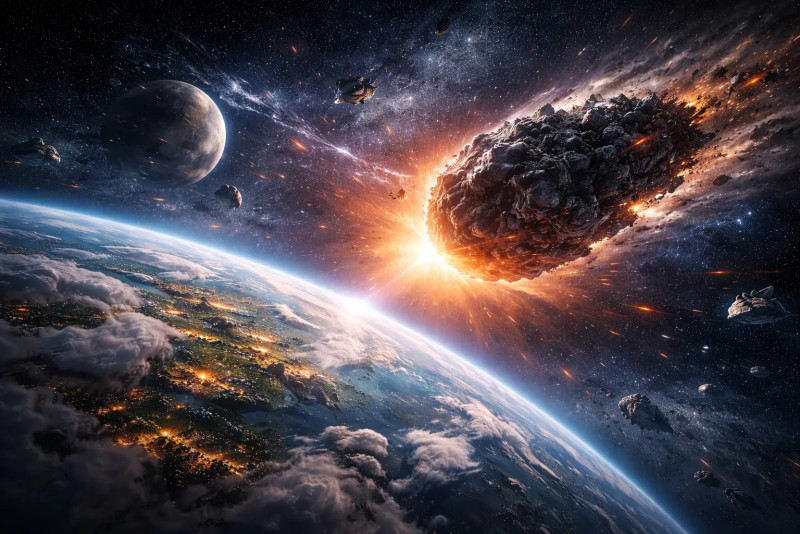
Among all space dangers, asteroids remain the most closely watched. These rocky bodies travel at enormous speeds, sometimes crossing Earth’s orbit. Most are small and burn up in the atmosphere. But larger asteroids can cause massive destruction.
Scientists monitor near-Earth objects constantly using global telescope networks. If a large asteroid were on a collision path, early detection would be critical. Fortunately, no known asteroid currently poses an immediate impact risk. However, history reminds us that impacts have shaped Earth before, including the event linked to dinosaur extinction.
Even smaller asteroid impacts can release energy equal to multiple nuclear explosions. This makes asteroid tracking one of the most important tasks in planetary defense.

Rogue Comets From Deep Space
Comets differ from asteroids because they contain ice, dust, and volatile gases. When heated by the Sun, they form glowing tails stretching millions of kilometers. While beautiful, some long-period comets arrive from deep space with little warning.
Unlike asteroids, which often have predictable orbits, long-period comets may appear suddenly. Their high speed and late detection make them potentially dangerous. Scientists study comet trajectories carefully, though most pass far from Earth.
Space Debris — The Invisible Threat
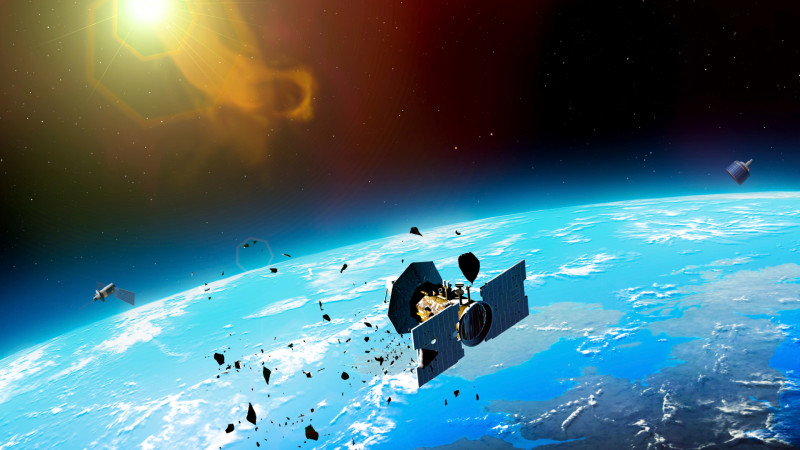
Not all dangers come from nature. Human-made space debris has become a growing concern. Thousands of fragments from old satellites, rocket stages, and collisions now orbit Earth at extreme speeds. Even small debris can damage spacecraft, satellites, and space stations.
Space agencies track larger debris objects, but millions of tiny fragments remain difficult to monitor. As space activity increases, debris management is becoming critical to protect satellites that support communication, navigation, and weather monitoring on Earth.

Solar Storms — Invisible But Powerful
The Sun is not always calm. It occasionally releases massive bursts of energy called solar storms. These storms send charged particles racing across space. When directed toward Earth, they can disrupt satellites, communication systems, and power grids.
The most powerful recorded solar storm, known historically as the Carrington Event, caused widespread telegraph failures in the nineteenth century. A similar event today could affect global technology infrastructure. Scientists monitor solar activity constantly to provide early warnings.

Gamma-Ray Bursts — The Universe’s Most Violent Explosions
Among the most powerful known events in the universe are gamma-ray bursts. These are intense explosions releasing enormous energy in seconds. If a strong gamma-ray burst occurred close enough and pointed toward Earth, it could damage the atmosphere and affect life.
Fortunately, such events are extremely rare near our planet. Most occur in distant galaxies. Still, their sheer power makes them one of the most dangerous cosmic phenomena known.

Black Holes — The Silent Giants
Black holes are regions of space where gravity is so strong that nothing escapes, not even light. While none threaten Earth directly, scientists continue to study them carefully. If a black hole ever passed close to our solar system, its gravitational influence could disrupt planetary orbits.
At present, all known black holes are safely distant. Yet their power reminds us of the extreme forces present in the universe.

Rogue Planets — Wanderers Without Stars
Some planets drift through space without orbiting a star. These rogue planets move silently through the galaxy. If one ever entered our solar system, its gravitational pull could disturb planetary paths, potentially causing long-term instability.
Such encounters are extremely rare. Still, rogue planets demonstrate that space contains large, unpredictable objects beyond traditional planetary systems.

Cosmic Radiation — The Invisible Hazard
Beyond Earth’s protective atmosphere lies intense cosmic radiation. This radiation poses risks to astronauts, satellites, and future space travel. Long-term exposure can damage cells, electronics, and materials.
Understanding cosmic radiation is essential for future human missions beyond Earth. Scientists are developing protective technologies to reduce its effects.
Fast Radio Bursts — A Mystery Still Unfolding
Fast radio bursts are powerful, brief pulses of energy detected from distant space. Their exact origin remains under investigation. While they pose no known threat to Earth, their energy and mystery keep scientists studying them closely.
These signals remind humanity that space still holds many unknown phenomena.

Humanity’s Defense Against Space Threats
Despite these dangers, humanity is not powerless. Scientists and space agencies monitor the skies constantly. Planetary defense systems track near-Earth objects. Solar observatories monitor the Sun. Space debris tracking protects satellites.
New technologies are also being studied, including asteroid deflection methods and early-warning systems. The goal is preparation, not fear. Knowledge is humanity’s strongest defense.
Why Space Still Inspires Wonder
Space is both dangerous and beautiful. The same universe that holds destructive forces also holds endless discovery. Understanding cosmic threats does not diminish wonder. It deepens it. Humanity’s journey into space continues with caution, curiosity, and determination.
The dangers above us are real, but so is human resilience. With science, observation, and preparation, humanity continues to explore the universe while protecting its home.
Disclaimer
This article is based on current scientific understanding, astronomical observations, and ongoing research. No known object currently poses an immediate global threat to Earth. Some cosmic phenomena discussed are extremely rare. Readers should view this information as scientific awareness rather than immediate danger.
Frequently Asked Questions
Are any asteroids going to hit Earth soon
No known asteroid is currently predicted to impact Earth in the near future. Scientists monitor near-Earth objects continuously.
Can solar storms really damage Earth
Powerful solar storms can affect satellites and power systems, but Earth’s atmosphere protects life on the surface.
Are black holes a danger to Earth
No. Known black holes are far from our solar system and pose no immediate threat.
What is the most dangerous object in space
Large asteroids and powerful solar storms are considered the most realistic potential threats.
Can humanity stop an asteroid
Scientists are researching asteroid deflection methods. Early detection is key to prevention.
Reference Sources and Scientific Context
NASA Near Earth Object Program
https://neo.jpl.nasa.gov
European Space Agency Planetary Defense Research
https://www.esa.int
NOAA Space Weather and Solar Storm Monitoring
https://www.swpc.noaa.gov
NASA Solar and Heliospheric Observatory Research
https://soho.nasa.gov
Nature Journal Astrophysics and Space Hazard Studies
https://www.nature.com
SETI Institute Space Science Research
https://www.seti.org