.png)
.png)
.png)
.png)
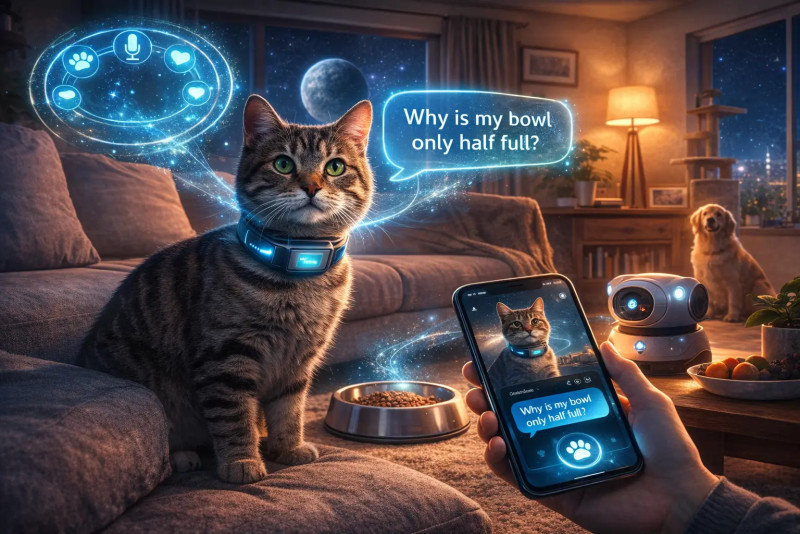
The Pet Translator Reality: By the End of 2026, Your Cat Might Finally Tell You What It Really Thinks
Have you ever stared into your cat’s eyes while they let out a long, dramatic meow, wondering if they’re hungry, bored, or quietly judging your choice of pajamas? For decades, we’ve relied on guesswork and "vibes" to understand our furry roommates. But the script is about to flip.
By the end of 2026, the "Pet Translator" isn't going to be a gimmick from a Pixar movie or a prank app on your phone. It’s becoming a scientific reality. Thanks to a massive leap in bioacoustics and multimodal AI, we are on the verge of decoding the secret language of barks, meows, and even the subtle twitch of a whisker.
But as the door to cross-species communication swings open, a bigger question looms: Are we actually ready to hear the truth?

The Tech Behind the Talk: How 2026 Changed Everything
If you’ve tried those "dog translator" apps from 2022, you know they were mostly for laughs. They played a random sound file of a person saying "I love you" every time your dog barked at a mailman.
The 2026 reality is different. Tech giants and specialized startups are now using Foundation Models—similar to the ones that power the world’s most advanced chatbots—but trained exclusively on animal data.

1. Decoding the "Meow"
Cats rarely meow at other cats; it’s a language they developed specifically to manipulate... ahem, communicate with humans. AI models are now being fed millions of hours of cat vocalizations paired with high-definition video of their body language. By analyzing the pitch, frequency, and the specific curve of a cat's tail, AI can now distinguish between a "feed me now" meow and a "there is a spider behind the fridge" alert with startling accuracy.
2. The Multi-Sensor Approach
It’s not just about sound. The newest wearable collars hitting the market this year don’t just track GPS; they track biometrics. They monitor heart rate, skin temperature, and even "micro-gestures." When your dog lets out a huff, the AI correlates that sound with their pulse and posture to tell you if they’re experiencing mild anxiety or pure, unadulterated joy.
3. The "Baidu" Effect and Global Patents
In late 2025, major tech firms filed patents for real-time animal-to-human translation interfaces. These aren't just toys; they are sophisticated systems designed to bridge the emotional gap. We are seeing a shift from "guessing" to "knowing."

What Will They Actually Say?
We like to imagine our pets have deep, poetic thoughts. We picture our golden retriever saying, "The golden hue of the sun reminds me of our first walk in the park." The reality might be a bit more... blunt.
Experts suggest that initial high-fidelity translations will likely focus on immediate needs and emotional states. Your pet’s "translated" messages might look more like this:
-
The Food Critic: "This brand of kibble is acceptable, but the one in the blue bag was superior. Also, I can see the bottom of the bowl. This is a crisis."
-
The Space Invader: "I love you, but please stop kissing my forehead. I just spent twenty minutes grooming that exact spot."
-
The Alarmist: "There is a squirrel in the yard. It is a threat to our entire way of life. Why are you sitting down? We must escalate to Level 10 barking immediately."

The "Truth" Might Be a Bit Salty
There’s a reason people say "ignorance is bliss." Currently, when our pets act out, we give them the benefit of the doubt. If a cat knocks a glass off the table, we say, "Oh, he's just being silly!" With a translator, the AI might tell you: "I am bored, and I enjoy the sound of glass breaking. Your reaction is entertaining to me." Are we ready for the personality shift that comes with truly understanding our pets? We’ve anthropomorphized them for centuries, treating them like furry children. If AI reveals they are more like demanding roommates or tiny, chaotic geniuses, it might change the way we bond with them forever.

The Ethical Minefield: Should We Be Listening?
As exciting as this sounds, it brings up some heavy ethical questions that experts are currently debating:
-
Privacy for Pets: Does your dog want you to know they’re feeling stressed? By "hacking" their communication, are we stripping away the last bit of autonomy they have?
-
The Risk of Misinterpretation: No AI is 100% accurate. If an app tells you your dog is "angry" when they are actually "in pain," the consequences could be devastating.
-
The End of Mystery: Part of the magic of owning a pet is the silent bond—the way you just know what they need without a single word. Will a digital voice in your ear kill that instinct?
Frequently Asked Questions (FAQs)
Q: Can I buy a pet translator right now?
A: There are apps like MeowTalk and various "dog bark" analyzers available, but they are still in the early stages. High-accuracy, real-time translators are expected to become commercially viable and mainstream by the end of 2026.
Q: Will it sound like a human voice?
A: Most developers are using synthetic voices that can be customized. You might be able to choose a "voice" that fits your pet’s personality—though many researchers prefer using a simple text-to-screen interface to avoid making it feel too "uncanny."
Q: Is it really translation, or just a smart guess?
A: Technically, it’s pattern recognition. The AI isn't learning a "vocabulary" in the human sense; it’s learning that Sound A + Body Position B = Emotional State C. However, as the data gets better, the "guess" becomes so accurate it functions exactly like a translation.
Q: Will this work for all animals?
A: Most current research is focused on dogs and cats because we have the most data on them. However, projects like the Earth Species Project are working on decoding whales, crows, and even honeybees.
Are We Ready?
The dream of Dr. Dolittle is no longer a fantasy. We are standing on the edge of a world where our pets can finally "speak" their minds. It will undoubtedly make us better owners—allowing us to catch illnesses earlier and meet their needs more precisely.
But it will also require a lot of humility. We might find out that we aren't the "masters" we thought we were. We might find out our pets have much more complex—and sometimes much more mundane—inner lives than we ever imagined.
By December 2026, you might not have to wonder why your cat is staring at that empty corner of the room. But don't be surprised if the answer is just: "I’m trying to see if I can make you nervous."
Disclaimer: While AI pet translation technology is advancing rapidly, current tools are primarily for entertainment and supplementary insight. Always consult with a professional veterinarian or animal behaviorist for serious health or behavioral concerns. AI interpretations should not replace professional medical advice or your own intuition as a pet owner.
References and Sources:
-
University of Michigan: AI Can Identify Dog Emotions Through Barks (Research on vocal pattern recognition)
-
Earth Species Project: Decoding Non-Human Communication (The nonprofit leading the charge in animal AI)
-
Baidu Patent Filing: Real-Time Animal Vocalization Translation