.png)
.png)
.png)
.png)
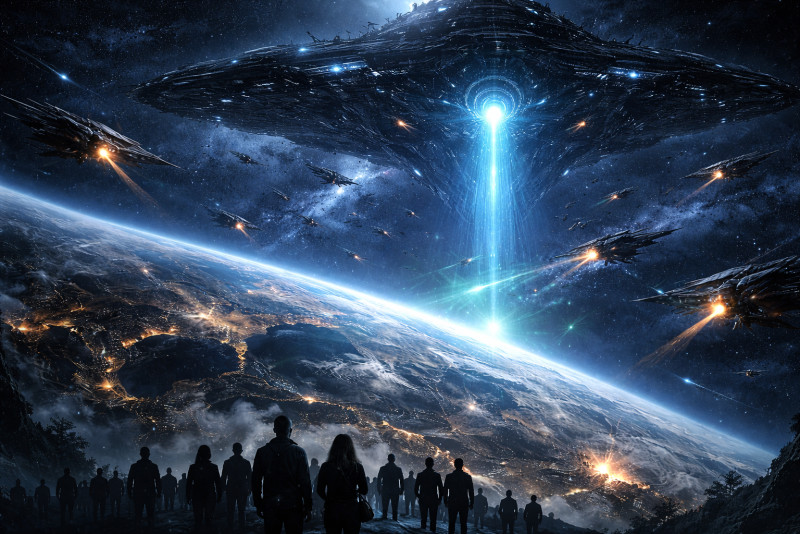
For centuries, humanity has looked at the stars with wonder and hope. The idea of meeting intelligent life beyond Earth has inspired science, philosophy, and imagination. Many dream of peaceful contact, shared knowledge, and a united cosmic future. But there is another possibility, one far darker and far more serious. What if the first civilization we meet is not friendly. What if humanity’s first contact becomes its first alien war.
This question is not only the subject of stories. Scientists, defense analysts, and space researchers have quietly discussed the risks of hostile contact for decades. While no confirmed alien civilization has been discovered, experts agree that preparing for unknown possibilities is part of responsible scientific thinking.

Why Scientists Take This Scenario Seriously
Space is vast and ancient. If intelligent life exists elsewhere, it may be far older and more advanced than humanity. Such a civilization might have technologies beyond our understanding. Their intentions would be unknown.
Scientists do not assume aliens would be friendly or hostile. Nature on Earth shows that intelligence does not always lead to peace. Competition, survival, and expansion shape behavior across species. Some researchers believe a technologically advanced civilization might view a younger species as irrelevant, dangerous, or simply in the way.
This does not mean conflict is likely. It means uncertainty exists. And uncertainty demands caution.

How First Contact Could Turn Dangerous
Most scientists agree that first contact would likely begin with signals or observation rather than direct arrival. However, several scenarios could lead to tension or conflict.
Misunderstanding could play a major role. Communication between two completely different species would be extremely difficult. Signals may be misinterpreted. Intentions could be unclear. What humans see as peaceful might appear threatening to another civilization.
Competition for resources could also create conflict. Planets, energy, and habitable environments may be valuable in a crowded galaxy. If survival or expansion drives alien behavior, Earth could become strategically important.
Fear could trigger defensive reactions. Humanity might interpret unknown technology as a threat. A more advanced civilization might view human military responses as hostility. History shows fear often leads to escalation.

Humanity’s Current Readiness
At present, humanity is not prepared for interstellar conflict. Our technology is designed for Earth and nearby space. Even the most advanced spacecraft travel slowly compared to cosmic distances.
However, humanity does possess strengths. Global communication, scientific cooperation, and rapidly advancing technology could play critical roles. Artificial intelligence, planetary defense systems, and space observation networks already monitor cosmic threats like asteroids. These systems could help detect unusual activity in space.
Unity would be essential. Facing an unknown civilization would likely unite nations in ways never seen before. Human survival would depend on cooperation rather than conflict among ourselves.

Could Advanced Civilizations Avoid War
Some scientists believe a highly advanced civilization might avoid conflict entirely. Technological maturity may lead to stability and cooperation rather than aggression. A civilization capable of interstellar travel might already have solved internal conflict, resource scarcity, and survival challenges.
Others suggest advanced species might observe without interference, similar to scientific observation of wildlife. This idea relates to the non interference principle often discussed in astrobiology.
Still, uncertainty remains. Without evidence, both peaceful and hostile outcomes remain possible.
The Role of Communication
If first contact occurs, communication will shape everything. Understanding intentions, culture, and signals could prevent misunderstanding. Scientists studying extraterrestrial intelligence focus heavily on mathematics and universal scientific patterns as possible shared languages.
Clear communication might transform a potential conflict into cooperation. Failure to communicate could do the opposite.

What Would an Alien War Look Like
Any real interstellar conflict would likely be very different from human warfare. Distance, technology, and physics would shape its nature.
A highly advanced civilization might use energy based systems, automated probes, or technologies beyond human understanding. Direct invasion may not even be necessary. Control of communication, space infrastructure, or planetary systems could determine outcomes.
Humanity’s best defense might not be weapons, but knowledge, adaptation, and resilience. History shows survival often favors those who learn quickly and cooperate effectively.
The Psychological Impact on Humanity
Even the discovery of alien intelligence would transform human society. The confirmation of a hostile civilization would have even greater impact.
Global priorities would shift instantly. Scientific research would accelerate. Political divisions might shrink as humanity recognizes a shared identity. Fear, curiosity, and determination would shape public response.
Humanity has faced global threats before, from natural disasters to pandemics. Each time, survival depended on science, cooperation, and resilience. The same principles would guide humanity in any cosmic challenge.

Scientific Reality and Caution
It is important to state clearly that no hostile alien civilization has been detected. No confirmed extraterrestrial intelligence has contacted humanity. This article explores a theoretical scenario discussed in scientific and strategic circles.
Researchers continue to search for signals from intelligent life using advanced telescopes and monitoring systems. The goal is understanding, not fear. Science prepares for possibilities, but it does not claim unproven events.
Could Humanity Win
Victory in a hypothetical alien conflict would not depend only on technology. Survival would depend on adaptability, unity, and intelligence. Humanity has advanced rapidly in a short time. Our greatest strength has always been learning and cooperation.
If humanity ever faces such a challenge, the outcome would depend on how quickly we understand the unknown and how strongly we stand together.

Frequently Asked Questions
Has humanity ever encountered aliens.
No confirmed encounter with extraterrestrial intelligence has occurred.
Are scientists searching for alien life.
Yes. Global programs monitor space for signals and study planets that may support life.
Could aliens be hostile.
It is unknown. Scientists consider both peaceful and hostile possibilities.
Is humanity prepared for alien contact.
Not fully. Preparation mainly focuses on observation, communication, and scientific study.
Would humanity unite if facing an alien threat.
Many experts believe a shared cosmic challenge could unite humanity on a global level.
Scientific Disclaimer
This article explores a hypothetical scenario based on scientific discussion and strategic analysis. There is currently no confirmed evidence of hostile extraterrestrial civilizations or interstellar conflict involving humanity. The purpose is to examine possibilities, not predict events.
Conclusion
Humanity stands at the edge of a vast and mysterious universe. The possibility of meeting another intelligent civilization is one of the greatest questions in science. Whether peaceful or hostile, such contact would transform human history forever.
The idea of a first alien war may sound dramatic, but it reminds us of something deeper. Humanity’s greatest strength is not technology alone. It is unity, curiosity, and the ability to adapt to the unknown.
References and Source Material
NASA Search for Extraterrestrial Intelligence Research
SETI Institute Scientific Publications
United Nations Office for Outer Space Affairs Planetary Protection Discussions
Historical Studies on the Fermi Paradox and Interstellar Contact Risk
Astrobiology Research on Extraterrestrial Intelligence
https://www.nasa.gov
https://www.seti.org
https://www.unoosa.org
https://astrobiology.nasa.gov
https://www.britannica.com/science/Fermi-paradox