.png)
.png)
.png)
.png)
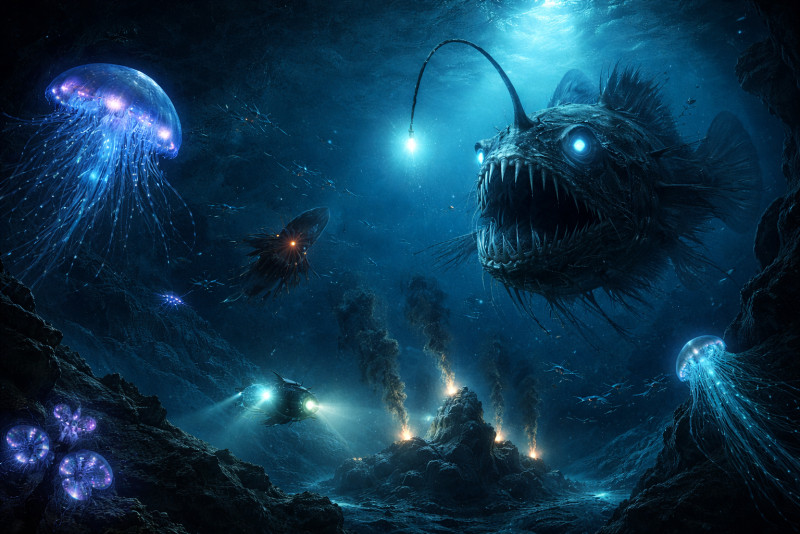
Far below the reach of sunlight lies a world so strange it feels almost unreal. The deep ocean is cold, crushing, and completely dark. Pressure is strong enough to crush steel. Temperatures hover near freezing. Food is scarce. And yet, life thrives here in forms so bizarre they seem impossible.
Scientists have explored only a small portion of this hidden world. Every expedition reveals creatures that challenge what we thought life could be. Some glow in darkness. Some survive without oxygen. Some live near boiling vents. Others look like something from another planet.
These deep sea beings are not just strange. They raise one of the biggest questions in evolution. How did life adapt to such an extreme and hostile environment.

A World Without Sunlight
The deep sea begins around one thousand meters below the surface, where sunlight disappears completely. Plants cannot grow here. Without plants, the traditional food chain collapses. Yet life exists.
Instead of sunlight, some deep sea ecosystems rely on chemical energy from the Earth itself. Near hydrothermal vents, hot mineral rich water bursts from the ocean floor. Microorganisms use chemicals like hydrogen sulfide to create energy in a process called chemosynthesis.
This discovery shocked scientists when it was first observed in the late twentieth century. It proved life does not always depend on sunlight. This finding changed how researchers think about life on Earth and possibly other worlds.

Creatures That Glow in Darkness
One of the most fascinating traits of deep sea life is bioluminescence. Many creatures produce their own light through chemical reactions inside their bodies.
The anglerfish is a famous example. A glowing lure hangs from its head and attracts prey in total darkness. The vampire squid releases glowing clouds to confuse predators. Many jellyfish pulse with soft blue light in the black ocean.
Scientists believe glowing light helps deep sea animals hunt, hide, communicate, and survive. In a world without sunlight, creating light becomes a powerful evolutionary advantage.

Life Under Crushing Pressure
At extreme ocean depths, pressure can exceed one thousand times the pressure at sea level. Under such force, most life would collapse instantly. Yet deep sea creatures have evolved flexible bodies, unique proteins, and special cell structures that allow survival under crushing conditions.
Some species have no air spaces in their bodies, which prevents collapse. Others use pressure resistant enzymes that continue functioning where normal biology would fail. This ability pushes the boundaries of what scientists once believed possible for life.

The Giant Creatures of the Abyss
Deep oceans are home to enormous beings rarely seen by humans. The giant squid, once considered a myth, can grow longer than a bus. Massive isopods resemble giant armored insects crawling across the ocean floor. Deep sea jellyfish drift like glowing ghosts in darkness.
The reason for such size is still debated. Some researchers suggest slow metabolism and cold temperatures allow certain species to grow large over long lifespans. Others believe fewer predators and stable conditions help deep sea giants survive.

Creatures That Live Near Boiling Water
Hydrothermal vents release water hot enough to melt metal, yet life thrives nearby. Tube worms grow in dense colonies around these vents, surviving without mouths or digestive systems. Instead, they host bacteria inside their bodies that convert chemicals into energy.
This partnership between organism and bacteria is one of the most extraordinary examples of evolution. It shows life can adapt in ways far beyond traditional expectations.
Animals That Barely Move Yet Survive
Some deep sea creatures live extremely slow lives. With little food available, many species conserve energy by moving slowly and living long. Some deep sea fish grow very slowly and may live for decades.
In darkness and cold, speed is not always the key to survival. Patience and energy conservation often determine life and death.
Evolution’s Biggest Puzzle
These creatures challenge long held assumptions about life. Evolution in the deep sea did not follow the same path as surface life. Instead of sunlight, warmth, and oxygen, life adapted to darkness, pressure, and chemical energy.
Scientists now believe extreme environments may actually help life survive for long periods, evolving in isolation and stability. The deep sea may hold clues about how life began on Earth billions of years ago.

Could These Creatures Exist Beyond Earth
Because deep sea organisms survive in extreme conditions, scientists believe similar life could exist on icy moons such as Europa or Enceladus, where oceans may lie beneath frozen surfaces.
The deep ocean has become a natural laboratory for understanding how life might exist in alien environments. Studying these creatures could one day help humanity detect life beyond Earth.
The Mystery Is Far From Solved
Despite modern technology, humans have explored only a small fraction of the ocean floor. Every year, new species are discovered. Some look unlike anything previously seen. Some survive in ways that still puzzle scientists.
The deep sea remains one of the last great unknown frontiers on Earth. Its creatures continue to challenge science, evolution, and human imagination.
Scientific Disclaimer
This article is based on documented marine biology research and oceanographic discoveries. While deep sea creatures may appear unusual or mysterious, they are natural results of evolution and adaptation. Ongoing scientific research continues to study these organisms and their environments. There is no supernatural explanation behind their existence.
Frequently Asked Questions
Why are deep sea creatures so strange.
They evolved in extreme conditions such as darkness, pressure, and limited food, which led to unusual adaptations.
Do deep sea animals really glow.
Yes. Many produce their own light through bioluminescence to hunt, hide, and communicate.
How do creatures survive deep sea pressure.
They have flexible bodies, pressure resistant enzymes, and special biological structures.
Have we explored the entire deep ocean.
No. Most of the deep ocean remains unexplored, and new species are discovered regularly.
Could deep sea life exist on other planets.
Scientists believe similar life may exist in oceans beneath icy moons in our solar system.
Conclusion
In the silent darkness of the deep ocean, life has taken forms that once seemed impossible. Creatures glow, survive crushing pressure, and thrive without sunlight. These beings are not mistakes of nature. They are powerful examples of evolution’s ability to adapt and survive.
The deep sea reminds us that life is far more resilient and mysterious than we once believed. As exploration continues, the ocean may reveal even stranger secrets waiting in the dark.
References and Source Material
NOAA Ocean Exploration Deep Sea Research
National Geographic Ocean Studies and Marine Biology Reports
Schmidt Ocean Institute Deep Sea Discoveries
Woods Hole Oceanographic Institution Research Publications
NASA Astrobiology and Extremophile Research
https://oceanexplorer.noaa.gov
https://www.nationalgeographic.com/ocean
https://schmidtocean.org
https://www.whoi.edu
https://astrobiology.nasa.gov