


The universe is enormous, ancient, and full of stars beyond counting. Modern astronomy tells us there are more planets than grains of sand on Earth. Many of them may have oceans, atmospheres, and the right conditions for life. Yet despite decades of searching, humanity has never confirmed contact with intelligent extraterrestrial beings.
This silence has troubled scientists for generations. If the universe is full of life, why do we see no clear signs of advanced civilizations? Why has nobody contacted us? Why does space feel so quiet
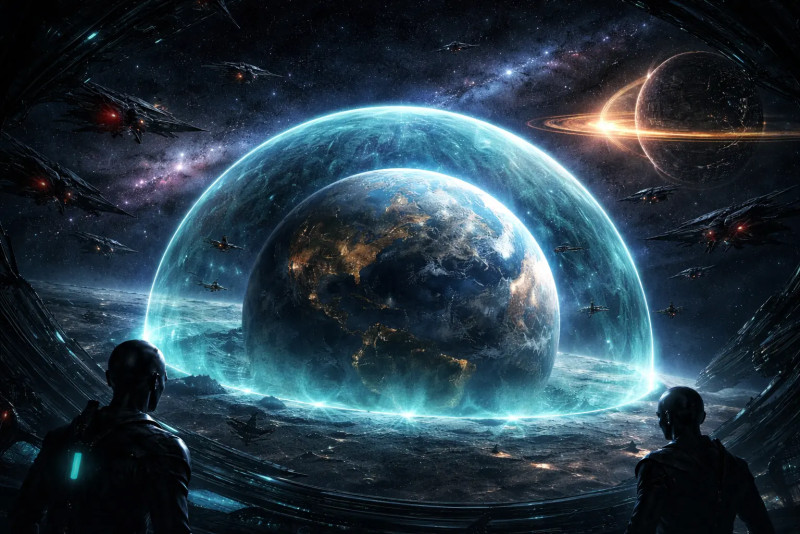
Among the many explanations, one idea stands out for its mystery and quiet power. Some scientists call it the Zoo Hypothesis. It suggests something astonishing. Humanity may not be alone. We may simply be inside a protected cosmic zone, observed but not disturbed, like animals in a galactic wildlife reserve.
This is not just fantasy. It is a real scientific thought experiment discussed for decades. And if true, it would completely change humanity’s understanding of its place in the cosmos.

The Great Silence of the Universe
In the 1950s, physicist Enrico Fermi asked a simple question during a casual discussion with colleagues: Where is everybody?
The question later became known as the Fermi Paradox. The universe is billions of years old. Even with slow space travel, a single advanced civilization could spread across the galaxy in a relatively short cosmic time. If intelligent life is common, the galaxy should already show clear signs of activity.
But it does not. No confirmed alien signals. No visible megastructures. No undeniable spacecraft. Just silence.
This mystery has led to many theories. Some believe intelligent life is extremely rare. Others think civilizations destroy themselves before reaching space. A few suggest alien life may exist in forms we cannot recognize.
The Zoo Hypothesis takes a different path. It proposes that advanced civilizations may be deliberately avoiding contact with us.

Understanding the Zoo Hypothesis
The Zoo Hypothesis was formally introduced in 1973 by astronomer John A. Ball. The idea is simple yet powerful.
Imagine a wildlife reserve on Earth. Animals inside live naturally without outside interference. Scientists observe them quietly from a distance. Humans do not reveal themselves because that would change the animals’ behavior and natural development.
Now imagine Earth as one of those reserves, but on a cosmic scale. According to this hypothesis, advanced alien civilizations may know about us, may even be watching us, but intentionally avoid contact so humanity can evolve naturally.
In this view, Earth is not ignored. It is protected, isolated, and possibly studied.
Why Would Advanced Aliens Stay Silent
If a civilization is millions of years more advanced than humanity, its thinking may be far beyond human understanding. Still, scientists have proposed several possible reasons for non-interference
Non-Interference Ethics
Advanced beings may follow rules similar to conservation principles. Contacting a developing civilization might disrupt its culture, science, and evolution. Allowing natural growth could be seen as respectful and ethical
Scientific Observation
Observing a young intelligent species may provide valuable knowledge about how life develops, how intelligence emerges, and how societies evolve. Humanity could be part of a long-term cosmic study
Security Concerns
Young civilizations can be unstable. War, environmental destruction, and unpredictable behavior may make early contact risky. Advanced observers might prefer to wait until humanity becomes more peaceful and cooperative
Timing of Contact
It is possible that contact is planned only when humanity reaches certain milestones, such as interstellar travel, global unity, or advanced scientific maturity

Could There Be Signs We Are Being Observed
There is no confirmed scientific proof that Earth is inside a cosmic reserve. However, some curious observations keep the idea alive in scientific discussions
Despite decades of searching, radio telescopes have not detected clear artificial signals from intelligent civilizations. The sky appears quiet, even though statistically it reported to be full of habitable worlds
Some researchers have also noted that humanity has not observed obvious large-scale alien engineering projects, even though advanced civilizations could theoretically build massive structures around stars. This absence is sometimes interpreted as deliberate concealment or avoidance
These points are not proof. They are part of an ongoing scientific puzzle

The Role of the Fermi Paradox
The Zoo Hypothesis is one of many answers to the Fermi Paradox. Others include
Civilizations destroy themselves before spreading across the galaxy
Interstellar travel is far harder than expected
Alien life exists but is extremely rare
Advanced beings exist in forms beyond human detection
Humanity is among the first intelligent species to arise
The Zoo Hypothesis stands out because it suggests the silence is not accidental but intentional
Scientific Reality and Caution
It is important to understand that the Zoo Hypothesis is a speculative idea, not established science. There is currently no confirmed evidence that aliens are observing Earth or that a galactic reserve exists
Scientists treat this hypothesis as a useful way to explore possibilities about extraterrestrial intelligence and cosmic silence. It encourages open thinking, but it does not claim proven truth
Astronomy continues to search for real evidence through radio telescopes, planetary exploration, and advanced space missions

What If the Hypothesis Were True
If humanity someday discovered that Earth is part of a protected cosmic zone, the consequences would be enormous
Humanity would no longer see itself as alone in the universe
Religion, philosophy, and science would face deep questions
Global unity might increase as humans realize they share one cosmic identity
The search for knowledge would accelerate dramatically
Such a discovery would mark one of the greatest turning points in human history
Humanity’s Next Steps in the Search
Even without proof of alien observers, the search continues. Scientists are scanning space for radio signals, studying distant planets, and searching for unusual cosmic patterns that might indicate intelligence
The discovery of microbial life elsewhere would already be historic. The discovery of intelligent life would transform civilization forever
Until then, the mystery remains open
Disclaimer
This article discusses a scientific hypothesis and speculative possibility. There is no confirmed scientific evidence that Earth is inside a galactic wildlife reserve or being observed by extraterrestrial civilizations. The Zoo Hypothesis is part of ongoing scientific debate related to the Fermi Paradox and extraterrestrial intelligence research.

Frequently Asked Questions
Is the Zoo Hypothesis proven
No. It is a speculative scientific idea with no confirmed evidence
Who proposed the Zoo Hypothesis
Astronomer John A. Ball proposed it in 1973 as a possible explanation for the silence of the universe
Are scientists searching for alien life
Yes. Programs such as SETI and modern space telescopes continue searching for signs of extraterrestrial intelligence
Why have we not found aliens yet
Possible reasons include rarity of life, technological limits, vast distances, or intentional silence
Could aliens be watching Earth right now
There is no scientific proof of this. It remains a theoretical possibility, not an established fact
Conclusion
The universe still holds countless mysteries. Among them, the idea that Earth could be part of a protected cosmic reserve is one of the most fascinating. Whether true or not, it forces humanity to confront a profound question about its place in the universe
Are we alone, or simply not yet invited into the wider cosmic community
The answer may one day reshape everything we know
References and Source Material
John A. Ball (1973) – The Zoo Hypothesis – Icarus Journal
NASA Astrobiology Institute – Search for Extraterrestrial Intelligence
SETI Institute Research Papers and Observational Data
Enrico Fermi and the Fermi Paradox Historical Scientific Discussions
Drake Equation and Probability Studies on Intelligent Civilizations
https://icarusjournal.org/zoo-hypothesis
https://www.seti.org
https://astrobiology.nasa.gov
https://www.nasa.gov
https://www.britannica.com/science/Fermi-paradox