.png)
.png)
.png)
.png)
Why This Moment Matters
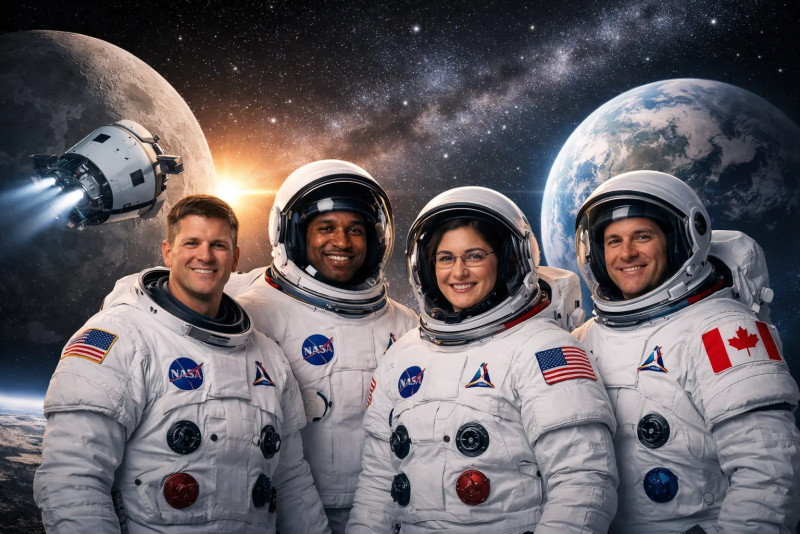
For the first time since 1972, humans are preparing to fly beyond Earth’s orbit. Not robots. Not probes. People. Artemis II is the mission that ends a 50-year pause in deep-space human travel. Four astronauts will climb into NASA’s Orion spacecraft, circle the Moon, and come home—proving that humanity is ready to venture far from Earth again. This is not a rehearsal in low orbit. This is a real journey into deep space, watched by the entire world, and it marks the start of a new lunar era.
A 50-Year Gap Finally Closes
When Apollo 17 returned to Earth in December 1972, no one imagined it would take half a century for humans to go that far again. The reasons were many—politics, budgets, changing priorities—but the result was simple: humans stayed close to home.
Now, NASA is breaking that pattern.
Artemis II is the first crewed mission of the Artemis program, designed to return humans to the Moon and eventually prepare for Mars. Unlike Artemis I, which flew without astronauts, this mission carries four people on a multi-day journey that will take them farther from Earth than any human has traveled since the Apollo era.
This is not about nostalgia. It is about capability.
Meet the Four Humans About to Leave Earth’s Orbit

Reid Wiseman – Mission Commander
A veteran astronaut and former U.S. Navy test pilot, Reid Wiseman leads Artemis II. He has already lived aboard the International Space Station and understands what it means to operate in extreme conditions. As commander, his job is decision-making under pressure—when Earth is just a pale dot outside the window.

Victor Glover – Pilot
Victor Glover brings deep operational experience and calm precision. He previously served on a long-duration space station mission and understands both spacecraft systems and human endurance. On Artemis II, he will help guide Orion through deep space navigation, where small mistakes can have massive consequences.

Christina Koch – Mission Specialist
Christina Koch holds the record for the longest single spaceflight by a woman. Her time in orbit gave scientists crucial data on how the human body handles extended exposure to microgravity and radiation. On Artemis II, she becomes part of the first woman-led deep-space crew in history.

Jeremy Hansen – Mission Specialist (Canada)
Representing the Canadian Space Agency, Jeremy Hansen becomes the first non-American astronaut to travel beyond Earth’s orbit. His presence highlights how modern space exploration is international by design, not competition.

The Orion Spacecraft: Built for the Void
The astronauts will fly aboard the Orion spacecraft, NASA’s most advanced human-rated spacecraft ever built.
Orion is not designed for short trips. It is built for deep space—thick radiation shielding, redundant systems, and life-support technology meant to sustain humans far from Earth’s protection.
Unlike low-Earth orbit missions, Orion cannot rely on quick rescues. Once the spacecraft leaves Earth’s gravity well, the crew is on their own.
That reality changes everything.
What Artemis II Will Actually Do
Artemis II will not land on the Moon. Instead, it will do something equally important.
The mission will:
-
Send humans beyond Earth orbit
-
Perform a lunar flyby
-
Test life-support systems in deep space
-
Validate navigation, communications, and heat shield performance
-
Prove astronauts can safely travel to and from lunar distance
This mission is about confidence—technical and human.
Why This Flight Is Riskier Than It Sounds
Low-Earth orbit missions benefit from Earth’s magnetic field, which protects astronauts from harmful radiation. Artemis II leaves that shield behind.
Deep space brings:
-
Increased radiation exposure
-
Communication delays
-
Psychological stress from isolation
-
No immediate rescue options
Every system must work. Every decision must be right.
According to planetary scientists like Dr. Silvia Sanchez-Martinez, deep-space missions are where engineering meets biology, and where unknowns still outnumber certainties.

The Bigger Artemis Vision
Artemis II is not the end goal. It is the bridge.
Future missions will:
-
Land astronauts near the Moon’s south pole
-
Build long-term lunar infrastructure
-
Test technologies needed for Mars
The Moon is not the destination. It is the training ground.
Data from Artemis II will shape every mission that follows.

Frequently Asked Questions (FAQs)
Is Artemis II going to land on the Moon?
No. Artemis II will fly around the Moon and return to Earth. The landing comes later.
When was the last time humans left Earth’s orbit?
In 1972, during Apollo 17.
Why is this mission so important?
It proves humans can safely travel to deep space again, opening the door to long-term exploration.
Is Artemis II more dangerous than ISS missions?
Yes. Deep space has higher radiation levels and no immediate rescue options.
Will Artemis II help with Mars missions?
Absolutely. Every system tested here is a stepping stone toward Mars.
Disclaimer
Mission timelines are subject to change due to technical checks, safety reviews, and weather conditions. Spaceflight remains inherently risky, and all launch schedules are finalized only after full mission readiness reviews by NASA and its partners.
Final Thoughts: A Line Drawn in History
Artemis II is not just another launch. It is a line drawn across time—connecting Apollo’s final footsteps to a future that reaches far beyond the Moon.
Four humans are about to leave Earth’s neighborhood and remind the world that exploration did not end. It paused.
Now, it continues.
References & Source Proof
-
NASA – Artemis II Mission Overview
https://www.nasa.gov/humans-in-space/artemis-ii/ -
NASA – Orion Spacecraft Deep Space Capabilities
https://www.nasa.gov/orion -
Canadian Space Agency – Jeremy Hansen Artemis II Assignment
https://www.asc-csa.gc.ca/eng/astronauts/ -
NASA Press Release – Artemis II Crew Announcement
https://www.nasa.gov/press-release/