.png)
.png)
.png)
.png)
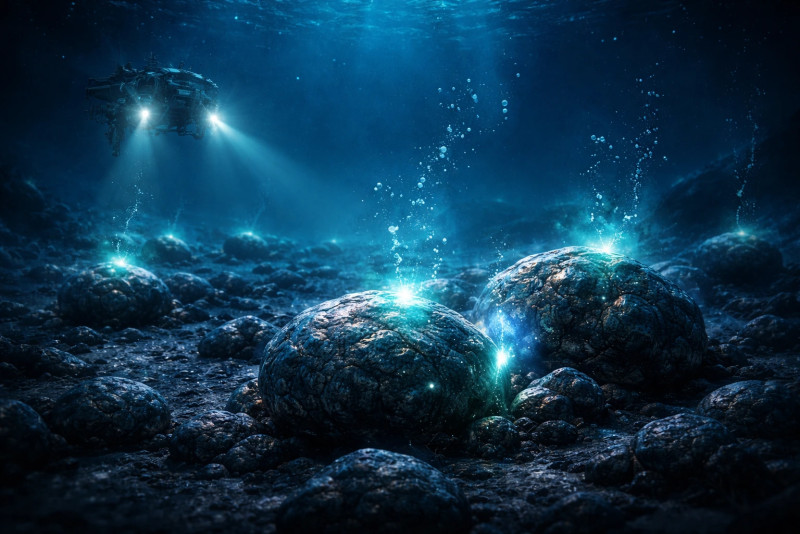
The “Battery Rocks” on the Ocean Floor That Are Breathing Without Sunlight
Deep on the ocean floor, where sunlight has never reached and life was thought to survive only in slow motion, scientists found something that should not exist. Rocks that appear to produce oxygen. No plants. No algae. No light. Just stone, water, and electricity. This discovery, now known as the Sweetman Discovery, has stunned marine biologists and geochemists alike. If confirmed, it could rewrite what we know about oxygen, life on Earth, and even how life might exist on other worlds.

A Discovery That Shouldn’t Be Possible
For decades, scientists believed oxygen production required sunlight. Photosynthesis was considered the only major natural process capable of releasing free oxygen into the environment. That belief is now under serious pressure.
While studying the Clarion–Clipperton Zone in the Pacific Ocean — a vast, dark region thousands of meters below the surface — researchers detected unexpected oxygen levels near clusters of metallic rocks. These rocks were not alive. They were not warm. And yet, oxygen was present where it should not have been.
At first, the data was dismissed as faulty.
Sensors were recalibrated. Equipment was replaced. Measurements were repeated again and again.
The oxygen was still there.

Meet the Sweetman Discovery
The phenomenon is named after Andrew Sweetman, a deep-sea ecologist whose team was studying seabed ecosystems linked to polymetallic nodules — potato-sized rocks rich in manganese, nickel, and cobalt.
These nodules were already known to conduct electricity weakly. What no one expected was that, under the immense pressure of the deep sea, they might behave like natural batteries.
When seawater interacts with the metal-rich surfaces of these rocks, tiny electrical currents may split water molecules — releasing oxygen in the process.
No sunlight required.

Why Scientists Are Calling Them “Battery Rocks”
The term “battery rocks” is not poetic exaggeration. Laboratory tests suggest these nodules can generate small but continuous electric charges.
Here’s the simplified idea:
-
Seawater acts as an electrolyte
-
Metal-rich nodules act as electrodes
-
Pressure and chemistry trigger electrochemical reactions
-
Water molecules split
-
Oxygen is released
This process resembles electrolysis — something humans usually do with wires and power supplies. Nature, it seems, may have been doing it quietly for millions of years.

Why This Shakes Biology at Its Core
Oxygen changed Earth forever. Its rise led to complex life, animals, and eventually humans. The assumption was always the same: oxygen came from sunlight-driven organisms.
If oxygen can be produced without light, then:
-
Life may exist in places once considered impossible
-
Early Earth may have had alternative oxygen sources
-
Deep-sea ecosystems may be more complex than believed
-
Planets without stars could still host oxygen-rich environments
This immediately caught the attention of astrobiologists working with NASA.
Why Space Scientists Are Paying Attention
NASA researchers have long searched for oxygen as a “biosignature” — a sign of life — on distant planets. Observations from James Webb have already detected oxygen-related chemistry in exoplanet atmospheres.
But this discovery complicates the picture.
If oxygen can form without life or sunlight, then oxygen alone may not mean biology. This has direct implications for future missions, including Artemis, which aims to explore environments where sunlight is scarce or absent.

Could These Rocks Support Life Directly?
Some microbes do not need sunlight. They rely on chemical energy instead. If battery rocks are producing oxygen, they could create tiny oases of habitability in otherwise hostile environments.
Scientists are now investigating whether:
-
Microbial life clusters near these nodules
-
Oxygen levels fluctuate with electrical activity
-
These rocks influence local ecosystems
So far, results are cautious. No dramatic life explosions have been confirmed. But subtle biological responses are being observed.
The Mining Question No One Can Ignore
The Clarion–Clipperton Zone is also the world’s most targeted deep-sea mining region. Polymetallic nodules are rich in materials used for electric vehicles and renewable energy technologies.
If these rocks play a role in oxygen production, removing them could alter deep-sea chemistry in ways we don’t yet understand.
Environmental scientists warn that large-scale mining could disrupt processes that took millions of years to develop.
Skepticism Still Exists — And That’s Healthy
Not all scientists agree on the interpretation.
Some argue:
-
The oxygen could be released from sediments, not rocks
-
Microbial activity may still be involved
-
Measurement conditions may exaggerate results
This is why researchers emphasize that the Sweetman Discovery is still under active study. Extraordinary claims require extraordinary evidence, and the scientific community is proceeding carefully.

Why This Discovery Feels So Unsettling
There’s something deeply unsettling about the idea that rocks can “breathe.”
It challenges how we define life. It blurs the line between biology and geology. And it reminds us that Earth still holds secrets beneath its surface — secrets that don’t care what we think is possible.
As marine chemist Dr. Silvia Sanchez-Martinez noted in conference discussions, nature often “solves problems without asking permission from textbooks.”
What Happens Next
Future research will focus on:
-
Long-term oxygen monitoring
-
Controlled lab replication
-
Biological impact studies
-
Deep-sea preservation policies
New submersible missions are already being planned, and funding agencies are watching closely.
This story is far from over.
Important Disclaimer
This article is based on peer-reviewed observations, conference presentations, and early-stage research findings. The mechanisms behind oxygen production in deep-sea polymetallic nodules are still being studied. No final conclusions have been declared by global scientific bodies. Interpretations may evolve as further evidence emerges.
FAQs
What are battery rocks?
Battery rocks are metal-rich nodules on the ocean floor that appear to generate small electrical currents capable of splitting water molecules and releasing oxygen.
Who discovered them?
The phenomenon was identified by researchers led by Andrew Sweetman during deep-sea ecological studies.
Do these rocks mean there is life without sunlight?
Not directly, but they suggest environments without sunlight could still support oxygen-dependent processes.
Why does NASA care about this?
Because oxygen is used to search for life beyond Earth. This discovery changes how oxygen should be interpreted.
Are these rocks alive?
No. They are geological formations, not living organisms.
References / Proof of Source
-
Sweetman, A.K. et al. – Deep-sea oxygen production observations (Nature Geoscience discussions)
-
International Seabed Authority environmental reports
-
NASA Astrobiology Program research summaries
-
Marine Geochemistry Conference Proceedings (2023–2025)
-
Oceanographic Institute field sensor data releases