.png)
.png)
.png)
.png)
By Ronald Kapper
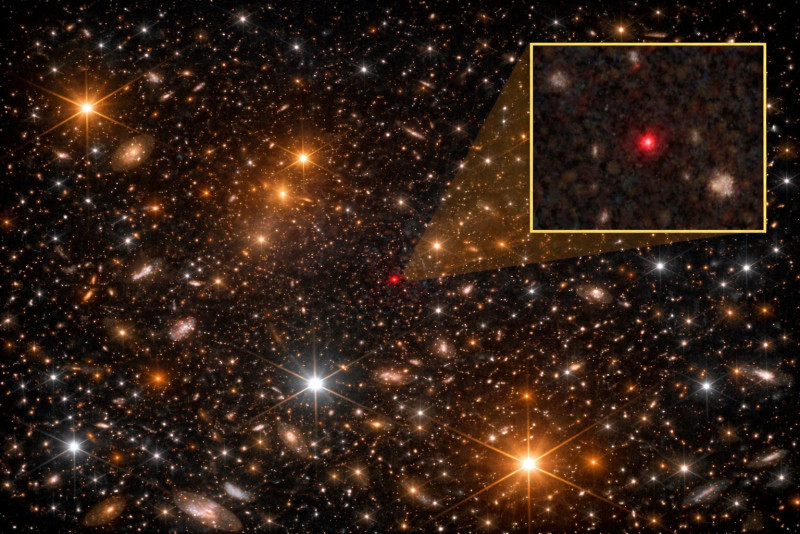
Imagine looking back in time and finding a tiny, furious factory of newborn stars blazing away when the universe was still an infant. That’s what astronomers have done. The James Webb Space Telescope has spotted a galaxy nicknamed MoM-z14. It sits a mere 280 million years after the Big Bang — a blink in cosmic terms — and it’s packed with surprises.
This is not your textbook, slow-growing early galaxy. MoM-z14 is shockingly bright for its size, extremely compact, and shows chemical fingerprints that hint at fierce, rapid star birth. It’s being called a “toddler” galaxy because it already looks mature in ways we didn’t expect so soon after the universe began. This single find is pushing scientists to rethink how quickly the first structures lit up the cosmos.

What exactly did Webb see?
Webb used its infrared cameras and spectrograph to spot MoM-z14 and measure its redshift — the stretching of light by cosmic expansion. Spectroscopy gives a precise redshift: z ≈ 14.44, which places the galaxy about 280 million years after the Big Bang. Put simply: we are seeing light that set out when the universe was tiny and raw. The detection includes a clear break in the spectrum and several emission lines that back up the distance measurement.
The object is tiny — just a few hundred light-years across — yet it shines like a much larger system. It also shows unusually strong nitrogen emission, which is a big clue about what kinds of stars and star clusters formed early on. Those chemical signs look strangely similar to patterns seen in ancient star clusters inside our own galaxy. If that link holds, we may be seeing the birth of dense star clusters that later evolve into things we recognize today.
Why this breaks the old story
Before Webb, models predicted that galaxies this early should be rare, faint, and small. Instead, Webb keeps finding bright, surprisingly massive objects at extreme distances. MoM-z14 is one of a growing list of “early troublemakers” that arrive too early and shine too brightly for the old calculations. If many such galaxies exist, our picture of the early universe needs repair. The debate now: did galaxy builders work faster back then, or are our models missing a key ingredient?

Here are the main tensions MoM-z14 exposes:
-
Number density vs. theory: Surveys find more bright early galaxies than expected. If these counts hold up, something in our simulations is off.
-
Chemical maturity too soon: The nitrogen hints suggest early enrichment — heavy elements appearing earlier than models predict. That points to very efficient, massive stars forming and dying in short order.
-
Compact but luminous: MoM-z14 is tiny but intense. That combination challenges size-luminosity scaling relations used in early-universe modeling.
How did scientists confirm the distance?
The team first flagged the object in deep images. Then Webb’s near-infrared spectrograph (NIRSpec) checked the light carefully. The spectrum shows a sharp Lyman-break — the hallmark of extreme distance — plus detections of several ultraviolet emission lines that line up at z ≈ 14.44. Multiple lines and the break together make the distance measurement robust. In short: this is not a mirror trick or a fuzzy guess — it’s spectroscopic confirmation.

What could explain MoM-z14’s odd traits?
Scientists are exploring several ideas:
-
Rapid starbursts in tiny volumes. If a small region forms stars extremely fast, it can shine like a larger galaxy.
-
Dense star clusters. The chemical pattern resembles ancient globular clusters, hinting these tiny systems might be proto-clusters forming intensely.
-
Hidden black hole? Some early bright sources hide an active black hole that powers the light. But MoM-z14’s compactness and spectrum suggest stars, not a dominant black hole, are responsible.
None of these is a settled answer yet. The discovery opens new lines of research and more Webb time will be spent studying MoM-z14’s neighbors, gas, and internal motion.
What this means for the Big Bang story
The Big Bang remains the foundation: the universe expanded from an extremely hot, dense state. But the timeline of how quickly the first galaxies formed — and how fast they heated and enriched their surroundings — may be shorter than we thought. If bright, compact galaxies were common 200–400 million years after the Big Bang, the era of cosmic dawn became chaotic and intense earlier than models predicted. That changes how we think about reionization (the cosmic switch that made the universe transparent to ultraviolet light) and the seeds of later galaxies like our own.

Why scientists are both excited and cautious
Excitement comes from seeing the dawn with fresh eyes — Webb was built for this. Caution is scientific habit: extraordinary claims need confirming. Early results sometimes shift as more data arrive, and samples across the sky must be compared to rule out oddities or observational bias. Still, with spectroscopic confirmation in hand, MoM-z14 is a heavyweight result that demands new thinking.
FAQs
Q: How far away is MoM-z14 in light-years?
A: Light from MoM-z14 has traveled about 13.5 billion years to reach us. We see it as it was ~280 million years after the Big Bang.
Q: Is MoM-z14 the farthest galaxy ever seen?
A: Right now, MoM-z14 is among the most distant spectroscopically confirmed galaxies. Webb has pushed the record several times, and MoM-z14 currently sits at the frontier.
Q: Could this be an error?
A: The redshift is supported by multiple spectral features, making a measurement error unlikely. Still, more observations will probe its environment and rule out exotic alternatives.
Q: Will this change cosmology textbooks?
A: It will not overthrow the Big Bang itself, but it will force refinements in models of early galaxy formation and star formation efficiency. Expect updates to how we model the cosmic dawn.
Q: What now — more Webb time or new telescopes?
A: Both. Webb will follow up, and future missions like the Nancy Grace Roman Space Telescope and next-generation ground observatories will expand the census. The more eyes we have, the clearer the picture becomes.
Disclaimer
This article summarizes scientific findings based on public telescope data and preprints released by research teams. Science evolves with new data; details may update as researchers publish more results. The goal here is clear explanation and accuracy, not sensationalism.
Proof & source :
-
“A Cosmic Miracle: A Remarkably Luminous Galaxy at $z_{\rm{spec}}=14.44$ Confirmed with JWST” — arXiv preprint (survey results and spectral confirmation).
-
NASA Science Release: “Webb pushes boundaries of observable universe closer to Big Bang” (NASA science assets and images).
-
LiveScience coverage summarizing discovery and context.
-
Phys.org summary and background on implications for early galaxy counts.