.png)
.png)
.png)
.png)
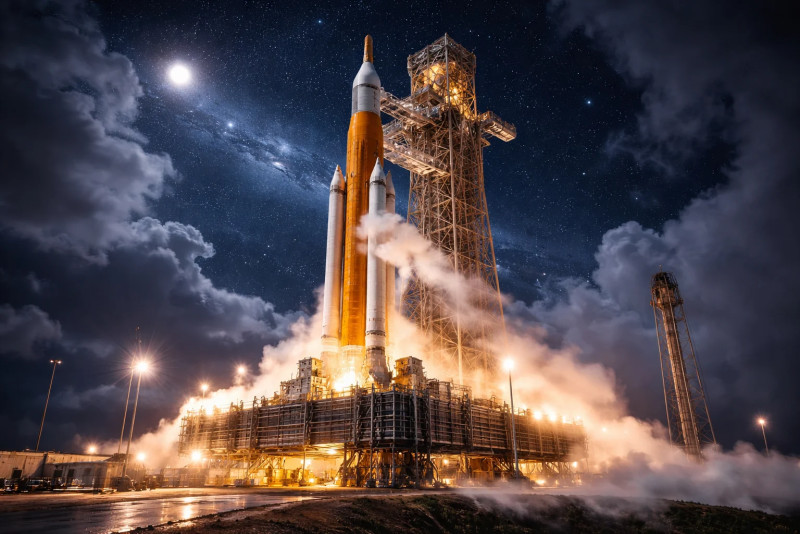
Tonight, as the clock ticks toward 9:00 PM EST on February 2, 2026, all eyes are on Launch Pad 39B at the Kennedy Space Center. NASA is about to pump over 700,000 gallons of "rocket juice"—super-chilled liquid oxygen and hydrogen—into the veins of the Space Launch System (SLS).
This isn't the actual launch. It’s the Wet Dress Rehearsal (WDR). But don't let the word "rehearsal" fool you. For the crew of Artemis II—Reid Wiseman, Victor Glover, Christina Koch, and Jeremy Hansen—this is the moment they find out if their ride to the Moon is actually safe.
But what if something goes wrong tonight? What if a sensor blinks red or a valve freezes shut? The scientific and geopolitical stakes are higher than most people realize.

The 9 PM Pressure Cooker: Why Today is Different
Florida is currently shivering under a rare arctic outbreak. For a rocket that relies on seals and O-rings, "unusual cold" is a phrase that makes NASA engineers sweat. We all remember the lessons of the past; cold temperatures can make flexible parts brittle.
NASA has already pushed this test back from the weekend to today, Monday, Feb 2, specifically to wait for better conditions. If the "simulated" countdown hits a snag at 9 PM, it’s not just a delay—it’s a data disaster.

The "What If" Scenario: A Failed Fueling
If a leak is detected tonight—a common "ghost" for the SLS during Artemis I—the mission doesn't just pause. It enters a scientific "limbo."
-
The "Scrub" Physics: Draining 700,000 gallons of cryogenic fuel is a violent process for the hardware. The tanks literally shrink and expand. If NASA has to "recycle" the clock or drain the tanks due to a failure today, the structural fatigue on the SLS core stage increases.
-
The Launch Window Collapse: We are currently targeting a February 8 launch. However, the lunar "windows" are narrow. If tonight's test fails, we lose the Feb 8, 10, and 11 opportunities. We might not see a human-crewed flight until late March or April 2026.
-
The Scientific Blindspot: The primary goal tonight is to see how the Orion spacecraft's batteries and heaters hold up under the "wet" conditions. A failure means we go into the actual launch with "untested" data on how the crew's life support reacts to the thermal shock of fueling.

Why This Matters for India
You might wonder, "Why does a test in Florida matter for science fans in India?"
The Artemis Accords, which India signed, mean that the success of Artemis II is a green light for global lunar science. Artemis II is the first time humans will leave Earth's orbit since 1972. If this fueling test fails and pushes the mission back by months, the secondary science payloads—including deep-space radiation experiments that benefit global space medicine—stay grounded.
Furthermore, ISRO’s own moon plans are increasingly synchronized with global lunar traffic. A delay in Artemis II ripples through the international schedule for lunar orbiters and future gateway modules.
The Science of the "Wet" Dress Rehearsal
The SLS is essentially a giant thermos. Liquid Hydrogen (LH2) is kept at -423°F, while Liquid Oxygen (LOX) sits at -294°F.
-
The Leak Threat: Hydrogen molecules are the smallest in the universe. They find every microscopic gap. During the 9 PM countdown, engineers will be looking for "Quick Disconnect" leaks—the exact problem that haunted the 2022 attempts.
-
The Battery Charge: Tonight is also the first time the Orion flight batteries will be fully integrated into a fueled countdown. If the power draw spikes unexpectedly, the mission is a "no-go."

Frequently Asked Questions (FAQs)
1. Why is it called a "Wet" Dress Rehearsal?
It is "wet" because the rocket is actually filled with liquid propellants. A "dry" rehearsal involves the countdown without the dangerous, super-chilled fuel.
2. Will there be astronauts on board tonight?
No. The Artemis II crew is currently in quarantine in Houston. They will watch the data closely, but they won't board the Orion capsule until the actual launch day (earliest Feb 8).
3. What happens if they find a leak at 9 PM?
If it's a minor leak, they may try to "seat" the seals by changing the pressure. If it’s a "Large Leak," the test is scrubbed, the fuel is drained, and the rocket may have to be rolled back to the Vehicle Assembly Building (VAB).
4. Is the cold weather in Florida really that dangerous?
Yes. Cryogenic fuels are already extreme. When the ambient air is also near freezing, it changes how the metal and rubber components on the ground equipment behave. NASA has strict "Commit Criteria" for temperature.
The Verdict: A High-Stakes Game of Physics
As we approach the 9 PM countdown tonight, we aren't just watching a fueling test. We are watching the most complex machine ever built attempt to handle the most volatile substances on Earth in a "rare arctic" environment.
If it fails, it’s a setback for human history. If it succeeds, we are exactly six days away from seeing humans head back to the Moon.
Proof of Source & References
-
NASA Artemis Blog (Feb 1, 2026): Countdown Begins for Artemis II Wet Dress Rehearsal
-
Space.com (Feb 1, 2026): Artemis 2 moon rocket powered up for critical fueling test
-
NASA Mission Update: Artemis II Launch Opportunities and Weather Constraints
Disclaimer: This article provides a scientific "What If" analysis based on real-time mission parameters provided by NASA as of February 2, 2026. Space flight is inherently unpredictable.