.png)
.png)
.png)
.png)
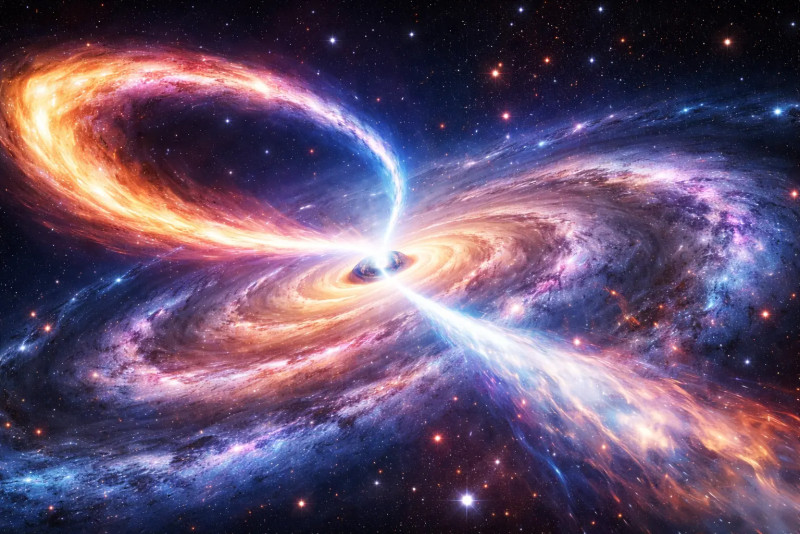
The Cosmic Fire Hose: How a Wobbling Black Hole Jet Is Rewriting the History of the Universe
For decades, we’ve pictured supermassive black holes as stationary monsters at the center of galaxies—quietly devouring stars and occasionally spitting out straight, laser-like beams of energy. But a brand-new discovery has just shattered that peaceful image.
Astronomers have spotted a gigantic, wobbling black hole jet in a galaxy known as VV 340a. This isn't just a tiny flicker; it’s a galaxy-wide "fire hose" of plasma that is swinging around wildly, blasting everything in its path. And here is the kicker: this discovery might completely change our Galaxy Evolution Theory.
If you think space is just a dark, empty void, buckle up. This find shows that our universe is much more chaotic—and much more connected—than we ever dared to imagine.

The Discovery: A Spinning Top in the Deep Dark
Using a powerhouse team of telescopes—including the James Webb Space Telescope (JWST), the Keck Observatory, and the Very Large Array (VLA)—scientists caught something they weren’t expecting. In the heart of the spiral galaxy VV 340a, a supermassive black hole is launching jets of plasma that don’t travel in a straight line.
Instead, they precess.
Think of a spinning top. When it starts to slow down, it doesn't just fall over; it begins to wobble in a circular motion. This is exactly what’s happening at the center of VV 340a. The black hole's jet is sweeping across the galaxy in a massive, helical "S-shape," spraying superheated gas across thousands of light-years.

Why Is It Wobbling?
Scientists believe this cosmic wobble (technically called jet precession) happens because the black hole is tilted. When the disk of gas and dust feeding the black hole is misaligned with the black hole’s own spin, gravity starts a tug-of-war. This forces the jet to swing around like a loose garden hose, splashing energy across the entire galaxy instead of just one spot.
Why This Flips Galaxy Evolution Theory on Its Head
Before this discovery, the "Standard Model" of how galaxies grow was pretty straightforward. We thought black holes only really affected their immediate neighborhood. We also thought these powerful, precessing jets only lived in old, "dead" elliptical galaxies that had already stopped making stars.

VV 340a changes all of that.
-
It’s a "Young" Galaxy: VV 340a is a spiral galaxy, much like our own Milky Way. Seeing a jet this powerful and this "wobbly" in a star-forming galaxy is a total shock.
-
The "Kill Switch" Effect: As the jet wobbles, it acts like a giant blender. It heats up the cold gas that galaxies need to create new stars. By "stirring the pot," the black hole effectively shuts down the galaxy's ability to give birth to new suns.
-
Galaxy-Wide Reach: Because the jet is wobbling, it hits way more territory than a straight jet would. It’s not just a surgical strike; it’s a carpet-bombing of energy that can reshape an entire galaxy in a relatively short cosmic timeframe.

The "Smoking Gun" Data
The data behind this is staggering. The VLA radio images revealed the "S-shaped" plasma trail, while the James Webb Space Telescope detected "coronal gas"—plasma heated to millions of degrees—stretching out over 20,000 light-years.
To put that in perspective, that’s about one-fifth the size of our entire Milky Way galaxy being blasted by a single black hole’s "exhaust."
"This is the first time we've seen a precessing, kiloparsec-scale radio jet driving such a massive outflow in a disk galaxy," says the research team.
The jet is pushing out gas at a rate equivalent to 20 suns every single year. At that speed, the galaxy will soon run out of the "fuel" it needs to grow, leading to an early cosmic "death."
What This Means for the Milky Way
Could this happen to us? Our own black hole, Sagittarius A*, is pretty quiet right now. But VV 340a is currently merging with another galaxy. This collision is likely what "turned on" the black hole and caused the wobble.
Since the Milky Way is on a collision course with the Andromeda Galaxy (don't worry, it's a few billion years away), this discovery gives us a terrifyingly beautiful preview of our own future. It suggests that our "quiet" home could one day host a wobbling fire hose that reshapes our entire neighborhood.
Frequently Asked Questions (FAQs)
1. What is a "wobbling" black hole jet?
It’s a phenomenon called precession. It happens when the axis of a black hole’s jet rotates in a cone-like shape, caused by a misalignment between the black hole's spin and the material falling into it.
2. How does this affect galaxy evolution?
Usually, galaxies grow by turning cold gas into stars. These wobbling jets heat that gas up or blow it out of the galaxy entirely, essentially "starving" the galaxy and stopping it from growing.
3. Which galaxy was this found in?
The primary discovery was made in VV 340a, a spiral galaxy that is currently in the early stages of merging with its partner, VV 340b (together known as the "Great Exclamation Point").
4. Is this dangerous for Earth?
Not at all! VV 340a is millions of light-years away. Even if our own black hole started wobbling, the timescales are so vast (millions of years) that it wouldn't affect our daily lives.
Final Thoughts
The discovery of the wobbling jet in VV 340a is a reminder that we are still "newbies" when it comes to understanding the universe. Space isn't a static painting; it's a living, breathing, and sometimes violent masterpiece. By watching these cosmic fire hoses in action, we’re finally starting to understand how the biggest objects in the universe control the fate of everything around them.
Disclaimer: The findings discussed in this article are based on recent peer-reviewed studies from the W. M. Keck Observatory, IPAC/Caltech, and NASA’s James Webb Space Telescope data as of 2024-2026. Astronomy is a rapidly evolving field; new data may further refine these theories.
References and Sources
-
IPAC/Caltech: Astronomers Discover the First Galaxy-wide Wobbling Black Hole Jet
-
ScienceDaily: A wobbling black hole jet is stripping a galaxy of star-forming gas
-
W. M. Keck Observatory: Official Release on VV 340a Galactic Outflows