.png)
.png)
.png)
.png)
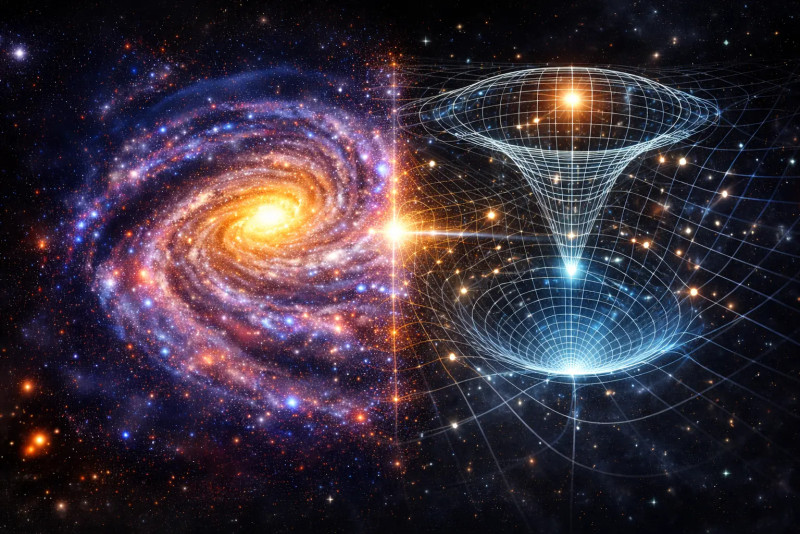
The Ghost in the Machine: Why We Might Be Wrong About Dark Matter
For nearly a century, we’ve told ourselves a specific story about the universe. It’s a ghost story, really. We look at galaxies spinning and notice they’re moving much faster than they should. According to the laws of gravity we learned in school, they should fly apart like a broken merry-go-round. To fix the math, scientists "invented" dark matter—an invisible, untouchable substance that supposedly makes up 85% of everything.
But here’s the kicker: after decades of hunting, we haven't found a single grain of it.
As we move through 2026, the scientific community is buzzing. New data from underground labs and deep-space telescopes are doing something unexpected. Instead of finding the "ghost," they are suggesting that the ghost might not be there at all. We might just be looking at gravity through a cracked lens.

The "Empty" Detectors: A Crisis of Silence
The biggest headache for traditional physics right now is the LUX-ZEPLIN (LZ) experiment. Buried a mile underground in an old gold mine in South Dakota, this massive tank of liquid xenon is the most sensitive dark matter trap ever built.
In late 2025 and early 2026, the LZ team released their most comprehensive data yet. The result? Nothing. While the detector was sensitive enough to pick up tiny solar neutrinos—a massive technical win—it didn't see a single "WIMP" (Weakly Interacting Massive Particle), which was the primary candidate for dark matter. When your best trap comes up empty after years of waiting, you start to wonder if you’re hunting a creature that doesn't exist.
Is Spacetime Just "Wobbly"?
While the experimentalists are coming up empty-handed, the theorists are getting wild. One of the most talked-about ideas in 2026 comes from Professor Jonathan Oppenheim at University College London. He suggests that we don't need dark matter if we accept that spacetime is "wobbly."
Instead of a smooth fabric, Oppenheim’s theory treats spacetime as something that fluctuates randomly. These tiny, violent "jitters" in the background of the universe could provide the extra energy needed to keep galaxies together. If he’s right, we don't need millions of tons of invisible particles; we just need to accept that the universe is a lot more chaotic at its core than Einstein ever imagined.
Key Insight: If "wobbly" spacetime is real, it would mean the laws of physics aren't perfectly predictable. It would be a "breakdown" of classical physics, but it would solve the dark matter mystery in one go.

Changing the Rules: The Rise of Modified Gravity
If dark matter isn't a thing, then our understanding of gravity must be wrong. This is where MOND (Modified Newtonian Dynamics) comes in. For years, MOND was the "fringe" theory, but 2026 is seeing it move into the spotlight.
The University of Ottawa Breakthrough
In a bombshell paper from late 2025, researchers at the University of Ottawa proposed a new model where the fundamental constants of nature—the "rules" of the game—actually change over time.
Professor Rajendra Gupta’s research suggests that as the universe ages, the strength of forces like gravity might evolve. This "weakening" of forces creates an illusion. At the scale of a whole galaxy, it looks like there’s extra gravity (dark matter) holding things together, but it’s actually just a side effect of how gravity behaves over billions of years.
Why This Matters for You
This isn't just "nerd talk." If dark matter is an illusion, it means:
-
Billions of dollars spent on particle detectors might have been targeting a mirage.
-
Our timeline of the Big Bang is likely wrong.
-
We need a "New Physics" that bridges the gap between the very small (quantum) and the very large (gravity).
What’s Next? The 2026 Horizon
We aren't throwing out the textbooks just yet. While experiments like LZ haven't found particles, other observations, like the Cosmic Microwave Background (the "afterglow" of the Big Bang), still point toward something being out there.
The next two years will be the "Make or Break" era. With the Jiangmen Underground Neutrino Observatory (JUNO) coming online and new data from the James Webb Space Telescope looking at the very first galaxies, we are about to get an answer.
Are we living in a universe filled with invisible "dark" particles? Or are we living in a universe where gravity is far more mysterious than we ever dared to dream?

Frequently Asked Questions
- Does this mean dark matter definitely doesn't exist?
- Not exactly. It means the simplest version of dark matter—particles called WIMPs—is likely not real. Scientists are now looking for "lighter" particles like axions or considering that "dark matter" is actually just a misunderstanding of how gravity works.
2. Why was dark matter invented in the first place?
To explain why galaxies don't fly apart. Visible stars don't have enough mass to provide the gravity needed to hold a galaxy together at high speeds. "Dark matter" was the placeholder for that missing gravity.
3. Is Einstein's theory of General Relativity wrong?
"Wrong" is a strong word. It’s more likely "incomplete." Just as Newton’s laws work on Earth but fail near a black hole, Einstein’s laws might work in our solar system but need "patching" when we look at the entire universe.
4. What is the most likely alternative to dark matter?
The leading alternatives are Modified Newtonian Dynamics (MOND), which changes the math of gravity at low accelerations, and f(R) gravity, which suggests the geometry of space itself provides the extra "pull."
Sources & References
-
ScienceDaily: New Research Challenges the Cold Dark Matter Assumption (2026)
-
UKRI: LUX-ZEPLIN Sets World Best in Hunt for Dark Matter (Dec 2025)
-
The Guardian: Controversial New Theory of Gravity Rules Out Dark Matter
-
University of Ottawa: New Equation May Explain Universe Without Dark Matter
Disclaimer: The field of theoretical physics is rapidly evolving. The "Modified Gravity" theories mentioned are subjects of intense debate and peer review. This article is for informational purposes and represents the cutting edge of 2026 scientific discourse.