.png)
.png)
.png)
.png)
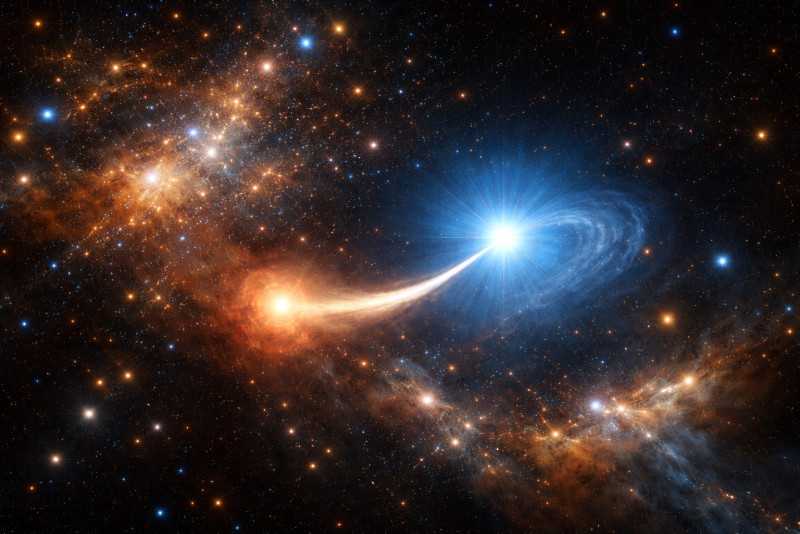
Some stars cheat death — they quietly rob a neighbor of gas and youth, then shine on as if time had no power over them; the James Webb Space Telescope has finally shown us how.
The scene: a stellar horror story, but true
Look up at the night sky and imagine a star that should be old, dull, and red suddenly glowing vivid blue — younger in every way except age. Astronomers have long called those oddballs “vampire stars” or, more technically, blue stragglers. For decades the mystery was simple and monstrous: how could a star in an ancient cluster appear to have rewound its clock and become hot and bright all over again? New observations from Webb give the clearest answer yet: thieves in the night, binary companions that hand over their fuel and life.

What Webb actually saw — the smoking gun
Webb’s powerful infrared vision allowed researchers to peer deep into crowded star clusters and detect the faint signatures of companion objects and the telltale flow of matter between them. Instead of vague hints, Webb captured spectra and images showing material transfer, heated disks, and white-dwarf partners — the exact apparatus you need for a star to siphon mass and reignite surface fusion. Those observations make the mass-transfer model the leading explanation for many blue stragglers.

The anatomy of a stellar vampire — step by step
-
Birth as a normal binary: Two stars form together, orbiting a common center.
-
One ages faster: The more massive star expands into a red giant first.
-
Close orbit — the trick: If the stars are close enough, the giant’s outer layers spill toward the companion.
-
Mass transfer: Material arcs or flows to the companion, forming an accretion disk or stream.
-
Rebirth: The receiving star gains mass and heat; it looks younger, bluer, and brighter — a “vampire” that stole youth from its partner.
Most blue stragglers in clusters now show fingerprints of one of these stages; Webb’s data supplies the missing frames in that cosmic movie.

Why this matters — beyond the cool factor
This isn’t just a flashy astrophotograph. Understanding mass transfer changes how we read the life stories of star clusters, how we measure ages of stellar populations, and how we expect binaries to behave as they approach explosive ends — novae, type Ia supernovae, and mergers that might spawn gravitational-wave events. In short: knowing which stars have been “cheating” prevents major mistakes in cosmic bookkeeping.
The darker variants — violent feeding and explosions
Not all mass transfer is quiet. When the donor dumps matter rapidly onto a compact companion, the result can be violent: thermonuclear flashes, novae, or runaway detonations. Some systems Webb examined show signs of both slow, gentle siphoning and episodes of furious feeding that light up in ultraviolet or X-rays — clues to dramatic endings. Observatories across the spectrum — from X-ray satellites to optical and infrared telescopes — are needed to tell the full life-and-death story.

How Webb’s infrared edge made the difference
Infrared light slips through dust and crowded star fields where optical telescopes struggle. Webb’s instruments measure subtle changes in temperature and composition that reveal which star is gaining mass and which is losing it. That’s how astronomers could separate a bright blue straggler from its hidden white-dwarf donor or a faint, stripped remnant. Those details were often invisible until Webb.
A careful, responsible frame — the scientific caution
Science thrives on proof, not sensational names. “Vampire star” makes a gripping headline, but the work rests on spectra, models, and repeated measurements. Webb’s results strongly support mass transfer as a common route to rejuvenation, but not every blue straggler is identical — collisions in crowded cluster cores and stellar mergers remain valid paths in some cases. Researchers are cautious, testing models across many clusters and many wavelengths before declaring a single universal cause.

FAQ — quick, plain answers
Q: Are “vampire stars” alive or dangerous to us?
A: No. These are ordinary stars in binary systems. Their “vampirism” happens across light-years and has no effect on Earth.
Q: Can any star become a vampire?
A: Only stars in close binaries where one can feed off the other. Lone stars can’t do this.
Q: Will the victim star always die?
A: Often the donor loses much mass and becomes a stripped, dim object — a white dwarf — but the exact outcome depends on masses and timing.
Q: Could mass transfer cause a supernova?
A: Yes. If enough mass lands on a white dwarf, it can trigger a thermonuclear explosion (type Ia supernova) or other explosive events.
Q: Did Webb prove mass transfer for all blue stragglers?
A: Webb made decisive detections in many cases, but astronomy is careful: mass transfer explains many blue stragglers, while collisions or mergers explain others. More observations will refine the fraction.
Final take — the universe keeps surprising us
The image of a star stealing life from a neighbor is more than a spooky metaphor — it’s a real astrophysical process that rewrites a star’s biography. Webb gave scientists the evidence they needed to watch the theft in action. That makes our view of star clusters richer and more honest: not every bright, youthful-looking star truly earned its glow by age alone. We now know some have been secretly stealing time.
Scientific caution, ethics, and a short disclaimer
This article summarizes peer-reviewed research and recent press releases and news reports. The term “vampire star” is a popular nickname; scientists use precise language (mass transfer, blue straggler, accretion) in research papers. Readers interested in raw data and detailed papers should consult the original research and observatory releases linked below.
References & proof (sources used)
(These are included so you can check the original reporting and press material. No links were inserted inside paragraphs per request.)
-
LiveScience — “James Webb telescope solves mystery of 'forever young' vampire stars from the dawn of time.” (Jan 31, 2026).
URL: https://www.livescience.com/space/astronomy/james-webb-telescope-solves-mystery-of-forever-young-vampire-stars-from-the-dawn-of-time -
Space Telescope Science Institute (STScI) — artist image and technical notes on mass-transfer binaries.
URL: https://www.stsci.edu/contents/media/images/2012/33/3084-Image -
European Southern Observatory (ESO) — “Vampire Star Reveals its Secrets” (press release on mass transfer observations).
URL: https://www.eso.org/public/news/eso1148/ -
Indian Institute of Astrophysics / PIB coverage — AstroSat discovery of vampire star in M67 (context on earlier detections and methods).
URL: https://www.pib.gov.in/PressReleasePage.aspx?PRID=2040159 -
Space.com — report on interacting “vampire” binary systems and high-energy observations (broader context).
URL: https://www.space.com/the-universe/stars/einstein-probes-x-ray-vision-discovers-an-impossible-pair-of-vampire-stars