.png)
.png)
.png)
.png)
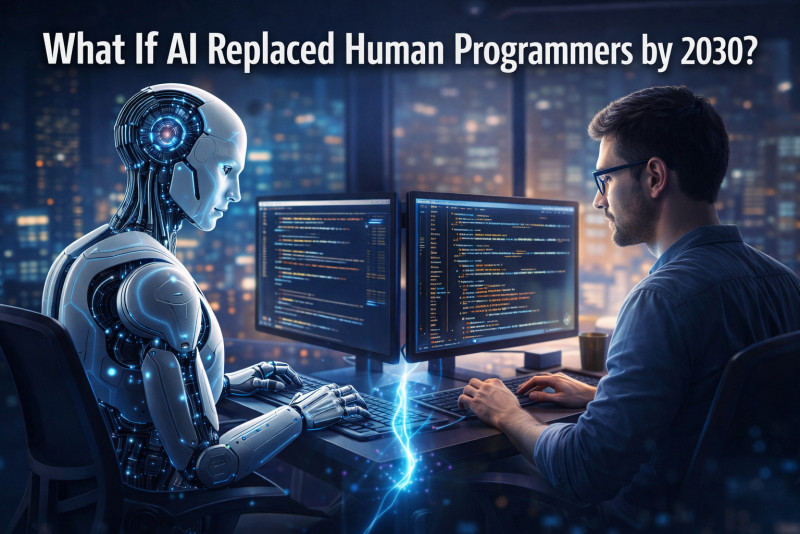
The tech world is currently obsessed with a single, spine-chilling question: Is the era of the human programmer coming to an end? If you listen to the heavyweights in Silicon Valley, the answer sounds like a countdown. We’ve gone from "AI will help you write code" to "AI will replace the need for coding entirely" in what feels like a heartbeat. With 2030 looming on the horizon, the anxiety in coffee shops from San Francisco to Bangalore is palpable.
But before you trade your mechanical keyboard for a tractor or a paintbrush, let’s peel back the layers of this digital revolution. Is this the end of a profession, or the birth of a superpower?
The 2030 Deadline: Why Everyone Is Panicking
The year 2030 has become a mythical milestone for Artificial Intelligence. Experts like Roman Yampolskiy have suggested that by this point, hiring a human for digital tasks might become "uneconomical." When a $20 monthly subscription can theoretically do the work of a $150,000-a-year engineer, the math looks grim for the human side of the equation.
We are already seeing the first cracks. In early 2026, Nvidia CEO Jensen Huang made waves by telling his engineers that his goal is for them to spend zero percent of their time writing code. His logic? Coding is just a "task." The "purpose" is solving problems. If AI can handle the syntax, humans can focus on the soul of the software.
The Rise of the AI "Teammate"
We’ve moved past simple autocomplete tools. We are now in the age of Agentic AI. Tools like Devin and upgraded versions of Cursor aren't just suggesting the next line of code; they are spinning up their own environments, debugging their own errors, and even taking on real jobs on platforms like Upwork.
In 2025, companies like Nubank reported saving thousands of engineering hours by letting AI agents handle massive code migrations that would have previously taken years. When the "grunt work" vanishes, the traditional entry-level "Junior Developer" role starts to look like an endangered species.
Why the "Death of Programming" Might Be Greatly Exaggerated
Despite the doom and gloom, there is a massive "but" in this story. If you’ve ever tried to get an AI to build a complex, multi-layered system, you know the frustration. It often feels like managing a brilliant but incredibly eccentric intern who occasionally hallucinates and forgets the laws of physics.
1. The "Spaghetti Code" Trap
AI is fantastic at generating snippets, but it struggles with architecture. Left to its own devices, AI can create "vibe code"—software that looks like it works on the surface but has a foundation made of sand. Experienced developers are already warning about a future "Code Collapse" where companies that over-rely on AI-generated slop find their systems crumbling under technical debt.
2. The Radiology Lesson
Jensen Huang often points to radiologists as a parallel. When AI began reading medical scans, people predicted the end of radiologists. Instead, the demand for them skyrocketed. Why? Because the AI handled the routine scanning, allowing doctors to focus on deeper diagnosis and patient care. Programming is likely to follow the same path. We won't be "coders" anymore; we will be Software Architects and System Designers.
3. The Security Nightmare
AI-generated code is notorious for sneaking in security vulnerabilities. In 2026, reports surfaced of AI agents accidentally installing malware via non-deterministic package managers. You still need a human "pilot" to ensure the ship isn't heading straight for an iceberg.
The New Hierarchy: Who Survives 2030?
The job market of 2030 won't be empty, but it will be unrecognizable. The divide won't be between "AI vs. Human," but between "AI-Powered Humans vs. Everyone Else."
-
The Prompt Architect: People who can talk to machines with precision.
-
The AI Auditor: Specialists who vet and secure AI-generated logic.
-
The Domain Expert: Engineers who understand why a bank needs a specific ledger system, not just how to write the loop for it.
What Happens to the "Junior" Developer?
This is the most controversial part. If AI does the "easy stuff," how do new people learn? The industry is currently grappling with this "learning paradox." The winners in 2030 will be those who use AI to learn faster, not those who use it to think less.
The Verdict: Will You Be Replaced?
If your job is strictly "translating requirements into C++ syntax," then yes, the clock is ticking. But if your job is solving problems using technology, you are about to enter a golden age.
By 2030, a single person will be able to build what used to require a team of fifty. We aren't losing programmers; we are gaining creators. The "barrier to entry" for building the next big thing is being demolished.
Frequently Asked Questions (FAQs)
Q: Should I still learn to code in 2026?
A: Absolutely. You need to understand the fundamentals (data structures, logic, systems) to verify if the AI is giving you garbage. It’s like learning math even though we have calculators—you need to know if the answer makes sense.
Q: Will salaries for programmers drop?
A: For basic "coding" tasks, yes. For high-level system design and AI orchestration, salaries are expected to stay high or even increase as productivity explodes.
Q: Which languages are safest from AI?
A: It’s less about the language and more about the complexity. Deep systems languages (C++, Rust) and legacy system maintenance (COBOL, Mainframe) remain high-human-touch areas, as does anything involving cutting-edge R&D.
Q: Is AI writing 100% of code yet?
A: No. While companies like Google report that over 30% of their new code is AI-assisted, human oversight is still required for almost all production-level deployments to ensure security and stability.
Disclaimer: The predictions in this article are based on current market trends, expert interviews, and technological trajectories as of early 2026. The AI field moves rapidly, and "Black Swan" events could significantly alter these timelines.
References & Sources: