.png)
.png)
.png)
.png)
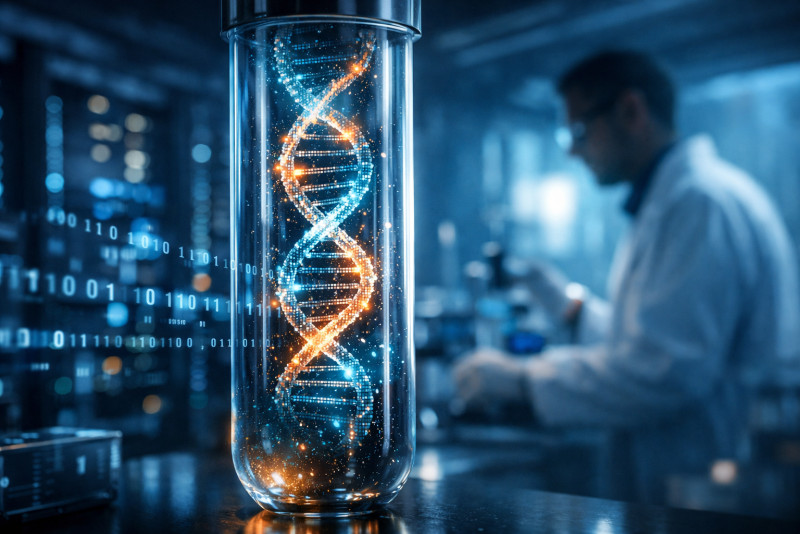
Imagine storing the entire internet inside a test tube. Every video, every website, every message—compressed into something smaller than a sugar cube. It sounds like science fiction, but researchers are already experimenting with this idea.
DNA, the molecule that carries genetic instructions in every living organism, is being tested as a digital storage system. If this technology ever scales, it could change how humanity stores information forever.
But how realistic is this future? And what would happen if the internet actually ran on DNA?
Let’s break it down in simple terms.
Why the World Is Running Out of Digital Storage
Every day, humanity creates massive amounts of data—videos, social media posts, AI models, satellite images, medical records, and more. Data centers are growing fast, consuming huge amounts of electricity and water for cooling.
Traditional storage has limits. Hard drives wear out. Magnetic tapes degrade. Cloud servers need constant power and maintenance.
Scientists are looking for something radically different. That’s where DNA comes in.

What Makes DNA a Super Storage Material
DNA stores information in four chemical letters: A, C, G, and T. Computers use 0s and 1s. Scientists can convert digital data into DNA letters, synthesize the DNA, and later read it back using sequencing machines.
The storage density is staggering. Some experiments suggest a single gram of DNA could hold hundreds of petabytes of data—millions of gigabytes. In theory, a room filled with DNA could store all the data ever created by humanity.
DNA also lasts a long time. Genetic material has survived for thousands of years in fossils and ancient samples. That means data stored in DNA could remain readable for centuries without electricity.
In short, DNA is tiny, durable, and incredibly dense—everything modern storage systems are not.
How Scientists Would Store Internet Data in DNA
The process is surprisingly logical:
-
Convert digital data into DNA code – Software translates binary data into A, C, G, and T sequences.
-
Synthesize DNA strands – Machines chemically build the DNA with the encoded information.
-
Store DNA in capsules or vials – DNA can be sealed in glass or polymer capsules for protection.
-
Read the data later – Sequencing machines decode the DNA back into digital files.
Researchers are already storing images, videos, and text files this way in labs.
Some experimental systems claim DNA storage could preserve data for thousands of years without needing refresh cycles, unlike hard drives that must be replaced every few years.

What Would Happen If the Internet Ran on DNA Storage
If DNA became the backbone of global storage, the digital world would look very different.
1. Data Centers Would Shrink Dramatically
Massive data centers could be replaced with tiny molecular archives. A building-sized server farm could shrink into a few shelves of DNA capsules.
2. Energy Use Could Drop
DNA storage requires no power to maintain. Unlike cloud servers that run 24/7, DNA can sit quietly without consuming electricity.
3. The Internet Could Last for Millennia
Future civilizations could read DNA archives long after current technology becomes obsolete. Unlike floppy disks or DVDs, DNA will always be readable as long as biology exists.
4. AI and Big Data Would Explode
Storing massive AI models, scientific datasets, and space exploration data would become cheap and compact.
The Big Problems No One Talks About
Despite the hype, DNA storage is not ready for everyday use.
It’s Extremely Expensive
Writing DNA data is costly. Synthesizing DNA sequences is far more expensive than storing data on a hard drive.
Reading Data Is Slow
Sequencing DNA takes time. You can’t instantly stream Netflix from a DNA vial.
Data Errors Can Happen
DNA can mutate or degrade. Scientists need complex error-correction methods to ensure data accuracy.
Privacy Concerns Are Massive
DNA is biological and personal. Mixing digital data storage with biological materials raises ethical and security concerns, especially if DNA data systems overlap with genetic databases.
Real Experiments That Prove This Is Not Sci-Fi
Scientists have already stored books, images, and music in DNA. Tech companies like Microsoft and research universities have funded DNA storage experiments for years.
Recent research suggests DNA storage could surpass silicon-based storage in density, longevity, and energy efficiency if technical barriers are solved.
Some prototypes aim to store terabytes in a single drop of liquid DNA in the future. That’s smaller than a memory card, yet far more powerful.

Could DNA Replace Hard Drives and Cloud Storage?
Not anytime soon.
DNA storage is best suited for cold data—information that must be preserved but not accessed often, such as archives, scientific records, and historical documents.
Your laptop, smartphone, and cloud apps will still rely on traditional storage for fast access. DNA is more like a digital time capsule than a daily hard drive.
However, experts believe DNA storage could become a major part of long-term global data preservation by the 2030s or 2040s.
The Ethical and Futuristic Questions
If humanity stores the internet in DNA, strange questions arise:
-
Could future beings read our data like a genetic fossil record?
-
Could DNA storage blur the line between biology and technology?
-
What happens if biological organisms evolve with stored data inside them?
These ideas sound futuristic, but they are already being discussed in academic research circles.
A Balanced Reality Check
DNA data storage is one of the most exciting ideas in modern science, but it is still experimental. Costs must fall, reading speeds must increase, and safety standards must be created.
This article discusses future possibilities based on current research. It does not claim DNA will replace current internet infrastructure soon. The concept remains a developing scientific field.
FAQs: DNA as Internet Storage
Can DNA really store the entire internet?
In theory, yes. DNA has an incredibly high storage density, but practical systems are still limited by cost and speed.
Is DNA storage already used commercially?
Some research labs and experimental startups are working on it, but it is not mainstream storage technology yet.
How long can data stored in DNA last?
Properly preserved DNA can last thousands of years, making it ideal for long-term archives.
Is DNA storage safe?
Scientifically, yes, but privacy and ethical concerns exist, especially if biological DNA and digital data intersect.
Will DNA replace cloud storage soon?
No. DNA storage is more likely to complement cloud storage for archival data, not replace it.
Final Thoughts
Using DNA as a hard drive for the internet sounds like a futuristic dream, but science is slowly turning it into reality. If successful, DNA storage could redefine how humanity preserves knowledge, culture, and history.
The internet of the future might not live in silicon chips or massive data centers. It might live in microscopic strands of DNA—quietly preserving human civilization for thousands of years.
References / Proof Sources
-
Scientific reviews on DNA data storage technology and workflow
-
Research papers on DNA synthesis and encoding digital data
-
Studies showing DNA storage density of hundreds of petabytes per gram
-
Industry and academic research on molecular data storage and future prospects
Reference Sources:
Science journals, Nature publications, academic research reviews, and technology research reports on DNA digital storage.
(Examples: Nature, Science.org, university research papers, and molecular storage review articles.)