.png)
.png)


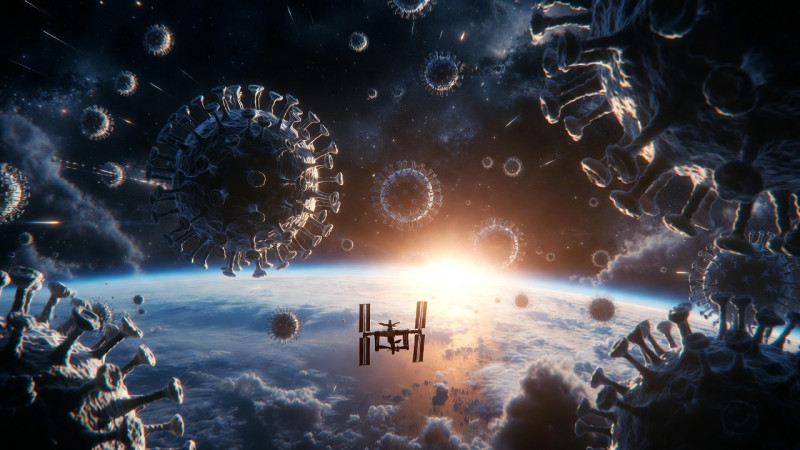
When most people imagine meeting aliens, they picture towering beings, glowing eyes, or advanced spacecraft hovering over Earth. But scientists think the first extraterrestrial life we encounter might be far smaller—and far stranger.
It might be microscopic.
Recent experiments aboard the International Space Station (ISS) show that viruses behave differently in space. Some even evolve in unexpected ways. These findings have reignited an unsettling question in astrobiology: what if the first aliens we meet are not intelligent beings, but microscopic pathogens drifting through the cosmos?
Viruses Are Changing in Space—and Scientists Are Watching Closely
In 2026, researchers reported that bacteriophages—viruses that infect bacteria—sent to the ISS evolved in microgravity and became more efficient at infecting and killing bacteria when returned to Earth. These changes occurred because space alters how organisms interact, forcing viruses and bacteria into a rapid evolutionary arms race.
Microgravity slows down fluid movement, meaning viruses and bacteria collide less often. To survive, viruses adapted, developing mutations that made them better at attaching to their hosts. Scientists say these space-evolved viruses showed genetic changes not seen in Earth-based samples.
This research is more than a curiosity. It demonstrates that space is a powerful evolutionary environment, capable of reshaping life in ways we are only beginning to understand.

Astrobiology’s Big Question: Is Life Common in the Universe?
Astrobiology is the science of searching for life beyond Earth. While telescopes hunt for alien planets, scientists also study the smallest possible forms of life—microbes and viruses.
One long-standing theory, known as panspermia, suggests that microscopic life could travel between planets on asteroids, comets, or interstellar dust. Some researchers even propose “virolithopanspermia,” the idea that viruses could hitch rides inside rocks traveling through space.
The logic is simple: microbes are incredibly resilient. Some can survive radiation, extreme cold, vacuum, and years of dormancy. If bacteria can survive space, viruses might be even tougher.
Why Viruses Could Be the Universe’s Most Common Life Form
On Earth, viruses are everywhere. They outnumber all other life forms combined and infect every known organism, from bacteria to humans. Many scientists believe that if life exists elsewhere, viruses—or virus-like entities—could be among the most abundant forms.
Unlike complex organisms, viruses require minimal structure. They are essentially genetic information wrapped in a protein shell. This simplicity makes them ideal candidates for surviving extreme environments.
If life emerged on other planets, viruses would likely evolve alongside it. And if interstellar material carries biological particles, viruses might be the most likely travelers.

Could Alien Viruses Reach Earth?
This is where the story becomes both fascinating and unsettling.
Scientists have found that meteorites can travel between planets, and some material from Mars has already landed on Earth. In theory, microscopic organisms could survive inside rocks shielded from radiation and heat.
However, experts stress that the risk of alien viruses infecting humans is extremely low. Viruses usually require very specific hosts. A virus evolved for alien biology would likely be incompatible with human cells.
Still, researchers take planetary protection seriously. Space agencies sterilize spacecraft to avoid contaminating other worlds—and to prevent unknown organisms from returning to Earth.
Space Is a Laboratory for Evolution
The ISS has become a floating laboratory for studying how life adapts beyond Earth. Microgravity, radiation, and isolation create conditions unlike anything on our planet.
Scientists have discovered that microbes mutate differently in space, sometimes becoming more resistant or more aggressive. These findings could help develop new medicines, including advanced therapies to fight antibiotic-resistant bacteria.
But the same research also raises concerns about long-term space missions. If microbes evolve faster in space, astronauts traveling to Mars or beyond could face new health risks.

The Rise of “Astrovirology”
A growing scientific field known as astrovirology is exploring how viruses might exist and evolve in space. Researchers are studying whether viruses could survive cosmic radiation, how they might travel between worlds, and what alien viral life might look like.
Some scientists argue that viruses could even play a role in shaping life on Earth. If panspermia is real, viruses from space might have influenced evolution billions of years ago.
While this remains speculative, it highlights how deeply connected life might be across the universe.
The Cosmic Perspective: Are We Already Descendants of Space Microbes?
One of the most provocative ideas in science is that life on Earth may not have originated here. Instead, the building blocks of life—or even microbes themselves—could have arrived from space.
Asteroid samples, such as those from NASA’s Bennu mission, have revealed complex organic molecules that could help seed life. This strengthens the idea that the universe is filled with life’s ingredients.
If microbes can travel through space, then viruses might also be cosmic travelers, silently drifting between stars.

Should We Be Afraid of Space Pathogens?
Science fiction often portrays alien viruses as world-ending threats. In reality, the danger is far more nuanced.
Most scientists believe extraterrestrial microbes would struggle to survive on Earth, let alone infect humans. Life is highly specialized. Even viruses from Earth rarely jump between species.
However, the research underscores the importance of planetary protection. As humans prepare to explore Mars and other worlds, preventing biological contamination is critical.
FAQs
What are space viruses?
Space viruses refer to viruses studied in space environments or hypothetical viruses that might exist beyond Earth. Research on the ISS shows viruses behave differently in microgravity.
Have scientists found alien viruses?
No confirmed alien viruses have been discovered. Current research focuses on how Earth viruses behave in space and whether viruses could exist elsewhere in the universe.
Can viruses survive in space?
Some microbes and spores can survive extreme space conditions, especially if shielded inside rocks. Viruses might also survive under certain conditions, but this is still under investigation.
Could alien viruses infect humans?
This is extremely unlikely. Viruses usually require very specific biological hosts, and alien life would be fundamentally different from Earth life.
Why is this research important?
Studying viruses in space helps protect astronauts, develop new medical treatments, and understand how life might exist beyond Earth.
Final Thoughts: The Smallest Aliens May Be the Most Likely
When humanity finally encounters extraterrestrial life, it probably won’t be a dramatic first-contact event with starships and ambassadors.
Instead, it might begin with a microscope.
Viruses, bacteria, and microscopic organisms are nature’s pioneers. They thrive in extreme environments and adapt faster than any complex organism. If life exists beyond Earth, these tiny entities may be the universe’s most common inhabitants.
And in a strange twist of cosmic irony, the first “aliens” we meet might already be closer than we think—floating in the silent darkness between stars.
Disclaimer
This article discusses scientific research and theoretical hypotheses in astrobiology. There is no confirmed evidence of extraterrestrial viruses or pathogens. The content is intended for educational and informational purposes and should not be interpreted as proof of alien life.
References / Sources (for verification)
-
Recent ISS bacteriophage evolution research published in PLOS Biology and covered by Space.com, LiveScience, and ScienceDaily
-
NASA Astrobiology Program publications on panspermia and microbial survival in space
-
Studies on asteroid samples and organic molecules from NASA’s OSIRIS-REx mission
-
Scientific literature on astrovirology and panspermia hypotheses