.png)
.png)
.png)
.png)
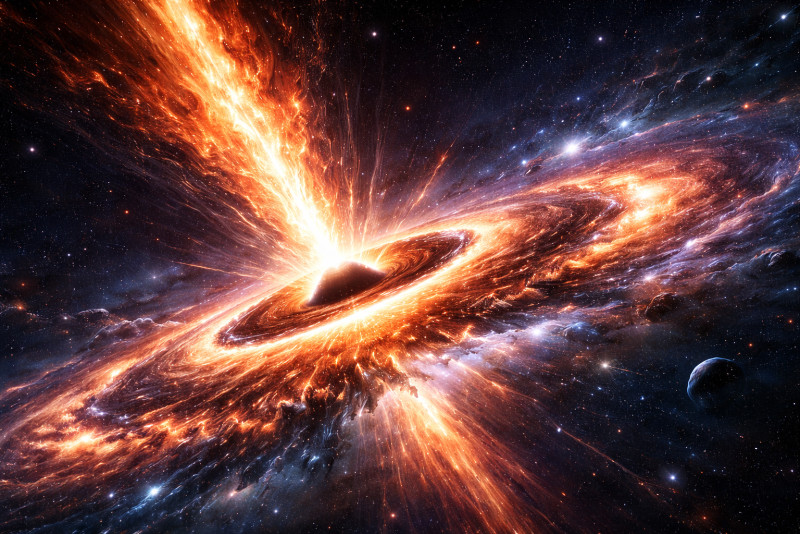
Most of us think of black holes as cosmic vacuum cleaners—silent, dark, and eternally pulling things in. But in January 2026, the James Webb Space Telescope (JWST) just proved that sometimes, black holes are more like cosmic volcanoes. And when they "erupt," the scale of the violence is almost impossible for the human mind to process.
While the images are beautiful, the reality for VV 340a is grim. This eruption is essentially a galactic murder in progress.
Galaxies need cold gas to give birth to new stars. It’s the "fuel" of the cosmic fire. But this black hole eruption is so hot and so fast that it is stripping the galaxy of its star-birthing material. According to the data, the jet is removing enough gas every single year to create 19 of our own suns. Think of it like this: the black hole is blowing away the very air the galaxy needs to breathe. Within a few million years—a blink of an eye in cosmic time—VV 340a will become a "red and dead" galaxy, a ghost town of old stars with no new life possible.
One of the most exciting parts of this real-time observation is the shape of the eruption. Webb didn't just see a cloud; it saw two narrow, twisted nebulae spiraling out from opposite sides of the black hole.
You might wonder why we didn't see this before. The answer is dust. VV 340a is a very "thick" galaxy, choked with cosmic soot that blocks visible light. Older telescopes like Hubble could see the outer edges, but they couldn't see the "crime scene" at the center.
Webb uses infrared light, which slices right through that dust. It’s the difference between trying to look through a brick wall and using an X-ray. For the first time, we can see the "coronal" heat signatures that were hidden for millions of years.
FAQs: The 10 Quintillion Bomb Eruption
Q: Is 10 quintillion a real number? A: Yes. A quintillion is a 1 followed by 18 zeros. To imagine 10 quintillion hydrogen bombs exploding every second is beyond any human experience of power. It represents a level of kinetic and thermal energy that could vaporize entire solar systems in an instant.
Q: Could this happen to the Milky Way? A: Not right now. Our central black hole, Sagittarius A*, is currently very quiet. It’s like a sleeping giant. However, evidence suggests that millions of years ago, our black hole had similar eruptions, which created the "Fermi Bubbles" we see today.
Q: How far away is VV 340a? A: It is considered "nearby" in cosmic terms, but don't worry—it’s still millions of light-years away. We are safe in our little corner of the suburbs, watching the fireworks from a very long distance.
Q: Does this mean black holes are dangerous to the universe? A: They are essential. While they can "kill" a galaxy by stopping star formation, they also regulate how galaxies grow. Without these eruptions, galaxies might grow too large and unstable. It’s all part of the violent balance of the cosmos.
Final Thoughts: The Scale of the Unknown
Discoveries like the VV 340a eruption remind us how small our daily worries are. While we argue about politics or Wi-Fi speeds, there are engines in the dark heart of space capable of tearing apart the fabric of reality with the force of quintillions of bombs.
As Webb continues its mission through 2026, we should expect more of these "impossible" sightings. The universe isn't just a place of quiet beauty; it’s a place of active, roaring power.
Disclaimer: This article discusses speculative and recent scientific findings. While the energy calculations and observations of VV 340a are based on reported data from the University of California, Irvine and NASA, the long-term effects on the galaxy are based on current astrophysical models of "black hole feedback."
Reference Links & Sources
-
ScienceDaily: 10 quintillion hydrogen bombs every second: Webb detects massive galactic eruption
-
SciTechDaily: A Nearby Galaxy Is Being Torn Apart by Its Own Supermassive Black Hole
-
NASA Webb Mission: Official Press Releases and Image Gallery
-
Journal Science: "Precessing kiloparsec-scale radio jet in a disk galaxy driving coronal gas outflow" (Jan 2026 Issue).