.png)
.png)
.png)
.png)
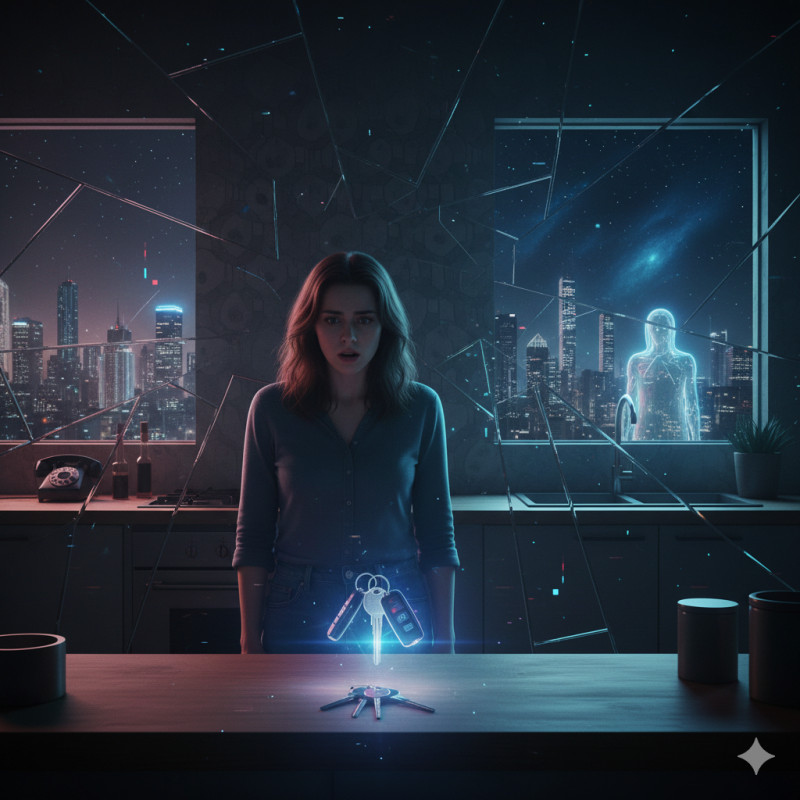
We’ve all had that moment. You put your keys on the kitchen counter, walk away for a second, and when you return, they’re gone—only to reappear in the exact same spot ten minutes later. Or maybe you’ve experienced "déjà vu" so thick it felt less like a memory and more like a skipped frame in a movie.
Most people call these "brain farts" or simple coincidences. But a growing corner of the physics world is starting to ask a much weirder question: What if those aren't glitches in your head, but glitches in the universe itself?
Welcome to the world of Quantum Hauntings. In early 2026, new research into the "Observer Effect" is suggesting that our consciousness might be doing a lot more than just watching the world—it might be stitching it together in real-time, sometimes with visible seams.
The Observer Effect: Reality’s "Rendering" Engine
To understand why your keys might have temporarily vanished, we have to look at the most famous experiment in history: the Double-Slit Experiment.
In short, when physicists shoot tiny particles (like electrons) through two slits, the particles act like waves—unless someone is watching. The moment a detector or a human eye looks at the particle to see which slit it goes through, the particle stops behaving like a wave and starts behaving like a solid marble.
The act of "observing" literally forces the universe to make a choice. This is called Wave Function Collapse.
In the high-stakes physics world of 2026, the Advanced Observer Model (AOM) has taken this a step further. It posits that reality isn't a fixed "place" we live in. Instead, it’s a dynamic stream of data that only "renders" into solid form when an observer—you—interacts with it.
When the "Render" Fails: Why We See Glitches
If the universe is constantly collapsing from a state of "infinite possibility" into "solid reality" based on our observation, what happens when that process stutters?
Think of it like a high-end video game. If you turn your character’s head too fast, sometimes the textures don’t load instantly. You see a flash of "nothing" or a distorted object before the game catches up.
A "Quantum Haunting" or a "glitch in reality" might be exactly that: a momentary delay in the wave function collapse. If your mind is distracted, or if multiple observers have conflicting "expectations" of a space, the physical world might lag.
-
Disappearing Objects: A temporary failure of the local wave function to resolve a solid state.
-
Déjà Vu: A "feedback loop" where the brain processes a quantum superposition (two versions of the same event) at the same time.
-
The Mandela Effect: Large-scale "memory shifts" that some theorists argue are actually shifts between slightly different entangled states.
2026 Breakthroughs: Conscious Entanglement
For years, skeptics argued that quantum effects only happen at the subatomic level—far too small for us to notice. But in January 2026, researchers at the Institute of Theoretical Physics published findings suggesting that quantum entanglement doesn't just stop because things get bigger.
They found that fundamental limits on how quantum states occupy space mean that "leaks" are unavoidable. Even behind the event horizon of a black hole, information remains distinguishably entangled.
If information can survive a black hole, it can certainly survive a trip across your living room. This suggests that we are "entangled" with our environment. When you look at an object, you aren't just seeing it; you are participating in its physical existence. If that entanglement is interrupted—by a spike in electromagnetic interference or even intense emotional stress—the "solid" nature of that object might briefly falter.
The Mind as a Quantum Sensor
Are some people just more "attuned" to these glitches?
New studies in Quantum Theory of Consciousness (QTOC) suggest that the human brain might function less like a classic computer and more like a biological quantum processor. Our neurons may use tiny structures called microtubules to navigate the "superposition" of the world around us.
This would mean that some individuals—those often dismissed as "sensitive" or prone to seeing paranormal events—might actually have "wider" observation windows. They are catching the frames of the universe that the rest of us skip over.
FAQs: Making Sense of the Matrix
Is this proof that we live in a simulation?
Not necessarily. While the "Simulation Hypothesis" is a popular way to explain these glitches, the Observer Effect suggests that reality could be natural but dependent on consciousness. It’s less like a computer program and more like a participatory dream.
Why don't we see glitches all the time?
Because the universe is "noisy." Most of the time, billions of atoms are interacting and "observing" each other (a process called decoherence), which keeps reality looking solid. Glitches only happen in very specific, "quiet" moments of quantum isolation.
Can I trigger a glitch on purpose?
Probably not. Most documented "glitches" occur when the observer is in a state of flow or extreme distraction. Trying to "force" a glitch usually provides too much "observation," which just locks reality more firmly into place.
Is this the same as a haunting?
Traditional "ghosts" might actually be "Time-Slip Glitches." If the Observer Effect allows for non-linear time (which some 2026 models suggest), a "ghost" might just be a brief overlap where an observer accidentally "renders" a moment from the past that is still entangled with the present location.
Proof of Source & References
-
The Quantum Insider (2026): Even Black Holes May Not Fully Hide Quantum Entanglement
-
Scientific Research (SciRP): Quantum Theory of Consciousness and the Observer Model
-
ResearchGate: Scientific Basis of Paranormal Perception and Quantum Metaphysics
-
Washington University: Glitches in the Matrix: Harnessing the Power of Atomic Flaws
Disclaimer: The theories presented here sit at the intersection of established quantum mechanics and speculative xenolinguistics/metaphysics. While the "Observer Effect" is a proven scientific principle, its application to "glitches in reality" is a developing theoretical field and should not be taken as absolute fact.