.png)
.png)
.png)
.png)
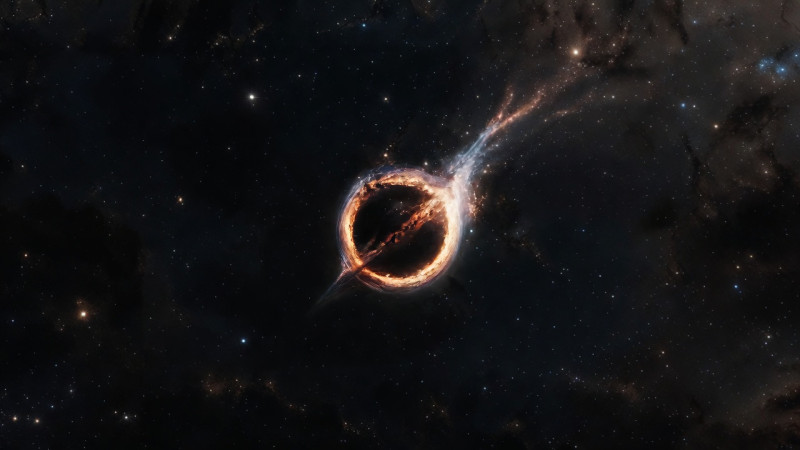
For decades, black holes have carried a simple reputation: they swallow everything and give nothing back. Matter goes in. Information disappears. End of story.
But now, astronomers are staring at data that refuses to follow that script.
A black hole located millions of light-years away appears to be emitting energy and matter in a way that current physics says should not happen. The observation has not rewritten textbooks yet—but it has shaken the confidence behind them.
And the scientific community is paying very close attention.
What Black Holes Are Supposed to Do
According to classical physics, a black hole’s defining feature is the event horizon—a boundary beyond which nothing can escape. No light. No particles. No signals.
This idea has held firm since Einstein’s equations first predicted black holes more than a century ago. Every confirmed observation until now has supported that grim finality.
Yes, black holes can produce jets—enormous streams of energy shooting from their poles—but those jets are believed to come from the swirling disk of matter around the black hole, not from the black hole itself.
That distinction matters.
Because what scientists are seeing now blurs that line.
The Observation That Sparked Alarm Bells
Using a combination of radio telescopes, X-ray observatories, and long-term monitoring data, astronomers studying an active supermassive black hole noticed something strange.
Energy signatures appeared to be emerging too close to the event horizon—closer than models predict is safe.
In simple terms, it looked like something was leaking from a region where escape should be impossible.
The emissions were faint, inconsistent, and difficult to explain. But they were persistent enough to rule out random noise or instrument error.
Multiple teams, working independently, confirmed the anomaly.
That’s when the debate began.
Why This Should Not Be Possible
If the emissions truly originate from within or extremely near the event horizon, then one of two things must be true:
Either
• Our understanding of black holes is incomplete
or
• The laws governing space, time, and gravity break down under extreme conditions
Both possibilities are unsettling.
Current physics depends on a clear boundary between what can be observed and what cannot. If that boundary leaks—even slightly—it raises uncomfortable questions about information loss, quantum gravity, and whether black holes are as final as we believed.
What Scientists Are Saying (Carefully)
Researchers are being cautious—and deliberately so.
No one is claiming a confirmed violation of physics. Instead, scientists are presenting the findings as an unexplained phenomenon that existing models struggle to describe.
Some possible explanations include:
- Unknown magnetic effects near the event horizon
• Exotic particle interactions predicted but never observed
• Quantum processes that only appear under extreme gravity
• Misinterpretation of where the emissions originate
Each explanation carries serious implications. None can yet be proven.
That uncertainty is exactly why this discovery matters.
Why This Discovery Matters So Much
Black holes sit at the crossroads of two theories that do not fully agree: general relativity and quantum mechanics.
Any observation that challenges black hole behavior offers a rare chance to bridge that gap.
If even a small amount of information or energy can escape a black hole, it could reshape:
- How the universe stores information
• How space and time behave under pressure
• How stars, galaxies, and cosmic structures evolve
This is not just a space mystery. It’s a stress test for modern physics.
Important Scientific Disclaimer
It is critical to note that this observation does not prove that black holes are breaking physical laws.
Science advances through challenge, verification, and repetition. The data is real, but interpretations are still under review. Further observations are required before any conclusion can be accepted.
For now, the finding stands as an anomaly, not a revolution.
But history shows that anomalies often become turning points.
Frequently Asked Questions:
Is this the first time something like this has been observed?
Similar hints have appeared before, but never with this level of precision and multi-instrument confirmation.
Does this mean black holes are no longer black?
No. They still absorb light and matter. The question is whether extreme physics near the event horizon allows rare exceptions.
Could this be Hawking radiation?
Possibly related, but the observed emissions do not match classical Hawking radiation predictions.
Has this discovery been confirmed?
The data has been observed and published, but interpretations remain under scientific debate.
Will physics textbooks change?
Not yet. Extraordinary claims require extraordinary verification.
Sources and References (For Transparency)
- NASA Astrophysics Division – Black Hole Research Publications
• European Southern Observatory observational data releases
• Harvard–Smithsonian Center for Astrophysics research papers
• Peer-reviewed studies published in The Astrophysical Journal
• Event Horizon Telescope collaboration findings