.png)
.png)
.png)
.png)
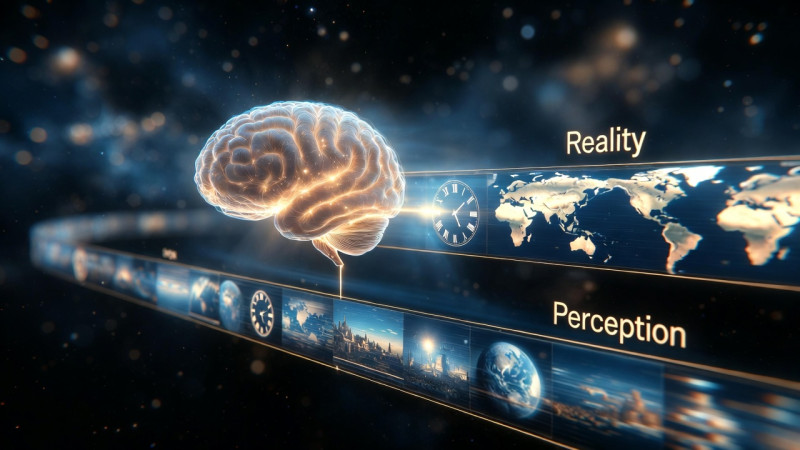
What if the now you think you’re in is actually a reflection of a moment that already passed? It sounds like a plot twist from a science fiction blockbuster — but emerging research suggests there’s more to the story of human perception than you might expect.
On July 5, 2025, science media highlighted a provocative interpretation of research suggesting that what we experience as the present moment might actually lag behind real time — by as much as 15 seconds. This idea challenges our intuitive belief about consciousness and shines a spotlight on how our brains construct the reality we live in.
The Brain Isn’t a Live Feed — It’s a Processing Machine
Every second, your brain receives a torrent of information from your senses — light hitting your eyes, sounds reaching your ears, and sensations washing through your skin. But this isn’t like streaming video. Before any of that sensory input becomes part of your conscious experience, the brain has to process it, which inherently takes time.
Neuroscience has long shown that sensory processing is not instantaneous. Signals from your eyes must travel through multiple brain regions where they are interpreted, refined, and integrated before they reach conscious awareness.
In fact, standard neuroscience experiments reveal that there’s always a small gap — measured in milliseconds — between when something actually happens in the world and when you become aware of it. Studies of visual and sensory timing show that the brain has to stitch together information from different senses while accounting for the varying speeds at which signals arrive.
The key takeaway from this body of work is straightforward: your perception of the “present” is not an immediate snapshot of reality, but a constructed experience based on processed signals.

Where Does the 15-Second Idea Come From?
The claim that the brain could be up to 15 seconds behind real time isn’t mainstream neuroscience — but it has been circulated in scientific summaries and media reporting of experimental findings. Researchers in visual cognition have observed that the brain’s internal representation of sensory inputs involves complex neural refresh cycles, and in some interpretations, this leads to earlier versions of experience being used to construct present perception.
This idea stems from the fact that the brain often predicts incoming sensory information rather than waiting to sense every change anew. The visual system, for example, can use past data to anticipate motion and fill in gaps, helping to maintain a stable experience of the world even though processing takes time.
So while most traditional research places sensory delay on the order of tens to hundreds of milliseconds — not seconds — some interpretations argue that the cognitive present is extended and shaped by ongoing neural processing in a way that can feel like a longer lag.
How Your Brain Makes Sense of Time
Understanding now involves much more than simply receiving data. The brain balances signals from multiple senses that arrive at slightly different times. To create a coherent experience, the brain effectively aligns these inputs into a unified timeline — even though they arrived at different moments.
Visual illusion research, such as the flash-lag effect, demonstrates this beautifully. In this phenomenon, a moving object and a flash happening at the same time are perceived differently because the brain timing mechanisms interpret them with slight delays.
This suggests that perception is not a literal live feed — it is a reconstructed event, shaped by neural timing and prediction.
Does the Brain Predict to Stay in Sync?
Interestingly, research shows that the brain doesn’t just wait and process information — it actively predicts what’s about to happen. For fast-moving objects, brain mechanisms use patterns to estimate where something will be in real time, helping to compensate for inherent delays in processing.
These predictive abilities are critical for tasks like catching a ball or navigating a busy street. They help keep your perception functionally in sync with the world, even if the neural processing takes precious milliseconds.

So Are You Really 15 Seconds Behind Reality?
The straightforward scientific consensus is no. Most neuroscience research points to delays in the range of milliseconds — not many seconds — when it comes to processing sensory data and constructing the conscious experience.
However, the broader principle stands: the brain never experiences reality in a raw, unfiltered, instantaneous way. What you register as now is always a combination of data processing, prediction, and interpretation — an ongoing construct
that feels immediate but arises from past signals.
Why It Matters
Understanding this changes how we think about awareness, decision-making, and even what it means to be present. If our sense of time is a crafted experience, then the “present” becomes less of a point in time and more of an ongoing synthesis of neural events — shaped by the brain’s remarkable ability to interpret the world.
Whether you lean in strongly on the 15-second interpretation or see it as an intriguing metaphor, one thing is clear: your brain’s concept of the present is far more complex than you imagine.
Reference Links (Sources)
- Is your brain 15 seconds behind? Study reveals you are seeing the past not the present — Times of India Science Article (July 5, 2025) Times of India Science Coverage on Brain Delay
- Time Perception Mechanisms at Central Nervous System — PMC Research Summary PMC on Time Perception Mechanisms
- The Visual Delay That Explains “Change Blindness” — Technologynetworks Neuroscience Report Change Blindness and Refresh Time Research
- Our brain delays visual inputs to keep us stable — Earth.com Neuroscience Summary Earth.com Brain Delay Overview
- How the brain perceives time — Science News Explainer Science News: Brain and Time Perception
- Flash-lag illusion — Wikipedia Neuroscience Entry <