.png)
.png)
.png)
.png)
Astronomers stared at the data and thought something was wrong.
Planets aren’t shaped like this.
Atmospheres aren’t made like this.
And worlds exposed to forces this violent are not supposed to survive.
Yet the signals were clear.
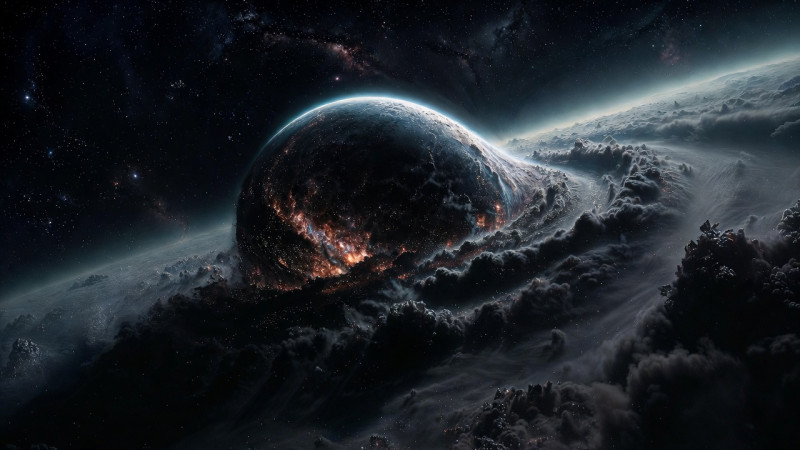
Using the James Webb Space Telescope, scientists have identified one of the most disturbing planetary discoveries ever made — a lemon-shaped exoplanet, stretched out of round by extreme gravity, wrapped in dark carbon clouds, and possibly producing diamond rain deep inside its atmosphere.
This is not just a weird planet.
It’s a warning that the universe is far stranger — and far less predictable — than our models say it should be.

A Shape That Breaks the Rules of Physics
From textbooks to telescopes, one rule has always held: planets become spherical. Gravity demands it.
This world breaks that rule.
Instead of forming a smooth ball, the planet appears elongated and distorted, as if it were pulled like molten metal and frozen mid-stretch. Astronomers believe the cause is brutal tidal forces from a nearby stellar remnant — likely a neutron star — whose gravity is strong enough to physically deform the planet.
This isn’t a temporary wobble.
The distortion may be permanent.
In cosmic terms, the planet is being slowly tortured by gravity — and somehow, it’s still holding together.
An Atmosphere Made of Darkness
When Webb examined the planet’s atmosphere, the discovery became even stranger.
Instead of water vapor, methane, or familiar planetary gases, scientists detected signs of carbon-rich chemistry — thick clouds packed with complex carbon compounds. Some researchers describe it as an atmosphere filled with cosmic soot, darkening the planet and trapping immense heat.
This kind of environment is rare. It suggests the planet either formed in a carbon-heavy region of space or was chemically altered by catastrophic events.
Either way, it is nothing like the worlds we know.
And deep within this dark atmosphere, carbon may be undergoing a dramatic transformation.

The Possibility of Diamond Rain
Here’s the idea that grabbed global attention — and for once, it isn’t pure hype.
Under extreme pressure and heat, carbon atoms can reorganize into crystalline structures. On Earth, this process takes millions of years deep underground. On this planet, it could be happening constantly.
Scientists believe that inside the planet’s atmosphere, carbon may condense, harden, and fall as solid diamond fragments, raining downward through layers of superheated gas.
This wouldn’t look like sparkling gemstones falling gently from the sky. It would be violent, crushing, and alien. But chemically and physically, diamond precipitation is possible.
If confirmed, it would mark one of the most exotic weather systems ever proposed.

How Did This Planet Survive Something That Kills Stars?
Perhaps the most unsettling mystery isn’t the diamonds or the shape.
It’s survival.
If this planet orbits a neutron star, it had to endure:
- A massive stellar explosion
- Blinding radiation bursts
- Gravitational forces capable of shredding planets
Most worlds in such environments are destroyed or flung into space. This one stayed.
Warped. Blackened. Altered — but alive.
That raises an uncomfortable possibility: planets may be far more resilient than we ever imagined, capable of surviving events we once thought were absolute death sentences.
Why Scientists Are Quietly Rewriting the Rules
This discovery is forcing astronomers to confront an uncomfortable truth: our planetary models are incomplete.
This single world challenges assumptions about:
- How round planets must be
- What atmospheres can contain
- Whether planets can exist near stellar corpses
- How carbon behaves under crushing pressure
In short, the universe is producing planets we didn’t think were allowed.
And if one such planet exists, it’s unlikely to be alone.

The Bigger “What If” Question
What if planets don’t always form peacefully around calm, stable stars?
What if some are forged in chaos — stretched by gravity, darkened by carbon, battered by radiation — and still survive?
Discoveries like this suggest we’ve only been seeing the universe’s safe zones. Webb is now peering into the danger zones.
And what it’s finding is unsettling.
Why This Matters Right Now
This isn’t just a strange headline. It’s a preview of what modern astronomy is about to uncover.
As telescopes become more powerful, the universe is revealing worlds that look less like science textbooks — and more like science fiction.
Except they’re real.
And they’re out there.